In short: on September 30, 2026, Google opened its first Search Central Live Deep Dive in Europe, in Barcelona. According to several attendees who posted on LinkedIn the same day, the Day 1 message matches Bangkok 2025: AI Overviews and AI Mode run on the same crawling and indexing system as classic search. No product announcements. Updates: Day 2 added on October 1 (robots meta, JavaScript rendering, canonicalization, structured data, hreflang, Google Trends), Day 3 added on October 3 (query understanding, quality, spam, Discover, crawl, indexing and serving timelines). I am not attending: this article aggregates and cross-checks those reports (ROAST recaps, LinkedIn posts).
LinkedIn, October 3, 2026: Victoria Yap; Estela Franco; Stefanie Senn; Marieke Botman; Fernando Maciá; Friederike Hagen; Robert Wojno; Rafa Labrador; Kira Breuer; George-Emanuel Cîță; Dave Smart; Elham Borojerdi.
What happened at Google Search Central Live Deep Dive in Barcelona?
The Search Central Live Deep Dive Europe 2026 runs from September 30 to October 2 in Barcelona. It is the first European edition of the Deep Dive format launched in Bangkok in July 2025 (the Search Central Live Paris 2026 recap covers the French edition). The event is free, application-based, and entirely in English. According to the official Google Search Central blog announcement, the program follows a page’s journey through Google Search:
- Day 1 (September 30): foundations and crawling, with Search Console to diagnose discovery issues.
- Day 2 (October 1): indexing, rendering, duplication and canonicalization, internationalization, the role of AI in indexing.
- Day 3 (October 2): serving, ranking, AI-powered search features, Google Trends.
On Google’s side, PPC Land names Cherry Prommawin, Gary Illyes and Martin Splitt. Two attendees also mention John Mueller being present (LinkedIn posts by La Teva Web and Clara Soteras Acosta). Clara Soteras Acosta also names Lino Cattaruzzi. In the community speakers announcement, Gary Illyes and Cherry Prommawin state that much of the content is reused from Bangkok, with new topics that are “mostly AI focused”.
Which AI Mode figures were shared at the Barcelona Deep Dive?
Two attendees report data shown on stage. These figures come from LinkedIn posts, not from a Google document: take them as reported numbers, not verified ones. Update: the ROAST recap attributes to Gary Illyes the quarterly doubling, queries about 3 times longer and 1 in 6 multimodal, which matches George-Emanuel Cîță. The 1 billion and 92% still have a single source.
| Reported data point | Source |
|---|---|
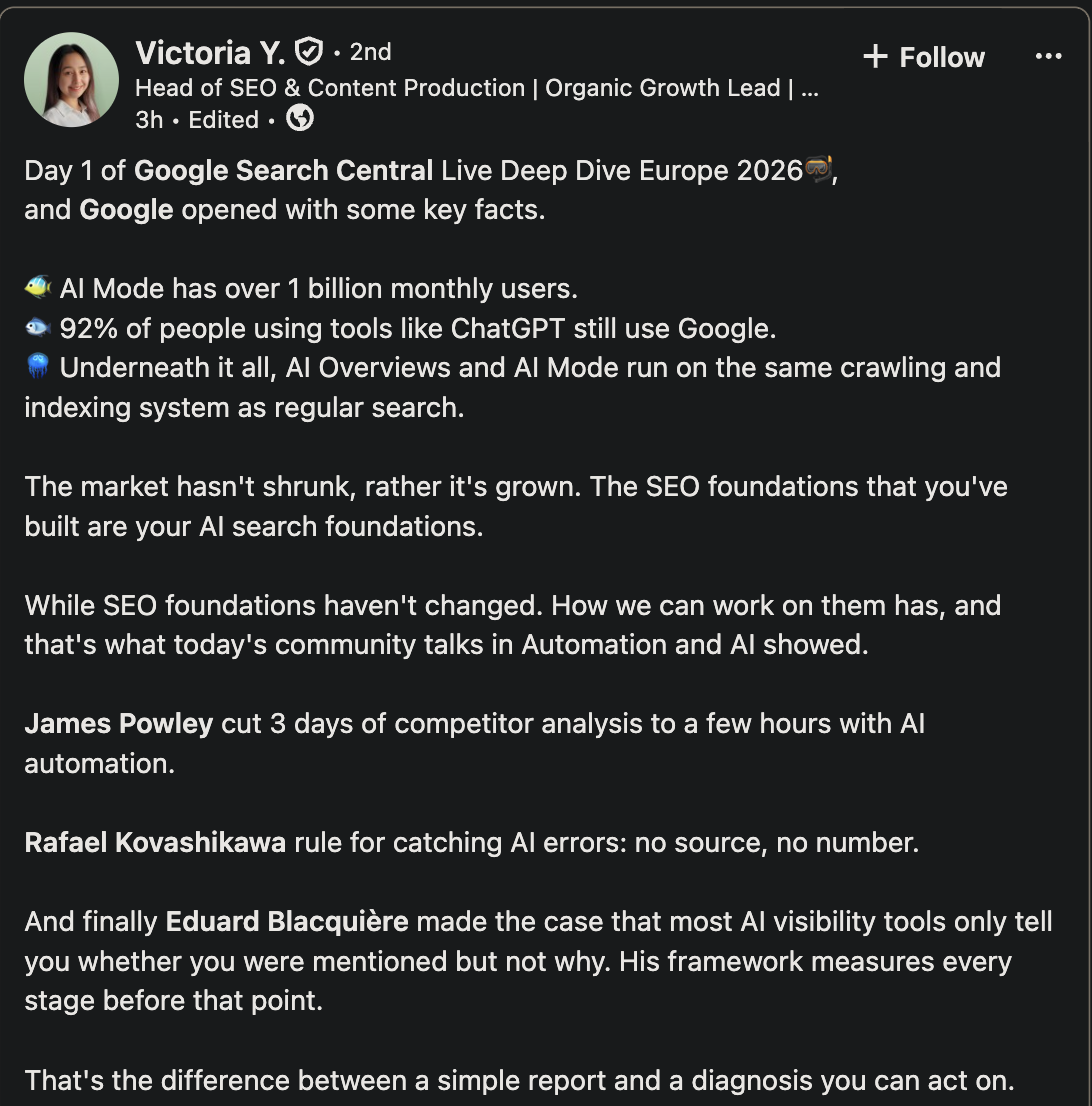
| AI Mode exceeds 1 billion monthly users | Victoria Y., Head of SEO & Content Production |
| 92% of ChatGPT-type tool users still use Google | Victoria Y. |
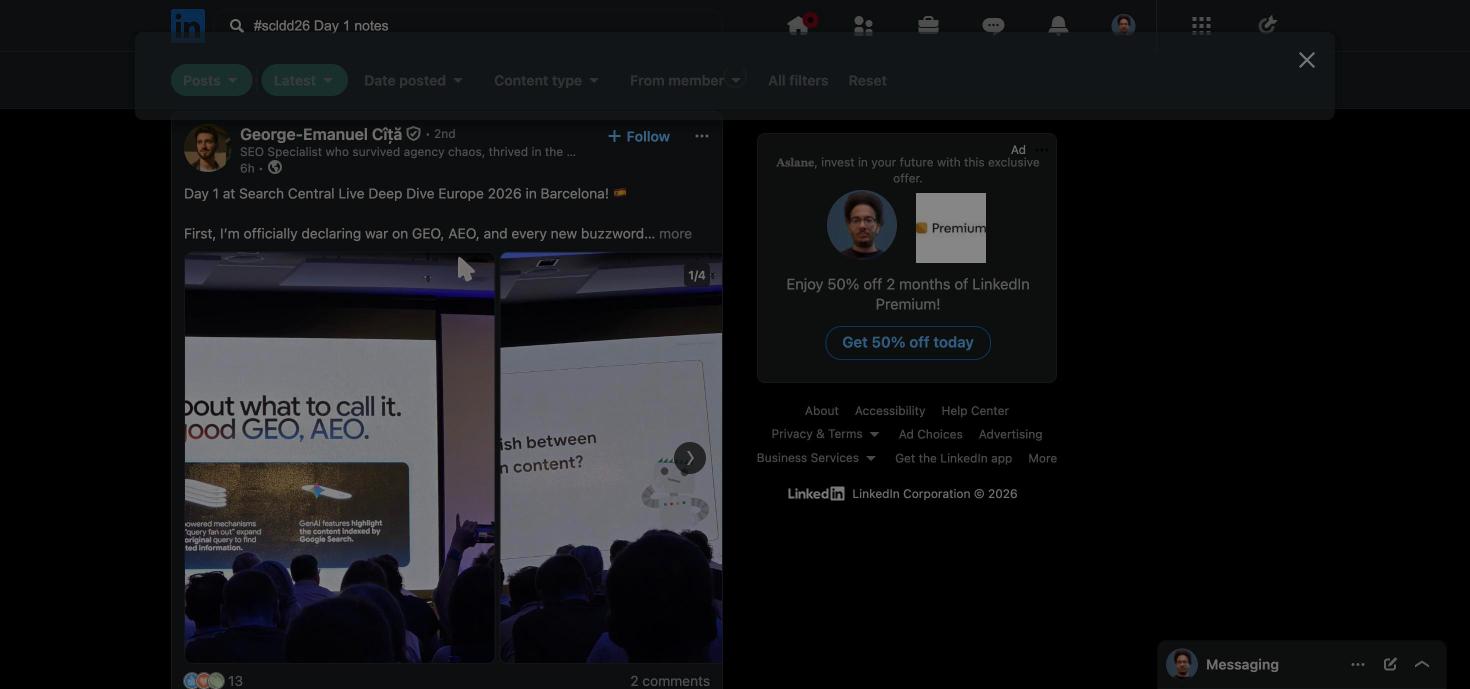
| AI Mode searches double every quarter, queries about 3 times longer, 1 in 6 multimodal | George-Emanuel Cîță, SEO Specialist |
Do AI Overviews and AI Mode use the same system as classic search?
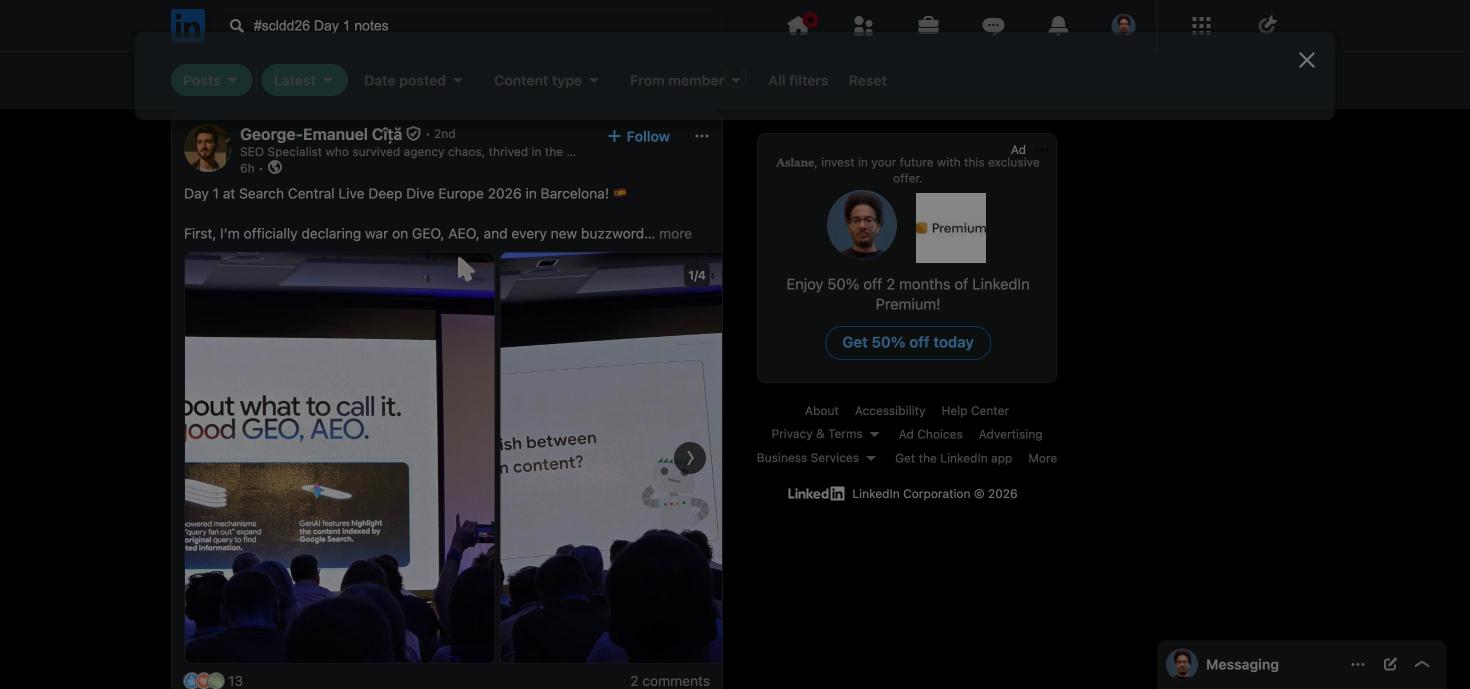
Yes, according to three independent Day 1 reports. Victoria Y. writes that AI Overviews and AI Mode “run on the same crawling and indexing system as regular search”. John Campbell (Head of Innovation & AI, ROAST) notes that what powers AIO and AI Mode is “the same SEO stack”. George-Emanuel Cîță sums it up: “good SEO is good GEO, AEO, AIO”.
Nothing new here, and it matches Google’s GEO checklist. In Bangkok in 2025, Gary Illyes had already said that classic SEO is enough for AI Overviews and that Google does not support llms.txt, per a post by Kenichi Suzuki relayed by Search Engine Land. Barcelona confirms the line, with no nuance so far. Worth watching on Days 2 and 3: what Google says about the role of AI in indexing.
What did Google say about crawl budget at the Deep Dive?
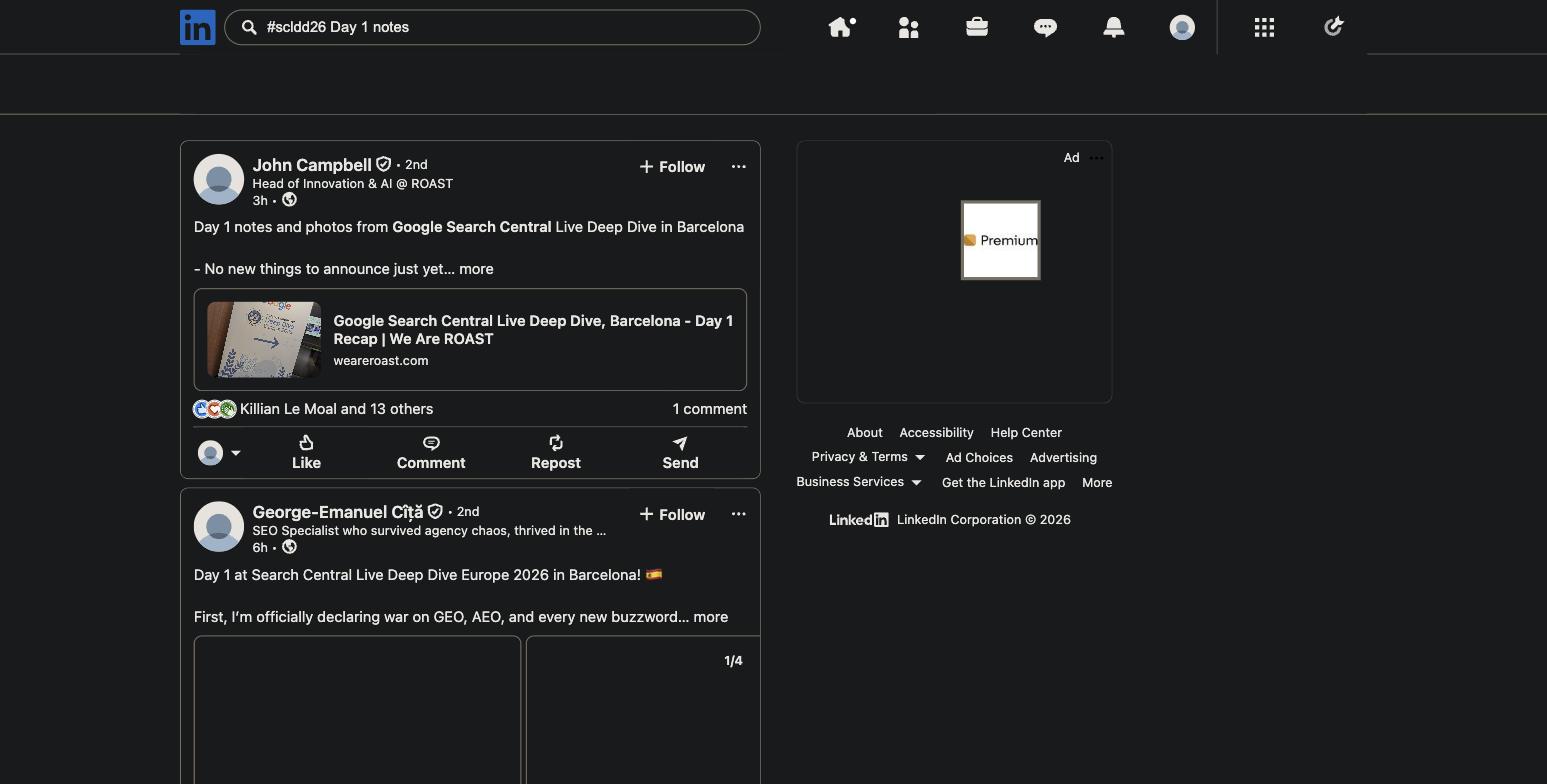
John Campbell reports one line: “You can buy crawl budget, get a better and faster server”. George-Emanuel Cîță confirms that sessions covered crawling, the impact of crawl errors, and the interpretation of robots.txt and crawl budgets. I don’t have the context for that sentence: it is consistent with Google’s documentation on crawl capacity (a fast server lets Googlebot crawl more), but it says nothing about any crawl demand criterion. I do not extrapolate.
Did Google announce anything at Search Central Live Deep Dive?
No. John Campbell: “No new things to announce just yet”, with “teasers on new data points that could come in the future”. Consistent with the format: an educational curriculum, not a product event. Watch for possible announcements on Days 2 and 3 and on the Search Central blog.
What did Google say about content quality?
Clara Soteras Acosta (LinkedIn post, September 30, 2026) reports that Gary Illyes, John Mueller, Lino Cattaruzzi and Cherry Prommawin kept returning to experience and content quality, including the notion of “non-commodity content”.
My take on the GEO side, not a Google statement: an LLM can’t rebuild original data, field feedback or client cases from the open web, so those are what it has the most reason to cite. Worth testing on your own queries.
What did community speakers say about AI and automation?
According to Victoria Y., the Day 1 community talks focused on automation and AI:
- James Powley: competitive analysis cut from 3 days to a few hours through AI automation.
- Rafael Kovashikawa: an AI error-prevention rule, “no source, no number”.
- Eduard Blacquière: most AI visibility tools tell you whether a brand is mentioned but not why; his framework measures each step upstream of the mention.
- Kira Breuer: a 7-minute lightning talk on her AI automations, per her own post.
- John McAlpin (LOCOMOTIVE): data analysis to detect technical SEO issues blocking AI visibility; write-up announced by his agency.
Eduard Blacquière’s point matches what we see in the field: a tracker that counts mentions does not diagnose (see the Profound vs Otterly vs Ahrefs Brand Radar comparison). A GEO audit has to walk back up the chain: crawlable, rendered, indexed, understood, selected. Christina Mantziou puts it this way: being available is not being understood, and being understood is not being selected.
Day 1 of Search Central Live Deep Dive: keynote, crawling and lightning talks
John Campbell’s Day 1 recap (ROAST) details a day devoted entirely to crawling. Here is what wasn’t in this article yet.
Keynote by Lino Cattaruzzi (President of Google Iberia). The mission doesn’t change, but user expectations do: closed platforms capture searches (so traffic is lost for the open web), content must be personalized, authentic, visual and easy to scan, and AI answers new needs. Five predicted shifts: constant testing with features folding into core Search once validated, a SERP going beyond links and ads (videos, cards), several needs served at once, priority to quality (“Made for Search” content will underperform), and traffic fluctuations framed as opportunities.
AI Mode, Gary Illyes edition. Since launch: query volume doubling every quarter, queries about 3 times longer, 1 in 6 multimodal, and follow-ups up more than 40% a month in the US. Four use cases: Explore (brainstorming grows 30% faster than overall), Learn, Decide (“which” queries grow 40% faster over six months) and Do (planning grows 80% faster). His conclusion: a single URL can’t answer a long, multi-part question, so AI assembles answers from several sources.
Crawlers. Search, AI Overviews and AI Mode depend on the same main crawler, Googlebot. Gemini currently uses a separate crawler.
Crawl errors. DNS errors are painful to debug, and CDNs increasingly block bots: a Cloudflare config can cut off Googlebot without anyone noticing. CAPTCHA pages returned as 200 with no real content are treated as soft 404s.
Robots.txt (Dave Smart). Resources hosted on another domain (CDN, subdomain) follow that domain’s robots.txt. A page can look properly configured while its resources are blocked elsewhere.
Crawl budget (Cherry Prommawin). One central crawling system serves Search, Ads, Shopping and Images. The crawl rate limit (hostload) is shared across all Google crawlers hitting a host and depends on connection time, TTFB and 429 and 5xx codes: if those rise, crawling slows down. Crawl demand depends on site quality, how often URLs change and their popularity; when Google doesn’t know them, it looks at parent paths. What wastes budget: errors, useless pages and infinite URL spaces (calendars, parameters).
The crawling “What would you do?” (John Mueller and Gary Illyes). Three scenarios. A stale CDN cache on 500,000 product pages: Gary says wait, John says serve a 503 on robots.txt to pause crawling. A WAF serving 429s and 503s during a flash sale (crawl down 90%): Gary checks the server and fixes the WAF, John does nothing. A crawled staging subdomain (50,000 URLs): Gary fires the developer, John uses the Search Console removal tool. For the other cases, the answer was an honest “it depends on the context”.
Lightning talks. Carlos Ortega Roldán on AI agents: not needed, llms.txt, Markdown versions (duplication) and robots.txt (an agent acting for a user can bypass it); useful, low CLS (agents read screenshots), schema as secondary verification, clean heading nesting, semantic HTML landmarks, ARIA and WebMCP. Lino Uruñuela: auditing JSON-LD with AI through a fix loop (code, Google errors and Google docs as input, Google’s validator, 3 attempts max). Kira Breuer: monthly reports in Python through the Search Console API, which caps at 50,000 rows, with bulk export to BigQuery as the alternative. Thiago Pojda: SEO can be scored, GEO is hard to measure; selling JSON-LD as the entry door to AI answers is a misstep; listicles work; query fan-out exists, sometimes in a different language than the prompt. Tobias Schwartz: spotting near-identical URLs (encoding, http/https, www, parameter order). Jovana Avramovic: AI changed workflows, not principles.
Day 2 of Search Central Live Deep Dive: indexing, JavaScript and canonicals
Update of October 1, 2026. The base is the Day 2 recap published by John Campbell (ROAST), who attends the event, cross-checked against attendees’ LinkedIn posts. Day 3 has its own section further down.
Robots meta tags (John Mueller). He covered lesser-known directives like max-snippet and max-video-preview. For maximum visibility he recommends max-image-preview:large and max-snippet:-1, per ROAST. Enrique Hidalgo adds the flip side: nosnippet and max-snippet:0 stop your content being used in AI Overviews and AI Mode, but also remove the snippet in classic results. See Google’s documentation on AI features.
JavaScript rendering. Erin Sparling detailed the pipeline: Google loads the page with a viewport around 10,000 pixels tall, without scrolling or clicking, so content triggered on scroll doesn’t render. Rebecca Yu reminded that a robots.txt blocking JavaScript files stops Google from building the page, even if it looks fine in a browser. Liv Day agrees it’s more common than you’d think. Sören Bendig showed real sites blocking resources their JS needs to run.
Page content and soft 404s (Gary Illyes). Google prioritizes main content over navigation, footer and boilerplate. According to Enrique Hidalgo, it extracts header, navigation and main content, with the footer weighing much less, and he talked about tokenization. Soft 404s (a 200 page that looks empty or broken) came up several times, with thin content, server or CMS errors and JavaScript problems cited as causes.
Duplicates and canonicals (John Mueller). Google clusters similar pages, picks a canonical and consolidates signals. His recommendations, per ROAST: redirects for migrations, proper HTTP status codes, check rel=canonical, hreflang for localization, report odd canonicals on the forums, keep canonical signals unambiguous. Enrique Hidalgo takeaway: 301, 302, canonicalization, clustering and crawling are different things. A 301 is a strong canonicalization signal, not a “better crawl” than a 302. And hreflang doesn’t guarantee that two near-identical URLs (country, currency or navigation changing, everything else the same) won’t end up clustered. Tobias Schwarz (spelled Schwartz in some sources) showed canonical loops and clusters with no clear leader.
Structured data and media (Gary Illyes). Images, video and structured data are extracted and sent to a separate media indexing engine. Schema.org feeds AI Overviews and AI Mode as context, not as code. Ryan Levering: “It’s never negative to have structured data”, the real question being whether the effort pays off. Nicolas Audemar relays the logic: models still get things wrong, some information stays ambiguous, and running large models on every page costs far more than reading explicitly structured data. Liv Day adds that more markup isn’t automatically more useful.
Images and video. Image sitemaps (mostly useful for JavaScript-loaded images), the picture element with an img fallback, WebP or AVIF at a balanced file size. For video: above the fold on mobile, descriptive text around it, a video sitemap. Enrique Hidalgo adds a dedicated page per video, a representative thumbnail and intent-led titles. Irene Cecotti shared a case where AI-generated alt text at scale through Screaming Frog dropped traffic: faster isn’t better, and AI output at scale needs checking.
Index structure (Gary Illyes). Queries are split into words, each pointing to a list of pages, and Google intersects those lists. Vector embeddings work alongside that system, per ROAST.
International. Cherry Prommawin listed common hreflang mistakes: stacking several implementation methods, wrong language codes, forgetting localization beyond translation (date formats, currency). Patrik Rojan relays her advice: localize for users first (market, language, country, currency), then help bots with hreflang. A ccTLD per localization is ideal, subdomains and subfolders work too. Google works out the language from the content, not from hreflang, which matches Google’s documentation on localized versions. On the community side, Alizée Baudez used the example of a Dutch furniture retailer lagging its French version despite a good translation: narrow, vertical Dutch homes didn’t match visuals designed for French interiors. Elham Borojerdi presented the joint multilingual SEO talk with Zahra Laleh, who could not be there in person. Their point: look-alike characters in Persian and Arabic can be different searches, which complicates keyword research.
Google Trends (Omri Weisman). Gemini in Explore (term suggestions, compare up to 8 trends), quick comparisons across periods, worldwide maps with sub-regions, the category filter is back. Trending Now updates within 10 minutes, useful for spotting reactive content gaps. No public API announced.
Poster session. John Campbell presented a free Google Sheets tool that automates daily indexing status checks for hundreds or thousands of URLs through the Search Console inspection API, within the 2,000 inspections per day per site limit. It tracks changes like index drops and canonical shifts over time.
The common thread, per Michael Field: how classic search works today and feeds AI Overviews and AI Mode, with plenty of “it depends” answers. Bruno Díaz González (La Teva Web) mostly took away the risk of fully or partly JavaScript sites that Google (and AI) struggle to process. Thiago Pojda (SIXT) gave “GEO is not ‘Just SEO’ (or maybe it is?)” on Day 1, in 7 minutes, with data from Ahrefs, Dan Petrovic, Peec AI and iPullRank.
Details beyond the recap. For a blog post, the title and body count, not the sidebar category list. Words are tokenized with an indication of their place in the main content.
Google deduplicates to avoid duplicates in results, keep index space for unique content, consolidate signals and understand variants (hreflang, rebrands, migrations). That’s also why a site: search on the old domain still returns results after a migration.
Migration. Martyna Ağanoğlu merged two brands into one domain with a new site launched at the same time: 2,000 pages cut to 100, no traffic loss and higher revenue. David Carrasco Pamies reminds us that migration difficulty comes from people, not technique.
Schema.org (Ryan Levering, Google engineer). The data is cleaned and filtered before appearing in results or feeding AI Overviews and AI Mode. Shopping updates are coming (details in the day 3 section), with server-side validation soon.
Other lightning talks. Patrick Domanico (dentsu) uses AI to edit interview transcripts and make interviews, podcasts and video searchable. Natalia Venditto (Adobe) presented “reframing”, for embedding AI-generated apps in a site, positioned as an emerging standard. Zahra Laleh and Elham Borojerdi: in Persian and Arabic, near-identical spellings are different searches, and old SEO tactics last longer because Google’s updates arrive later.
Index and Trends. Gary Illyes showed posting lists: a query like “embed a robots.txt file into an audio file” is split into words, each pointing to a list of URLs, and Google intersects those lists. Omri Weisman opened with a quiz, then advised hunting for anomalies: a spike can come from related searches, and an overall drop doesn’t mean less demand. Bonus tip: trends.google.com/tv shows live Trends on a screen.
More from Day 1 of the Barcelona Deep Dive
Posted on October 1, these reports add detail or nuance to Day 1. They are LinkedIn posts, not Google documents.
Search Console and llms.txt. Cecilia Valentina Dulcich took away that Search Console adds a control to exclude your site from AI Overviews and AI Mode, with no impact on web ranking according to Google, and that llms.txt isn’t needed, nor is splitting content into fragments for AI: the advice is to optimize for people. The Search Console control comes only from her post, so confirm it. Jamie R. also reports “forget about content chunking”, his paraphrase, not a quote.
Figures attributed to Lino Cattaruzzi (Jamie R.). Over 5 trillion searches a year, AI Mode queries 2 to 3 times longer, 94% of frequent LLM users also using Google. Victoria Y. said 92% the day before: both need confirming. Jamie R. also notes Google plans to expand agents in AI Mode (hotel booking already possible in the US) and lays out Eduard Blacquière’s five-stage framework (Know, Associate, Search, Retrieve, Selection), while most people only measure the last one.
Context, per Neil McCarthy. The keynotes by Lino Cattaruzzi and Gary Illyes set out that Google changed because traditional results can no longer answer newer, more complex queries. Google acknowledges SEOs struggle with lost KPIs and traffic fluctuations, while insisting Google remains the place to be. Gary Illyes reportedly said you can call it GEO if you like, but the fundamentals of technical SEO remain essential.
A critical voice. Fernando Maciá Domene found the level very popularized and well below his expectations, and doubts the SEOs in the room would confirm that Google sends more traffic than ever, as the official line claimed alongside 5 trillion searches last year.
Day 3 of Search Central Live Deep Dive: serving, ranking, quality and spam
Update of October 3, 2026. The base is the day 3 recap by John Campbell (ROAST), who is on site, cross-checked with LinkedIn posts (including Victoria Yap’s slide photos). These are second-hand summaries, not Google quotes. The thread of the day: search after the index, meaning understanding the query, retrieving candidates, then ranking.
Query understanding (John Mueller). Language detection (harder for brand terms, location helps), stop word removal, entity recognition (stop words stay in “The Lord of the Rings”). Synonym expansion is described as a very important part of ranking: “fried chicken place” expands to “restaurant”, “location”, “area”. Meaning depends on context (GM: General Motors or genetically modified). Canon and Nikon are not synonyms but “siblings”, spotted through “X vs Y” searches. On the AI side, LLMs generate fan-out queries sent to search. They don’t show up in Search Console, but may be visible in Gemini or via APIs.
Retrieval (Gary Illyes). Language and country are critical signals at retrieval. Quality then decides which candidates move on to ranking. Retrieval comes before ranking: Google narrows the index candidates first, then ranks them. In Victoria Yap’s photos, one slide shows a table of URLs with language, country and quality (high, med, low). My guess is that it illustrates this point, but the photo is too blurry to say.
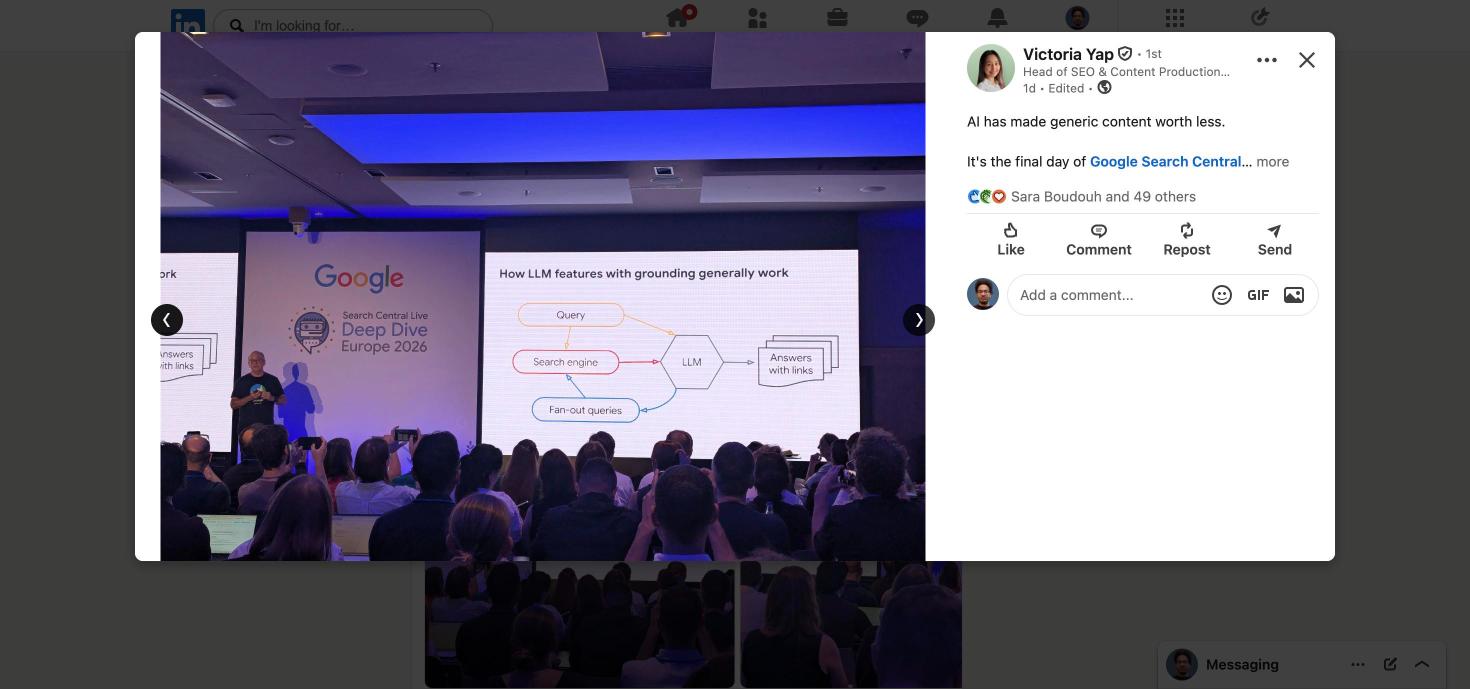
Grounding and fan-out. Another slide shows how LLM features with grounding generally work: query, search engine, LLM, answers with links, with a fan-out query loop between the engine and the LLM. Same message as days 1 and 2: AI relies on search.
Quality (Duy Nguyen, Google). Four pillars: effort, originality, talent or skill, accuracy. Hundreds of ranking signals that vary by result type, and continuous testing. He recommends reading the public Search Quality Rater Guidelines. Low-quality content floods the web whether a human or an AI wrote it. Positive examples: shoe reviews with original metrics, proprietary photos, detailed research.
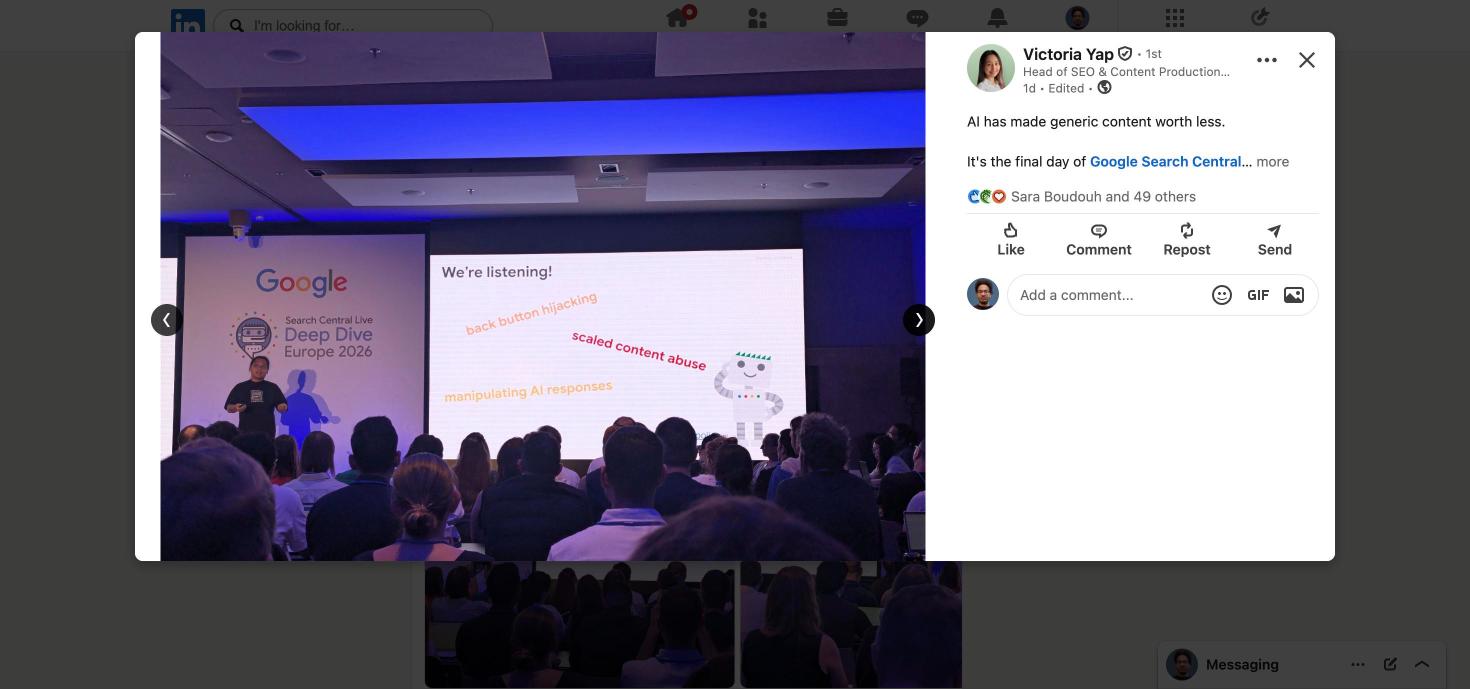
Spam and core updates (Gary Illyes). Google reportedly filters 40 billion spam pages a day (ROAST, single source). There are more spam updates because AI inflates content volume, and Google also uses AI to catch more of it. Three drivers of change: more content formats (beyond ten blue links), broader content, and content issues. Core updates target pages, not domains, which explains why some pages rise and others fall on the same site. Spam updates cover cloaking, doorway pages, scraped content, link spam, hacked content and, increasingly, scaled content. A “We’re listening!” slide names three abuses: back button hijacking, scaled content abuse and manipulating AI responses.
Discover (Eric Murillo, Google). No Discover bot: it’s the same index stack as everything else. An “Eligibility Gate”: policy violation, filtered; low quality (E-E-A-T), filtered; safe and trusted, Discover eligible. Then image quality affects CTR: small thumbnail, lower CTR; large high-resolution image, higher CTR. Reported recommendations: at least 1,200 px wide, over 300,000 total pixels, 16:9 ratio, and max-image-preview:large enabled. Avoid generic images (logos) and text-heavy ones; images follow the same policies as content (nothing misleading or exaggerated). Eric notes that “AI slop” is growing in the feed. User feedback builds new spam filters, and manual actions show up in Search Console.
Rich results and shopping. Gary: rich results usually require structured data, while AI results extract from text. Google Images can use product images from Merchant Center, which isn’t required to appear but adds an indexing route. Alex Jansen (Google) presents “conversational attributes”: flexible product information that replaces thousands of fixed attributes, to answer questions like “how much water?” or “what safety features?” for a kettle. Plus a “product highlights” field. Message: the bar for product data quality is going up (ROAST, single source).
Search Console (Ariel Kroszynski). Over the past year: Groups (creation with regex), AI-assisted report configuration, and multimodal as the newest. No update on the generative AI report: the team is working on adding more AI search data, no timeline. A dark mode mock-up was shown, not real yet.
Quality and SERP lightning talks. Robert Wojno (Hostinger): “What is VPS hosting?” (1.6M impressions) underperformed a niche Palworld guide (46K impressions), which had a 23x higher CTR and better conversions. Juan Seguí (acceseo): AI needs human verification; calling a double pram “compact” doesn’t say whether it fits in a lift with a parent and a child; detailed FAQs brought +14% organic clicks and fewer pre-sales questions. Noe Rivas (seosve): pick the right format for the audience, for example a simplified topic for beginners plus a video, which showed up in AI Overviews, Gemini, YouTube and Images. Nik Vujic: Search Console and GA4 data in LLM agents, with a metric like “does the article rank for more queries over time?”. Simon Vreeman: build a hierarchy of evidence (expert opinion, case studies) before testing. Alex Wright (iDHL): a case where organic sessions fell 47% (direct -2%) while enquiries per 100 clicks rose 2.7x, the brand’s share of search clicks went from 17% to 38%, Ads CTR rose 36%, the brand was 1st or 2nd in five AI engines and 83% of AI citations came from non-owned sites (ROAST, single case). Pablo Pérez (Google) revisits the “Messy Middle”: in the UK, searches for “is [brand] legit” have climbed since 2020, peaking in 2026, so trust is part of the journey.
Gary Illyes’ average timelines. The slide that circulated the most. These are reported averages, not Google documentation. Estela Franco (LinkedIn) confirms most of it for crawling, indexing and serving. According to ROAST, crawl capacity drops immediately if the server struggles, core updates roll out over 2 to 4 weeks and spam updates in 1 to 2 days. A “never” is often tied to quality: a fast technical fix doesn’t help if Google devalues the page.
| Process | Typical | Slow case |
|---|---|---|
| Crawl: new URL discovery | ~20 hours | Weeks, or never |
| Crawl: refresh of a known URL | ~30 days | Weeks, or never |
| Sitemap processing | ~24 hours | Up to 14 days, or never (quality) |
| robots.txt update picked up | ~24 hours | 25 hours |
| End-to-end indexing | ~1.5 hours | Months, or never (quality) |
| Meta annotations | 45 to 90 minutes | 1 to 4 days |
| Canonical change | 1 to 3 weeks | Months (conflicting signals) |
| Removal from the index | 1 to 3 weeks | Months |
| Site move | 1 to 3 months | 6 months to over a year |
| Removal via Search Console | ~2 hours | 24 hours |
| Snippet or title update | 1 to 2 days | Weeks to months |
| Core update recovery | 3 to 6 months | 6 months to 1 year (next update) |
| Spam update recovery | 1 to 2 weeks | Months (batch refreshes) |
The close (Gary Illyes). Three messages: use AI because it streamlines work, use it responsibly because it hallucinates (and don’t amplify “AI slop” with your briefs), and remember that AI on Google is just SEO. The same processes power AI and classic results, no new acronyms needed. His closing line: AI results are built on SEO infrastructure, SEO isn’t dead.
What attendees say. Stefanie Senn repeats “Good SEO is good GEO, AEO” and suggests UEO for User Engine Optimization. Marieke Botman notes that “GEO is just good SEO” came up several times, that not everyone in the room may agree, and that her conclusion is “it depends”. Fernando Maciá found day 1 a bit light, but days 2 and 3 more substantial. On posters, Friederike Hagen singles out Sabine Langmann (complex site migrations and stakeholder management), Sergio Q. (modeling internal link flow) and Victoria Y. (what AI can’t replace in SEO).
What I take from it (my interpretation, not a Google instruction).
- Check indexing before talking AI visibility: a page that isn’t in the index can neither rank nor be cited.
- Put the timelines in client plans: canonical 1 to 3 weeks, site move 1 to 3 months, core update recovery 3 to 6 months.
- Discover: images at least 1,200 px wide, 16:9,
max-image-preview:large, no logos or text-heavy images. - Quality: original data, proprietary photos, real detail and FAQs on the real questions, rather than rewritten content.
- Measure beyond clicks: enquiries, conversions, brand share of clicks, AI citations.
- Shopping: watch conversational attributes and product highlights in Merchant Center, to confirm in Google documentation.
What the Digitaloft recap adds
Liv Day (Digitaloft) published a full 3-day recap on October 4. It confirms several points already noted and adds others. The figures below come from that recap, so cite it as the source.
- Cross-checked. The 40 billion spam pages per day (ROAST, María José G. and Digitaloft, probably the same session). About 719,000 quality tests and 4,781 launches in 2023, in line with the “~800,000” and “~5,000” in Serhii Omelchenko’s notes. 94% of frequent LLM users also use Google frequently, which settles the 94% versus 92% question in favor of 94%. Alex Jansen’s conversational attributes are also confirmed.
- AI Mode query growth (Gary Illyes). Queries of 5+ words grow 1.5x faster. By type: exploring +30%, deciding (“which…”) +40%, doing (planning) +80%.
- Structured data (Ryan Levering, Google). Two internal schools of thought: some see no value, others see a foundation. Benefits cited: precision (machine formats such as ISO dates), efficiency (cheaper than LLM parsing), focus. No penalty for extensive markup, JSON-LD recommended, avoid conflicting data. Rakuten Recipes case: search traffic x2.7 and session duration x1.5. Note this is an older example taken from Google’s documentation, reused on stage.
- Conversational shopping attributes (Alex Jansen). question_and_answer, document_link, related_product, item_group_title, variant_option, popularity_rank. Example: a kettle with Q&A about temperature settings. The data quality bar is rising for agent-driven journeys.
- Trust. Pablo Pérez (Google, “messy middle”): search demand for “is [brand] legit?” has risen since 2020 and hit its highest point in 2026. Users turn to AI early in the purchase journey to explore, compare and research. Discover (Eric Murillo): no separate crawl, low-quality content filtered, previews must match the article, transparency on author and publisher.
- Updates. No new update announced. According to Digitaloft, the September 2026 spam update was still rolling out. Google’s advice after a core update: look at the site as a whole, not just the affected pages, and get an objective outside review.
- AI roadmap. Google stayed tight-lipped. The only lead mentioned: search agents that send notifications and updates (rollout starting). On Search Console, no detail on future AI insights, just “we expect more”. According to Gary Illyes, no system determines whether content is AI-written, but the ML models are trained on human-written content.
- Search Console (Ariel Kroszynski). social performance tracking, Query Groups in Insights since October 2025 (brand variants and misspellings), multimodal reporting (Lens, Circle to Search, image uploads, Chrome right-click “Search this image”), a generative AI report expected to get deeper, dark mode shown as a mockup with no date.
- Measurement (Alex Wright). One case with -65% search clicks and +17% enquiries, and an AI visibility project tied to +36% paid search CTR through brand awareness. Single case, read it as such.
- Queries (John Mueller). Pipeline: language detection, stopword removal, entity extraction, expansion. The “siblings” idea: non-synonym terms searched together, drawn from “X vs Y” queries. Mueller/Müller are treated interchangeably.
- Closing. Three messages: use AI, use it responsibly, and “AI on Google is just SEO”.
Digitaloft also reports day 2 indexing cases: a three-URL canonical chain, 80% of titles rewritten with a 25% CTR drop, and out-of-stock products kept at 200 with OutOfStock markup. Same caveat: these are “What would you do?” scenarios shown on stage, not Google rules.
E-E-A-T and quality: community notes from day 3
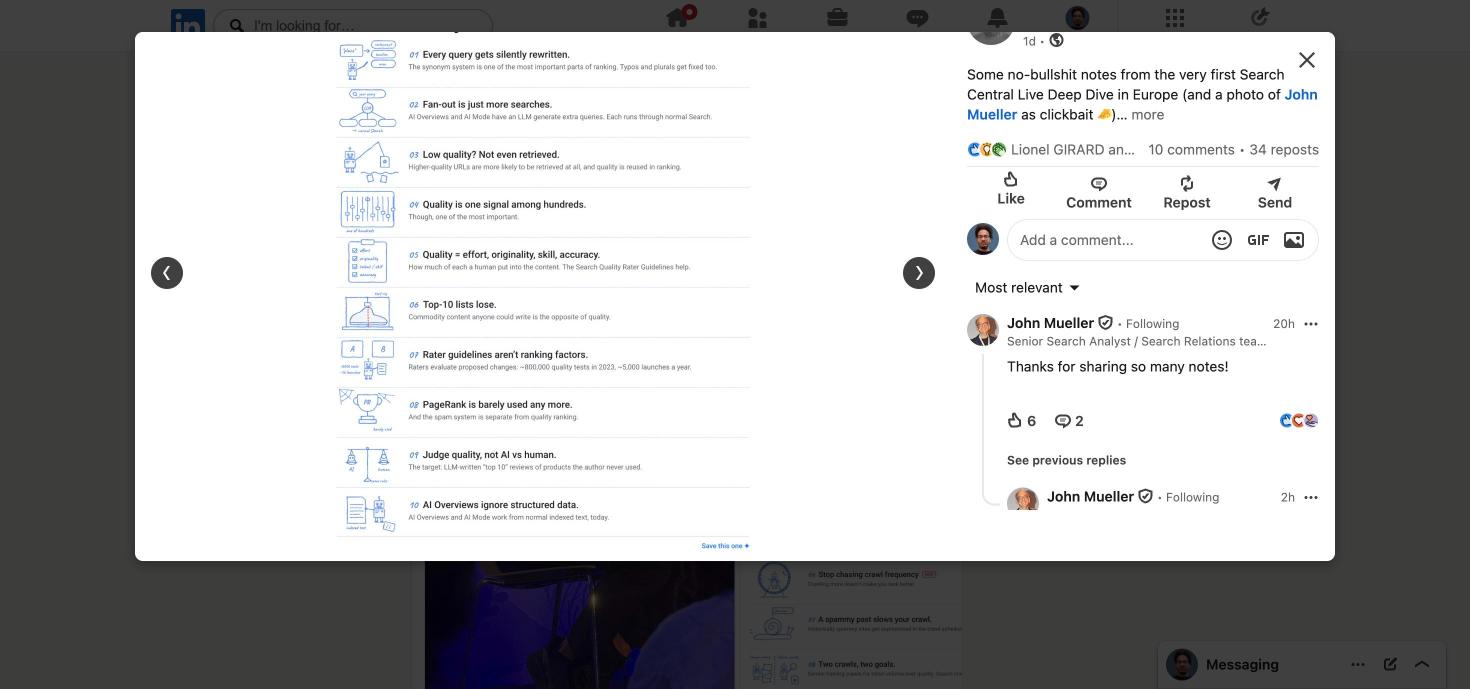
Serhii Omelchenko published day 3 notes titled “Commodity content loses” (LinkedIn, October 3). These are attendee notes, not Google slides, so read them as a summary.
- Quality comes down to effort, originality, talent or skill, and accuracy. It is one signal among hundreds, but one of the most important.
- A low-quality URL may not even be retrieved, and quality is reused later in ranking.
- “Top 10” lists anyone could write are the opposite of quality. The target: LLM-written “top 10” product roundups from authors who never used the products.
- The Search Quality Rater Guidelines are not ranking factors. Raters evaluate proposed changes: roughly 800,000 quality tests in 2023 and about 5,000 launches a year.
- Google judges quality, not AI versus human. Lucian Harhata agrees: human-written content can still be scaled content abuse.
- To verify (single source): “PageRank is barely used any more” and “AI Overviews ignore structured data”. On schema, Lucian Harhata reports that Google highlighted its accuracy and low processing cost. That fits Google’s docs: markup gives context, it does not drive AI features.
Désiré Nahon notes that Google put trust at the center of E-E-A-T, with four fundamentals: an accessible technical base, fresh and accurate data, effort, and trust. María José G. adds that E-E-A-T is not built overnight, should be treated as a long-term brand investment, and that there is still no clear metric for AI visibility.
More LinkedIn takeaways from day 3
- Lucian Harhata: “crawled, currently not indexed” is not automatically a technical bug (quality, duplication, main content). Google Trends shows relative interest, not volume. Community case cited: 2,000 URLs cut to 100, +100% monthly revenue, with several changes at once.
- Shopping: product Q&A, detailed specs and compatibility info to answer “will it work for me” questions.
- Stefanie Senn: Google reportedly handles over 5 trillion searches a year, with queries getting more complex, conversational and multimodal. Quote kept: “Good SEO is good GEO, AEO”.
- María José G. also mentions over 40 billion spam pages detected per day. That makes two posts, but probably the same session.
- Thiago Pojda gave a lightning talk “GEO is not just SEO (or maybe it is?)” using data from Ahrefs, Dan Petrovic, Peec AI and iPullRank.
- Maryam Safari: the closing Q&A featured Alex Jansen, John Mueller, Ariel Kroszynski, Duy Nguyen and Gary Illyes.
LinkedIn sources: Serhii Omelchenko, Désiré Nahon, Lucian Harhata, María José G., Stefanie Senn, Thiago Pojda, Maryam Safari (October 3 and 4, 2026).
Final verification pass (5 October): what changes
Last Google and LinkedIn scan before closing this article. The same posts keep coming back across queries, so coverage is saturated. Here is what is added or clarified.
- Timelines: still a single origin. Monica Brignoli, Robert Trif and Ajil Satheesan relay Gary Illyes’ ranges, taken from John Campbell’s ROAST recap. Robert Trif notes that Google has not published the slides and that the figures come from an attendee recap. Ajil Satheesan adds the refresh of a known URL (~30 days), Monica Brignoli sitemap processing (~24 h), Robert Trif manual action removal (1 to 2 weeks) and slower core update recoveries of 6 to 12 months. Status: 1 source, unofficial.
- Quote attributed to Gary Illyes. “If you know how search works, you largely also know how AI features work”, reported by Gonzalo Cobo Tirado (Bodeboca). It matches Lucian Harhata’s notes and Google’s AI features documentation. Status: 1 source for the exact wording, cross-checked for the idea.
- Google speakers confirmed. Javier Soria Domínguez names Gary Illyes, John Mueller and Cherry Sireetorn Prommawin as the hosts of the three days.
- “Scaled content is a bigger problem than link spam”. Attributed to Gary Illyes by Ana N. (MetricLinks), who relays a Lily Ray synthesis. I found it nowhere else. Status: 1 indirect source. The other points in that synthesis (Google’s AI guidance update, 4 spam updates in 2026) do not come from Barcelona and I have not verified them myself.
What should you do after Search Central Live Deep Dive?
These actions follow from the converging Day 1 message (same crawl and indexing stack). This is my interpretation, not Google guidance.
- Check crawling before talking GEO. Search Console Crawl Stats report: server response time, 5xx errors, discovered but not crawled pages.
- Audit robots.txt for Googlebot and AI crawlers separately. An unintended block removes the page from the whole chain.
- Validate rendering of key content (URL Inspection, rendered HTML): what is not rendered is not indexed, hence not citable.
- Use the Search Console Generative AI report to measure AI impressions, alongside citation trackers. Method and limits in my analysis of the Generative AI report.
- Do not invest in llms.txt for Google. Position confirmed in Bangkok 2025, not yet revisited in Barcelona (full framing in the GEO checklist).
- Keep your structured data: explicitly structured data is still more reliable and cheaper to use than LLM interpretation (Nicolas Audemar’s post, to confirm with a more detailed recap).
- Hreflang: don’t rely on it for language detection. Localize the content first, then use hreflang to link the versions.
- Robots meta: max-image-preview:large and max-snippet:-1 for maximum visibility (John Mueller’s recommendation per ROAST). Careful, nosnippet and max-snippet:0 also remove the classic snippet.
- Check that robots.txt doesn’t block any JavaScript file needed for rendering, and that key content doesn’t depend on scrolling.
- Canonicals: keep signals consistent across redirects, rel=canonical and hreflang, and audit clusters of near-identical pages (country or currency variants).
Who is talking about Google Search Central Live Spain, Deep Dive edition?
Primary sources for this article, published under #scldd2026 and #searchcentrallive and #scldd26. Non-exhaustive list, updated on October 1, 2026.
- Victoria Y.: Head of SEO & Content Production: AI Mode figures, same crawling and indexing system, Day 1 community talks.
- John Campbell: Head of Innovation & AI, ROAST: Day 1 notes, crawl budget, no announcements.
- George-Emanuel Cîță: SEO Specialist: AI Mode data, slide photos, “good SEO is good GEO, AEO, AIO”.
- Clara Soteras Acosta : Day 1 recap, speaker names and content quality theme.
- Nicolas Audemar (international SEO): structured data in the age of AI.
- Jamie R.: Day 1 and 2 recap, figures attributed to Lino Cattaruzzi, Eduard Blacquière’s framework.
- Patrik Rojan (Search Evolution Summit): Cherry Prommawin’s hreflang advice.
- David Iwanow: Alizée Baudez’s hreflang talk.
- Michael Field (Sykes Cottages): Day 2 common thread.
- Bruno Díaz González (La Teva Web): JavaScript.
- Thiago Pojda: “GEO is not ‘Just SEO’” talk.
- Enrique Hidalgo (Technical SEO): detailed Day 2 recap, robots meta, canonicalization, soft 404s, video.
- Liv Day (Digitaloft): Day 2 recap, JavaScript and robots.txt, structured data.
- Cecilia Valentina Dulcich: Day 1 recap, Search Console, llms.txt.
- Fernando Maciá Domene (Human Level): critical take on Day 1.
- Neil McCarthy: context of the Day 1 keynotes.
- Christina Mantziou: takeaway on the available, understood, selected chain.
- Kira Breuer: 7-minute lightning talk on her AI automations.
- John McAlpin and LOCOMOTIVE Europe: talk on data analysis to detect technical issues blocking AI visibility, poster session, write-up announced.
- La Teva Web: attendance and John Mueller being present.
- Irene Cecotti (SEO/AEO Lead, PhantomBuster): pre-event post: announced talk on new AI features that can hurt organic performance.
- Dave Smart (Technical SEO, Tame the Bots): pre-event post, no factual content.
What we still don’t know about the Barcelona Deep Dive
- I’m not in Barcelona. Everything I report about Day 1 comes from attendees’ LinkedIn posts published on September 30, 2026, which I read and captured the same day.
- The AI Mode figures (1 billion users, 92%) do not appear in any Google document I reviewed and have a single source. The quarterly doubling, queries 3 times longer and the 1 in 6 multimodal share are backed by the ROAST recap.
- A Dutch post claims Google said “natural” content is promoted better. Too vague and second-hand, so I’m leaving it out.
- Day 2 rests mostly on a single detailed recap (ROAST), cross-checked against a few posts. Some details (10,000 px viewport, the Search Console control to exclude AI Overviews) need confirming against Google’s documentation. Day 3 (ranking, AI features) is not covered. I’ll update the article once recaps are out.
- Clara Soteras Acosta mentions “standout moments for publishers” without giving details, so I’m not saying anything about them.
- John Campbell himself missed some Day 2 sessions (signal calculation, index inclusion decisions, lightning session J, the indexing “What would you do?”): I’m not saying anything about them.
Sources
- Google Search Central Blog: Deep Dive Europe 2026 program
- Google Search Central Blog: community speakers
- PPC Land: Barcelona, format and speakers
- Search Engine Land: Bangkok 2025, classic SEO and llms.txt
- ROAST: Google Search Central Live Deep Dive, Barcelona, Day 1 Recap (John Campbell, September 30, 2026)
- ROAST: Google Search Central Live Deep Dive, Barcelona, Day 2 Recap (John Campbell, October 1, 2026)
- Google Search Central: AI features and your website
- LinkedIn, September 30, 2026: Victoria Y.; Clara Soteras Acosta; John Campbell (ROAST); George-Emanuel Cîță; Christina Mantziou; Kira Breuer; LOCOMOTIVE Europe (John McAlpin); La Teva Web.
- LinkedIn, October 1, 2026: Nicolas Audemar; Jamie R.; Patrik Rojan; David Iwanow; Michael Field; Bruno Díaz González; Thiago Pojda; Enrique Hidalgo; Liv Day; Cecilia Valentina Dulcich; Fernando Maciá Domene; Neil McCarthy
- Google Search Central: localized versions of your pages (hreflang)
- ROAST: Google Search Central Live Deep Dive, Barcelona, Day 3 Recap (John Campbell, October 2, 2026)
- Digitaloft: Search Central Live Deep Dive Europe 2026 summary (Liv Day, October 4, 2026)
Leave a Reply
You must be logged in to post a comment.