On 11 November 2026, John Mueller and Martin Splitt hosted the first Search Central Live in Cape Town. According to attendees, Google explained how AI Mode builds on classic Search (grounding, query fan-out) and covered Preferred Sources, new Search Console reports and AI controls. Core message: good SEO is good GEO. No recording.
Published 12/11/2026. Sources and screenshots from 12/11/2026.
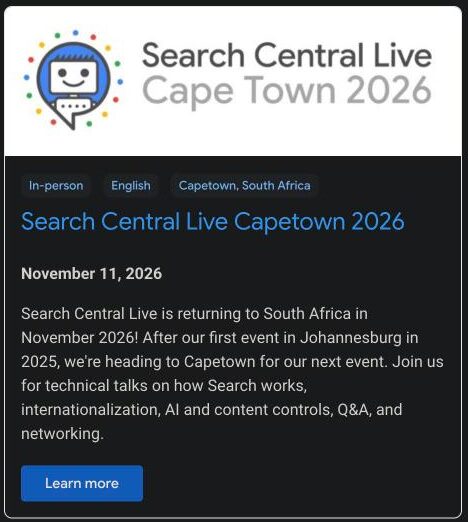
Search Central Live Cape Town 2026: date, venue, speakers and agenda
Search Central Live is the free event series run by the Google Search Central team. The Cape Town edition took place on Wednesday 11 November 2026, from 1pm to 7pm local time (GMT+2), at The Old Biscuit Mill in Woodstock. It was in English, in person only, with applications open until 19 October (Google Search Central Events page; PPC Land, 16/10/2026).
It is the second edition in South Africa. Google’s Events page says the first one was held in Johannesburg in 2025. Marianne Erasmus, Google News Partnerships Lead for the Middle East and Africa, mainly invited news publishers to apply in an October LinkedIn post.
| Item | Detail | Source |
|---|---|---|
| Date | 11/11/2026, 1:00pm to 7:00pm (GMT+2) | Google Events page, PPC Land |
| Venue | The Old Biscuit Mill, 373-375 Albert Road, Woodstock, Cape Town | PPC Land, 16/10/2026 |
| Format | Free, by application, in English, no livestream or recording | Google Events page, Search Growth Tech |
| Google speakers | John Mueller (Search Relations), Martin Splitt (Search Advocate), Kabelo Makwane (Country Director, South Africa), Marianne Erasmus (News Partnerships MEA) | PPC Land, Search Growth Tech |
| Audience | Publishers, SEOs, developers (e.g. Food For Mzansi, Greenpark Digital, Digital First, Geeky Tech) | LinkedIn posts from 11 and 12/11/2026 |
The agenda published by Search Growth Tech (updated 05/11/2026) listed 8 sessions:
- How Search works
- What’s new in Search
- AI experiences in Search (AI Overviews and AI Mode)
- Core SEO updates and best practices
- SEO mythbusting
- All about controls
- Internationalisation and localisation
- Q&A
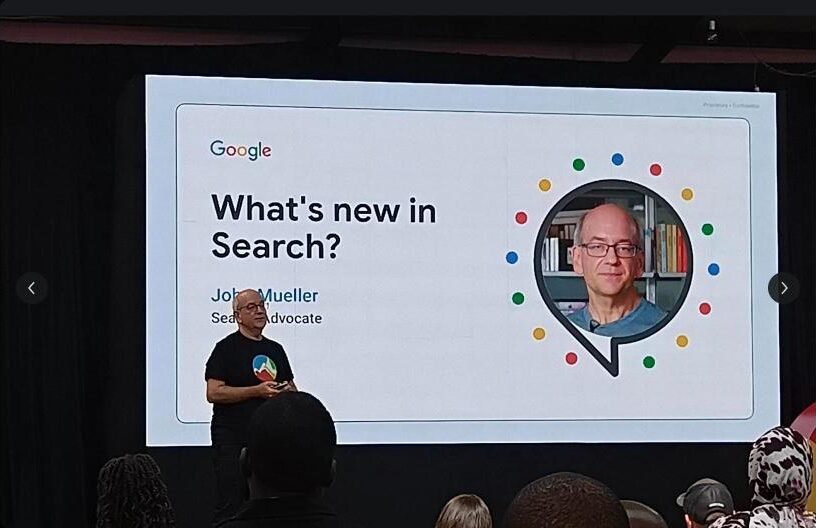
Attendee photos confirm at least three of them: “What’s new in Search?” presented by John Mueller, a “How does it all fit together?” diagram on crawling and indexing, and a slide on organic search.
“Good SEO is good GEO”: the fundamentals Google repeated in Cape Town
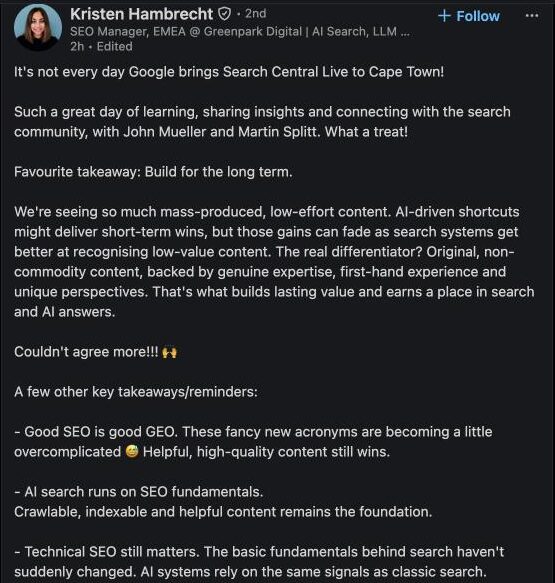
This is the message attendees mention first. Kristen Hambrecht, SEO Manager EMEA at Greenpark Digital, sums it up in three points in her 12 November post: good SEO is good GEO, AI search runs on SEO fundamentals, and technical SEO still matters. She adds that, based on what was said, AI systems rely on the same signals as classic Search.
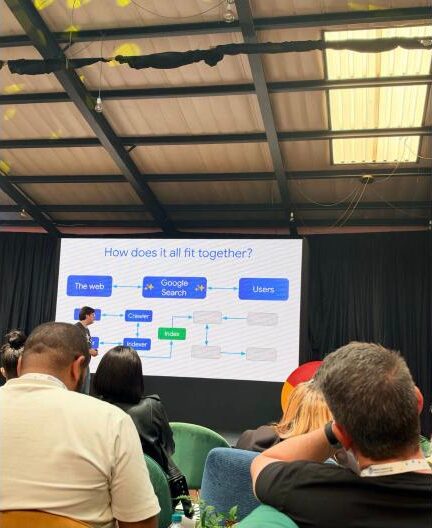
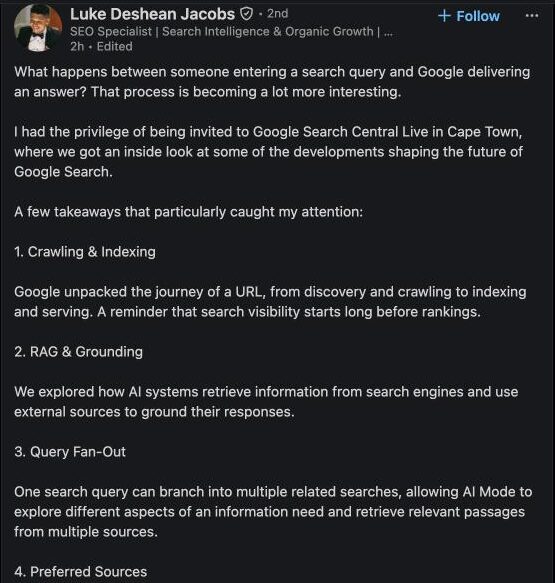
The “How Search works” session walked through the journey of a URL: discovery, crawling, indexing and serving (Luke Deshean Jacobs, SEO Specialist). The slide he photographed shows the web, Google Search and users, linked by the crawler, the indexer and the index.
Another slide restated a basic point many clients still mix up: organic search is not Google Ads, and appearing in organic results costs nothing.
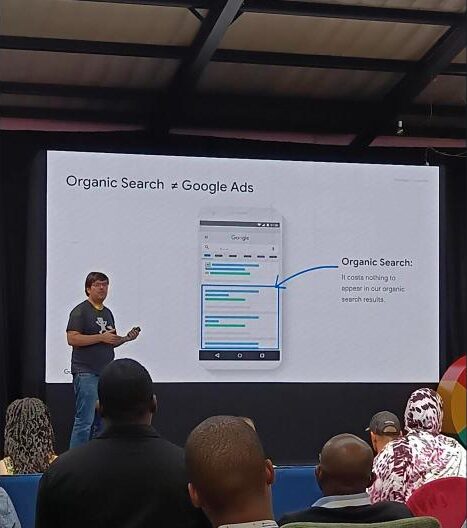
Nothing new on substance. It has been Google’s line since its guide on optimizing for generative AI features, published on 15 May 2026 and updated on 10 July 2026. It is also what Google said in Bengaluru on 30 October, with the same “Good SEO is good GEO, AEO” slide (see my Search Central Live Bengaluru recap).
My opinion, not a fact: this message applies to Google. ChatGPT, Perplexity and Copilot use their own indexes and source selection rules. For them, you still need to measure visibility separately, with GEO tools.
Grounding and query fan-out: how AI Mode picks sources, according to the Cape Town slides
This is the most useful part for GEO. Two slides posted by Luke Deshean Jacobs show how Google describes the link between its AI model and its search engine.
Grounding in RAG: the model fetches facts from the search engine
RAG (Retrieval-Augmented Generation) means a language model retrieves documents before answering, instead of relying only on what it learned in training. Grounding means anchoring the answer in those documents. The slide is cut off in the photo. What I can read shows 3 steps:
- The user’s question.
- The search engine retrieves current facts from the web.
- The “grounded” LLM combines the query and the facts, triggers a “grounding loop” if information is incomplete, then writes the verified answer.
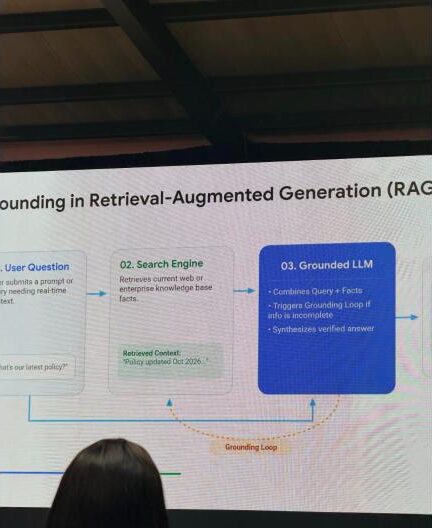
What it means: if your page is not crawled, indexed and ranking for the sub-queries, the model does not retrieve it. There is no separate entry door for AI in Google.
Query fan-out: one question becomes several searches
Query fan-out is when the system turns one question into several related searches run in parallel (see query fan-out in the glossary). The slide shown in Cape Town gives a concrete example. A long query about red e-bikes for a 5-mile commute with hills is split into “best ebikes”, “ebikes for hills” and “red ebikes”.
The slide separates three layers: the model’s general knowledge, specific knowledge from traditional results, and fan-out. The bottom of the slide, partly hidden, says this helps show a wider and more diverse set of links than traditional search.
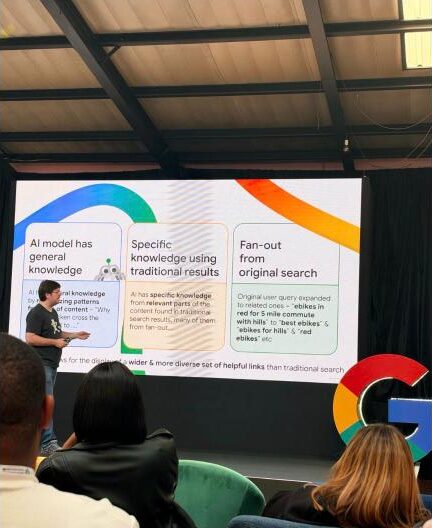
In practice, a page that only answers “best ebikes” has little chance of being used for the full query. A page that also covers hills, range and colors gives the sub-queries more useful passages. I explain the mechanism in detail in the technology behind AI Overviews and AI Mode.
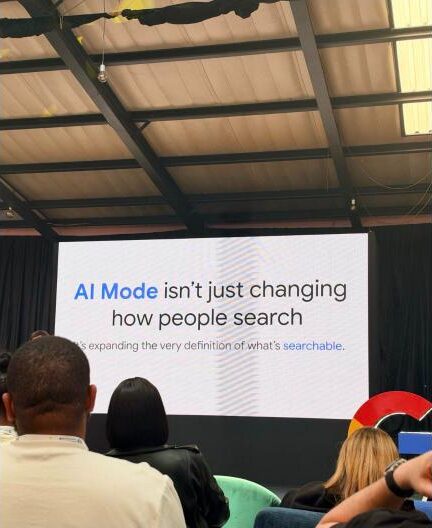
A final slide summed it up: AI Mode is not only changing how people search, it is expanding what is searchable. Luke Deshean Jacobs links this to multimodal search (see below).
Preferred Sources, Search Console, AI controls: what was new in Cape Town
Brandon Kyle Booth, SEO Team Lead at Digital First, lists the points from the “What’s new” session in his post. I cross-checked them against Google’s official announcements. All of them predate the event: Google gave an update, and nothing was launched in Cape Town based on the posts I read.
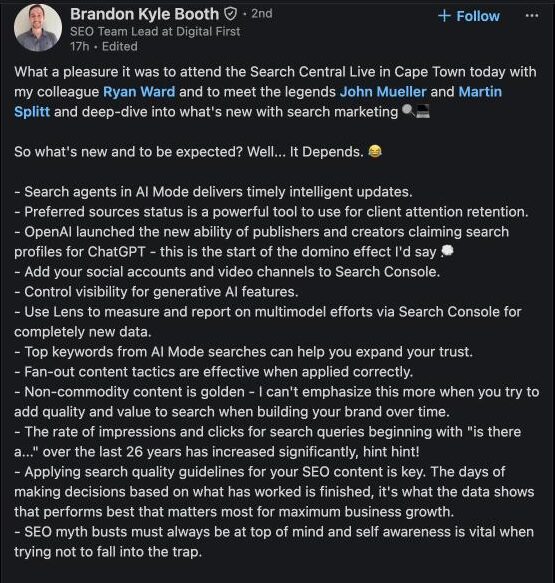
| Topic mentioned in Cape Town | What Google officially announced | Announcement date |
|---|---|---|
| Preferred Sources: “about twice as likely to click” | Users are 2x more likely to click a site marked as a preferred source (Nick Fox, Google, on LinkedIn; Google’s figure) | December 2025, repeated 30/04/2026 |
| Social accounts and video channels in Search Console | “Platform properties”: Instagram, TikTok, X and YouTube tracked in Search Console | 07/07/2026 |
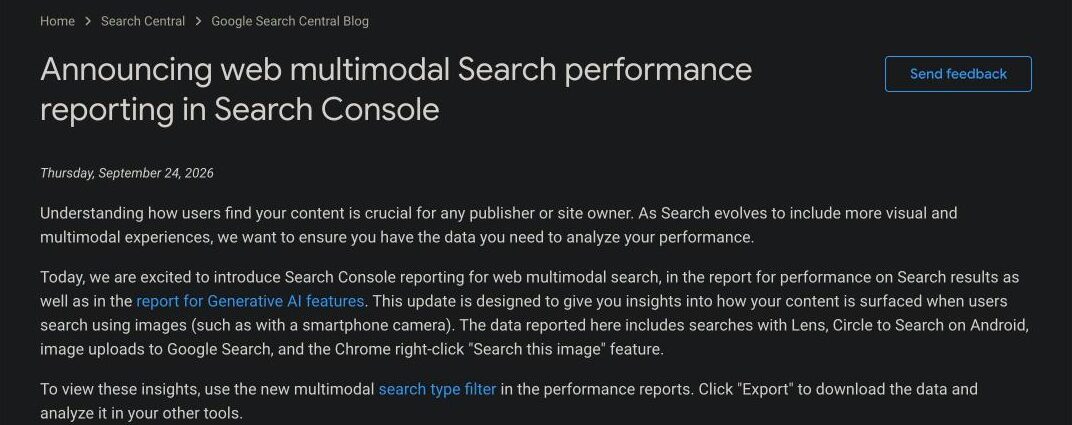
| Lens reporting in Search Console | “Multimodal” search type: Lens, Circle to Search, image upload, Chrome “Search this image” | 24/09/2026 |
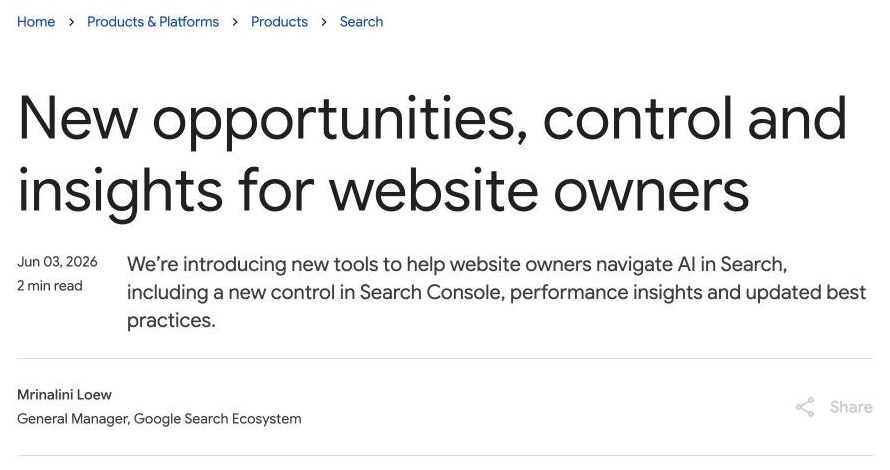
| Controlling visibility in generative AI | Search Console setting to opt out of AI Overviews, AI Mode and AI Overviews in Discover, extended to all sites on 31/08/2026 | 03/06/2026 |
| Search agents in AI Mode | Mentioned by 1 attendee (Brandon Kyle Booth), no detail | Not verified |
| “Top keywords” from AI Mode searches | Mentioned by 1 attendee, vague wording | Not verified |
Preferred Sources: the “2X” slide for publishers
Preferred Sources lets users choose the sites they want to see more often in Google. On the slide photographed in Cape Town, Google asks publishers to invite readers to add them, with an “Add as a preferred source on Google” button. A “2X” figure is visible at the bottom. The number is not new: Nick Fox posted it on LinkedIn on 30 April 2026 (PPC Land, 30/04/2026).
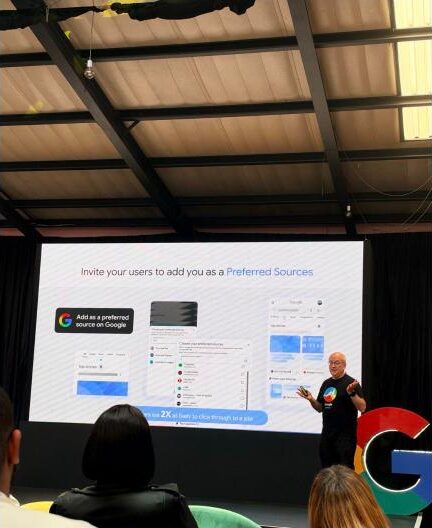
For a publisher, it is an easy win: add the button to articles and the newsletter. For a B2B brand, it matters less, as Preferred Sources mostly affects news content.
Search Console: social, multimodal and generative AI
Three 2026 additions were covered. Platform properties let you track Instagram, TikTok, X and YouTube posts in Google Search and Discover (Google Search Central Blog, 07/07/2026).
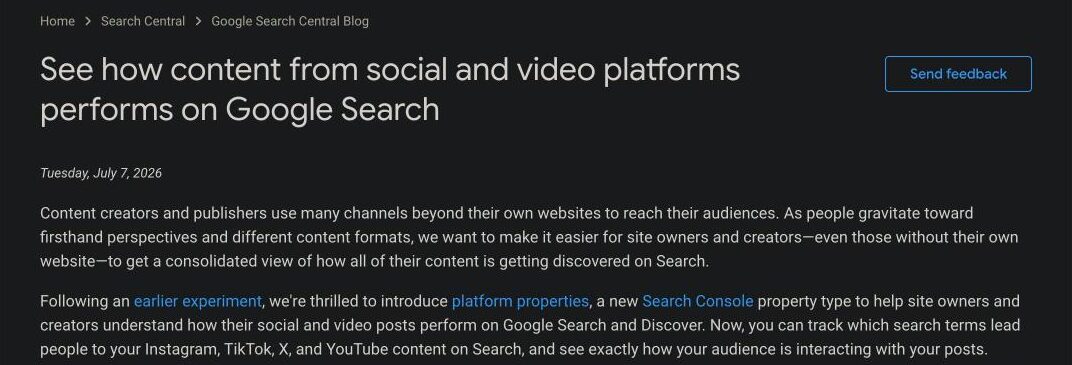
The “multimodal” filter shows searches made from an image. Key limit: no queries in this report (Google Search Central Blog, 24/09/2026; PPC Land, 24/09/2026).
Finally, the Search Console generative AI report shows impressions in AI Overviews and AI Mode, without clicks. I show how to read it in my guide to the Search Console generative AI report.
AI controls: leaving AI answers or blocking training
The “All about controls” session was not described in detail by attendees. The official context helps. On 3 June 2026, Google launched a Search Console setting that lets a site choose whether it appears in AI Overviews and AI Mode. Google says this setting is not a ranking signal for classic results (Google blog, Mrinalini Loew, 03/06/2026, updated 31/08/2026).
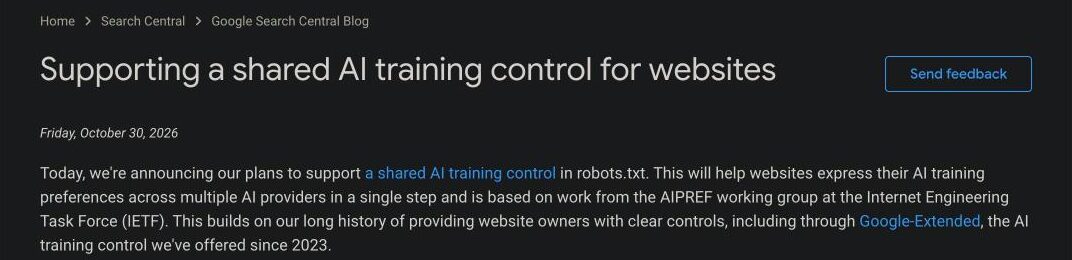
On 30 October 2026, John Mueller announced that Google plans to support a shared robots.txt signal to opt out of AI training, based on the IETF AIPREF working group. Google will treat it as a Google-Extended block, with support targeted for 2027 (Google Search Central Blog, 30/10/2026). I do not know if this was presented in Cape Town: no attendee mentions it.
Do not confuse the two: leaving AI Overviews and AI Mode is set in Search Console. Blocking Gemini model training goes through Google-Extended in robots.txt.
Non-commodity content and “care”: Mueller and Splitt’s message to SEOs
“Commodity” content is content based on common knowledge that anyone could produce. Kristen Hambrecht reports that Google warned against mass-produced, low-effort content. In her words, AI shortcuts may bring quick gains that fade as systems get better at spotting low-value content. The answer: original content with real expertise and first-hand experience.
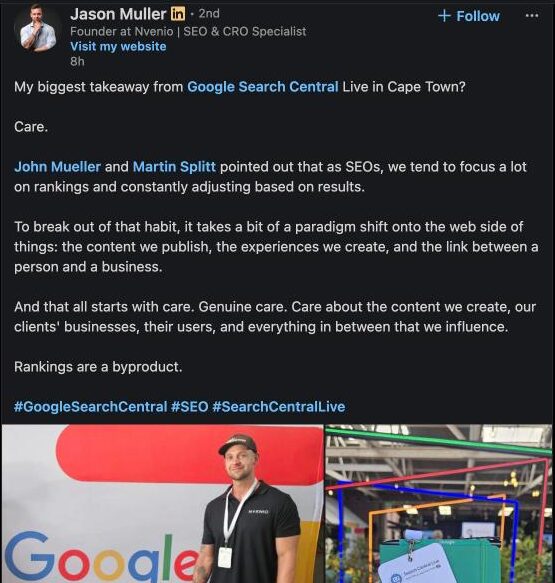
Jason Muller, founder of Nvenio, takes away one word: “care”. According to his post, John Mueller and Martin Splitt said SEOs focus too much on rankings and keep adjusting based on results. They suggested focusing on the content published, the experience created and the link between a person and a business. For him, rankings are a byproduct.
Brandon Kyle Booth adds two points: apply the Search Quality Rater Guidelines to your content, and decide based on data rather than on what used to work. He also reports a strong rise, over 26 years, in impressions and clicks for queries starting with “is there a”. He gives no figure, so I treat it as a reported trend.
ChatGPT profiles and the Business Hub: my first-hand test on 11 November
Brandon Kyle Booth lists one point that does not come from Google: OpenAI now lets publishers and brands claim a profile in ChatGPT. He calls it the start of a domino effect. I do not know if it was discussed on stage or if it is his own comment.
What I do know is that I did it the same day. On 11 November 2026, I created the aioseo.fr profile in OpenAI’s Business Hub:
- Context: aioseo.fr, my own site, tested on 11/11/2026.
- What I did: added the domain, then verified it with a DNS TXT record added in Cloudflare. The domain was validated in under 5 minutes.
- Result: the profile is created (draft status), but ChatGPT filed it under the wrong category (“Market research firm”). It cannot be changed without an ID check, which I declined.
- Limits: one site, one day of hindsight. I have no data yet on the profile’s effect on ChatGPT answers.
- What I would do differently: check the suggested category before validating the profile, and decide upfront whether to accept ID verification.
I documented everything with screenshots in my article on Businesses in ChatGPT and the Business Hub.
The link with Cape Town: Google says “do good SEO” for AI Mode, while OpenAI builds its own brand listings. Multi-engine GEO is not just about Google.
What I check first after this event, on my sites and my clients’ sites:
- Indexing of the pages that should answer fan-out sub-queries, in Search Console.
- The generative AI report and the multimodal filter in Search Console, to see if the site shows up.
- The generative AI control setting: left open unless there is a clear business reason.
- For publishers: the Preferred Sources button on articles.
- Brand profiles outside Google (OpenAI Business Hub, Bing Webmaster Tools for Copilot).
What we don’t know yet about Search Central Live Cape Town 2026
- The official slides. Google does not publish them and there is no recording. Everything above comes from attendees’ LinkedIn posts and photos.
- Details of 4 sessions: core updates, mythbusting, controls and internationalisation. No attendee had described them as of 12/11/2026.
- “Search agents” in AI Mode and “top keywords” from AI Mode searches: only one attendee mentions them, without detail.
- Press coverage. Search Engine Roundtable, Search Engine Journal, Search Engine Land and PPC Land had published nothing on the content of the day as of 12/11/2026.
I will update this article if new reports come out.
Other Search Central Live events I covered: Bengaluru, Barcelona, Paris, Zurich
Cape Town confirms the line from Bengaluru, twelve days earlier. To compare:
- Search Central Live Bengaluru 2026: what Google said on 30 October
- Search Central Live Deep Dive Barcelona 2026
- Google Search Central Live Paris 2026: Google is betting on agentic commerce
- Google Search Central Live Paris: what to expect on June 25
- Google Search Central 2025 in Zurich
Next dates on Google’s Events page: Search Central Live and Publisher Day Nordics in Copenhagen on 1 December 2026, then Search Central Live Zurich on 4 December 2026, with John Mueller, Daniel Waisberg and Martin Splitt.
FAQ about Search Central Live Cape Town 2026
When and where was Search Central Live Cape Town 2026?
On Wednesday 11 November 2026, from 1pm to 7pm (GMT+2), at The Old Biscuit Mill in Woodstock, Cape Town. The event was free, by application, and in English.
Who spoke at Search Central Live Cape Town 2026?
John Mueller and Martin Splitt from the Google Search Central team. Kabelo Makwane, Google’s Country Director for South Africa, and Marianne Erasmus, News Partnerships Lead for the Middle East and Africa, were also listed.
What did Google say about GEO in Cape Town?
That good SEO is good GEO: AI Overviews and AI Mode build on classic Search through grounding and query fan-out. For Google, there is no separate method, which matches its official guide from May 2026.
What was new at Search Central Live Cape Town 2026?
Nothing was launched on site, according to attendees. Google reviewed its 2026 announcements: Preferred Sources, platform properties and multimodal reporting in Search Console, and the generative AI visibility control.
Is there a recording of Search Central Live Cape Town 2026?
No, the event was in person only, with no livestream or recording. Its content is only known through attendees’ posts and photos.
Why I wrote this Search Central Live Cape Town recap myself
I was not in Cape Town. On 12 November, I read attendees’ LinkedIn posts and looked at their slide photos, then cross-checked each point with Google’s official announcements. When a point has only one source, I say so. I am an independent SEO and GEO consultant: nobody pays me for this content and I do not work for any agency or tool mentioned. If you were in the room and I got something wrong, write to me via ping-moi: I will fix it and date the correction.
Sources for the Search Central Live Cape Town 2026 recap
- Google Search Central, Events page, “Search Central Live Capetown 2026” listing, accessed 12/11/2026.
- PPC Land, Luis Rijo, “Google sets October 19 deadline for first Cape Town Search Central Live”, 16/10/2026.
- Search Growth Tech, “Search Central Live Cape Town 2026: Agenda & Speakers”, 26/10/2026, updated 05/11/2026.
- Google, official blog, Mrinalini Loew, “New opportunities, control and insights for website owners”, 03/06/2026, updated 31/08/2026.
- Google Search Central Blog, “See how content from social and video platforms performs on Google Search”, 07/07/2026.
- Google Search Central Blog, “Announcing web multimodal Search performance reporting in Search Console”, 24/09/2026.
- Google Search Central Blog, John Mueller, “Supporting a shared AI training control for websites”, 30/10/2026.
- Google Search Central, “Optimizing your website for generative AI features on Google Search”, 15/05/2026, updated 10/07/2026.
- PPC Land, article on the Preferred Sources guide and Nick Fox’s figure, 30/04/2026.
- PPC Land, article on Lens and Circle to Search reporting in Search Console, 24/09/2026.
- LinkedIn, attendee posts accessed 12/11/2026: Luke Deshean Jacobs, Brandon Kyle Booth, Kristen Hambrecht, Jason Muller, Food For Mzansi, Geeky Tech.
- LinkedIn, Marianne Erasmus, announcement post, October 2026; Google Search Central, announcement post, October 2026.
- Personal test: creating the aioseo.fr profile in OpenAI’s Business Hub, 11/11/2026.
Leave a Reply
You must be logged in to post a comment.