On 10 November 2026, OpenAI launched « Businesses in ChatGPT » in beta. A brand can claim its profile in ChatGPT through Business Hub, fix its details, send a product feed and see how often ChatGPT mentions it and how many clicks it sends to its site. Business Agents are limited to US ecommerce and online service businesses.
What OpenAI announced on 10 November 2026 with Businesses in ChatGPT
The launch has three parts. OpenAI calls it « an early step », with more markets and categories planned, no dates given. According to OpenAI, it targets the 1.2 billion people who use ChatGPT each week.
| Part | What it does | Who can use it on 11/11/2026 |
|---|---|---|
| Business Hub (business profile) | Claim your business, get verified, update key details, add a product feed with pricing and availability | Any eligible business located where ChatGPT is available |
| Business Hub insights | Mentions, website clicks and « discovery topics », aggregated | Claimed businesses, above a volume threshold |
| Business Agents | A brand agent that answers users’ questions in ChatGPT, in a separate conversation | Eligible ecommerce and online service businesses in the US |
There are three ways to claim a profile: directly in Business Hub, through an OpenAI representative for Enterprise customers and advertisers, or through Shopify (Shopify admin or Business Hub). OpenAI says eligible Shopify products are already in ChatGPT through Shopify Catalog. A Shopify store is not required to claim, according to Unite.AI and Relevant Audience.
Context matters. TechCrunch notes that OpenAI already tried to turn ChatGPT into a direct shopping destination with a commission based checkout, retired in March 2026. This time OpenAI starts with the business profile, which brings ChatGPT closer to what Google has long done with business profiles.
Business Hub metrics in ChatGPT: mentions, clicks and discovery topics
This is the part SEOs care about most. For the first time, OpenAI gives brands first-party numbers on their presence in ChatGPT answers. Until now, those numbers only existed in third-party tools that simulate prompts.
| Metric | What it counts | Known limit |
|---|---|---|
| Mentions | How often the business appears in ChatGPT answers. Per OpenAI’s help text quoted by Relevant Audience, an online business is counted when ChatGPT references its website, a local business when its result shows for a location | A brand name alone in the text does not count, per the same help text |
| Clicks | Clicks on links to the business’s website | Recorded clicks, not confirmed visits or conversions (OpenAI help text via Relevant Audience) |
| Discovery topics | Common themes across conversations where the website is cited | No access to prompts or conversations |
| Privacy thresholds | Numbers only show above a minimum volume | OpenAI does not publish the threshold values |
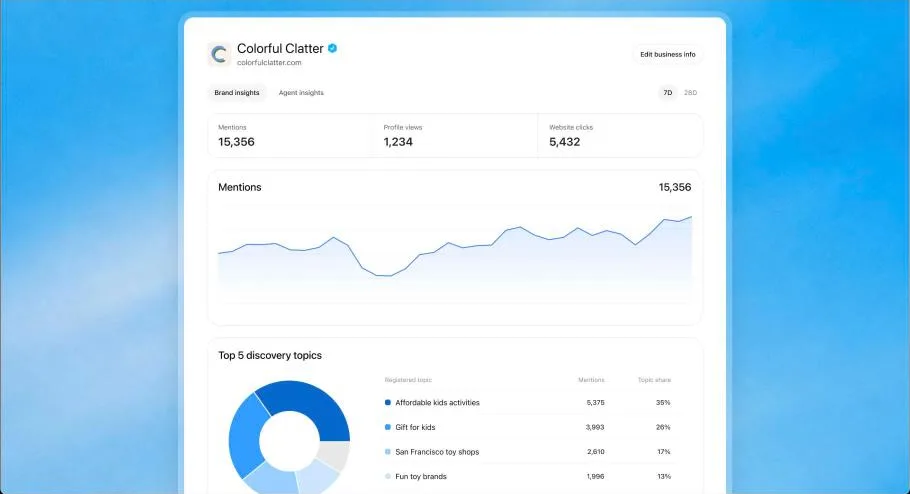
The example visual in the announcement shows a bit more than the text: a « Brand insights » tab and an « Agent insights » tab, a « Profile views » tile next to mentions and clicks, a 7 day or 28 day switch, and a top 5 of discovery topics with their share. The brand shown, Colorful Clatter, is a fictional OpenAI example, so its numbers mean nothing real.
What Business Hub does not give, and this matters later: no prompts, no position in the answer, no competitors, no share of voice. Relevant Audience says share of voice is not part of the beta. Digiday and PPC Land, which saw the interface before launch (spotted by Juozas Kaziukėnas of Marketplace Pulse on 6 November), already noted the lack of prompts and competitive ranking.
Business Agents in ChatGPT: a US-only brand agent tied to ChatGPT Ads
Once its profile is claimed, an eligible business can build, test and launch a Business Agent. When the business shows up in an answer, the user can open its ChatGPT profile and start a conversation with the agent. OpenAI stresses three points: the conversation is labeled, separate from the original conversation, and distinct from ChatGPT’s independent answers.
- The agent is built from the business’s guidelines and product feed. You cannot plug in your own agent (Relevant Audience).
- The agent must present itself as an AI representing the business. False urgency, pressure after a refusal and exploiting vulnerability are banned (Business Agents policy, summarized by Unite.AI).
- A purchase, booking, form or sharing of personal data requires the user’s explicit authorization (same source).
- A business can sponsor its agent and use it as a destination for ChatGPT Ads. Sponsored placements are labeled, according to OpenAI.
For a French site, Business Agents are not available today. The key point is elsewhere: OpenAI already links organic (the profile and agent) and paid (the sponsored agent). Benji Shomair, OpenAI’s VP of Monetization, described the agent as the organic experience and the sponsored agent as the paid one, with the same agent behind both (as reported by Relevant Audience).
Claiming a ChatGPT business profile outside the US: what works on 11 November 2026
Claiming is open to any eligible business located where ChatGPT is available, according to OpenAI. No country list is published. Eligibility depends on industry, location and verification checks, and claiming is first limited to businesses with a website (Relevant Audience). Reported verification methods are a call or text to the main business number, or DNS verification. For aioseo.fr, DNS verification is what I was asked for (details below). OpenAI did not detail the process to TechCrunch, Benji Shomair mentioning « multiple verification methods » depending on business type and market.
Claiming does not boost you in answers. OpenAI’s FAQ quoted by Unite.AI says claiming does not guarantee higher placement or sales. Benji Shomair adds that clearer information may help ChatGPT surface the business in more relevant conversations. On price, Relevant Audience says Business Hub and agents are free for now, without ruling out a paid model. OpenAI did not write that in its announcement.
I claimed aioseo.fr in ChatGPT Business Hub on 11 November 2026: steps and first findings
On the morning of 11 November 2026, I created the profile for aioseo.fr, a French blog about SEO and GEO, with no Shopify store. Here is what I saw, step by step.
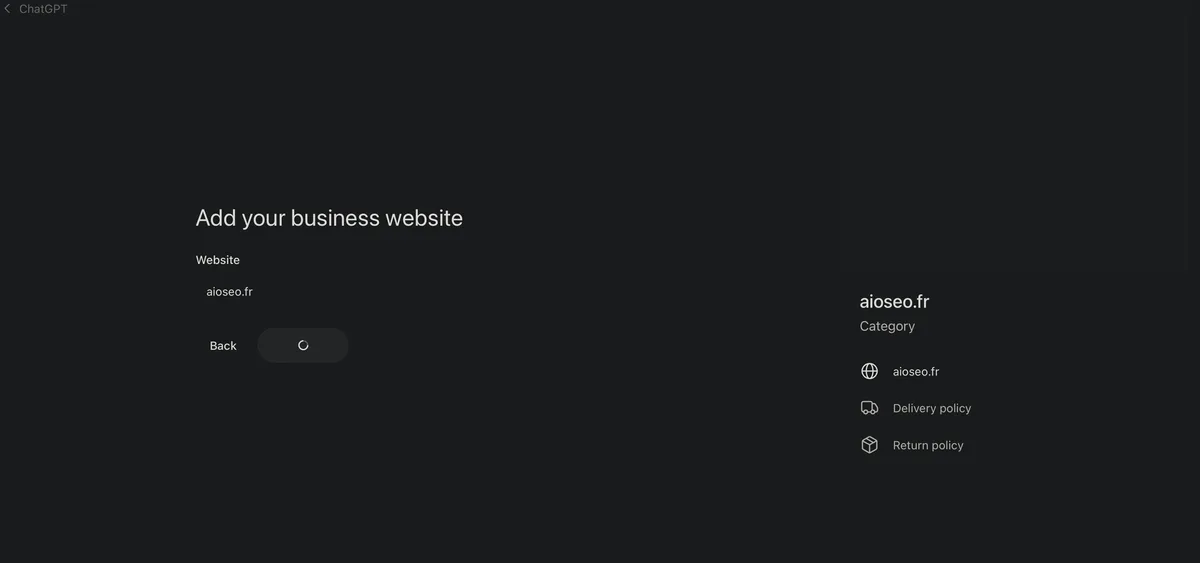
Step one, you enter the website address. A profile preview shows on the right with three lines: website, delivery policy, return policy. The model is clearly built for ecommerce.
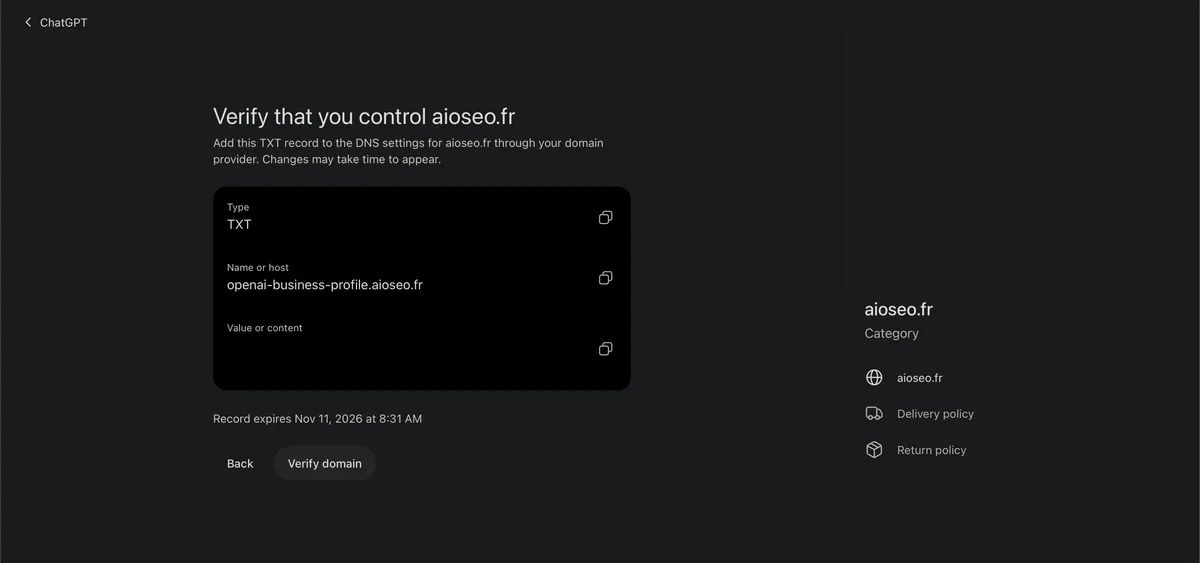
Step two, proof of ownership. ChatGPT asks for a TXT DNS record on the subdomain openai-business-profile.aioseo.fr, with a value like openai-business-profile= followed by a token. The screen shows an expiry time for the record: about 30 minutes to add it. I added it in Cloudflare and verification passed in under 5 minutes. I masked the token in the screenshot.
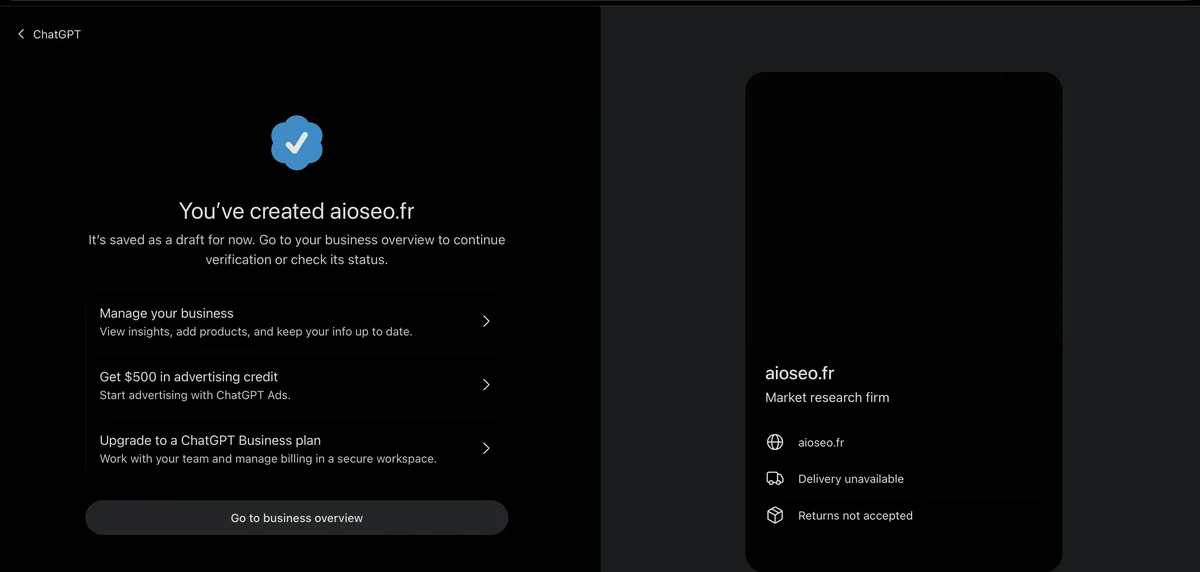
Step three, the profile is created, but as a draft. And the first version has errors: ChatGPT classified aioseo.fr as « Market research firm » and added « Delivery unavailable » and « Returns not accepted », which make no sense for a blog. The same screen offers 500 dollars of ChatGPT Ads credit and an upgrade to ChatGPT Business.
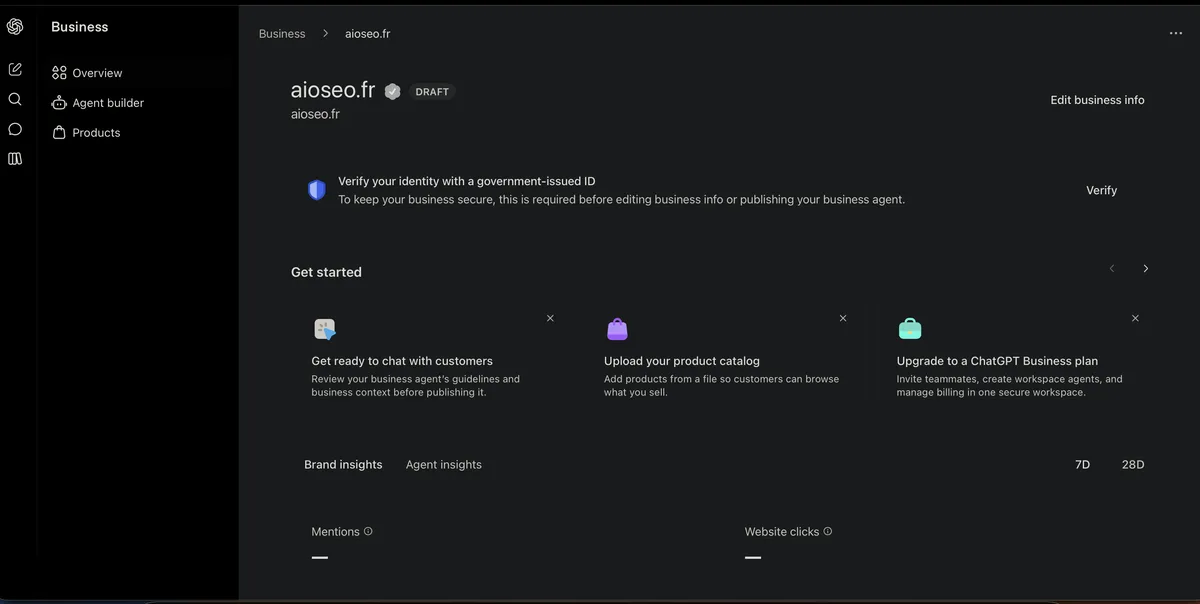
Step four, the dashboard. To edit profile details or publish an agent, ChatGPT requires identity verification with a government-issued ID. I find the request unusual for a simple profile, and I chose not to do it. So the wrong category stays: I will see what ChatGPT does with it. The menu shows Overview, Agent builder and Products. The Brand insights and Agent insights tabs are there, with only two tiles, Mentions and Website clicks, over 7 or 28 days. Both are empty on day one. There is no « Profile views » tile on my account, unlike OpenAI’s example visual.
My takeaways. Claiming works from France for a site without Shopify, and DNS verification is fast. But the category ChatGPT picked was wrong: if you do not fix it, that description may be what gets served. The limits of this test are clear: one site, one day, no mention or click data yet. I will update this section when the first numbers come in. I will also report whether an unverified, miscategorized profile still gets mentions.
My advice, if your business is eligible:
- Claim the profile, even without an agent. You get the only mention and click data coming from OpenAI itself.
- Check the auto-assigned category. The one for aioseo.fr was wrong. Also align name, description and contact details with your site and your Google profile.
- Know that editing the profile requires a government ID. I did not provide one for aioseo.fr: it is a choice to make knowingly.
- If you sell online, take care of the product feed (price, availability). OpenAI says it may be used to answer customer questions.
- Record your baseline as soon as the first numbers appear: mentions, clicks, discovery topics. The windows shown are short (7 or 28 days, per an advertising executive quoted by Relevant Audience), so export or note them regularly.
Search Console, Bing Webmaster Tools and ChatGPT: the three native AI consoles compared in November 2026
With Business Hub, the three big search players now each have their own AI visibility report. They do not measure the same thing.
| Console | Date | Surfaces covered | What is counted | What is missing |
|---|---|---|---|---|
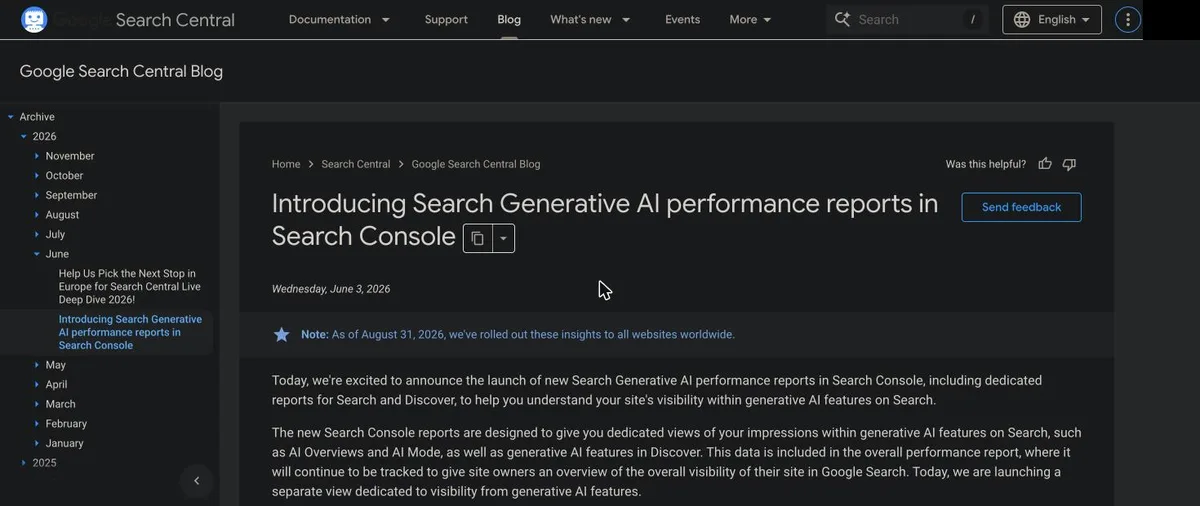
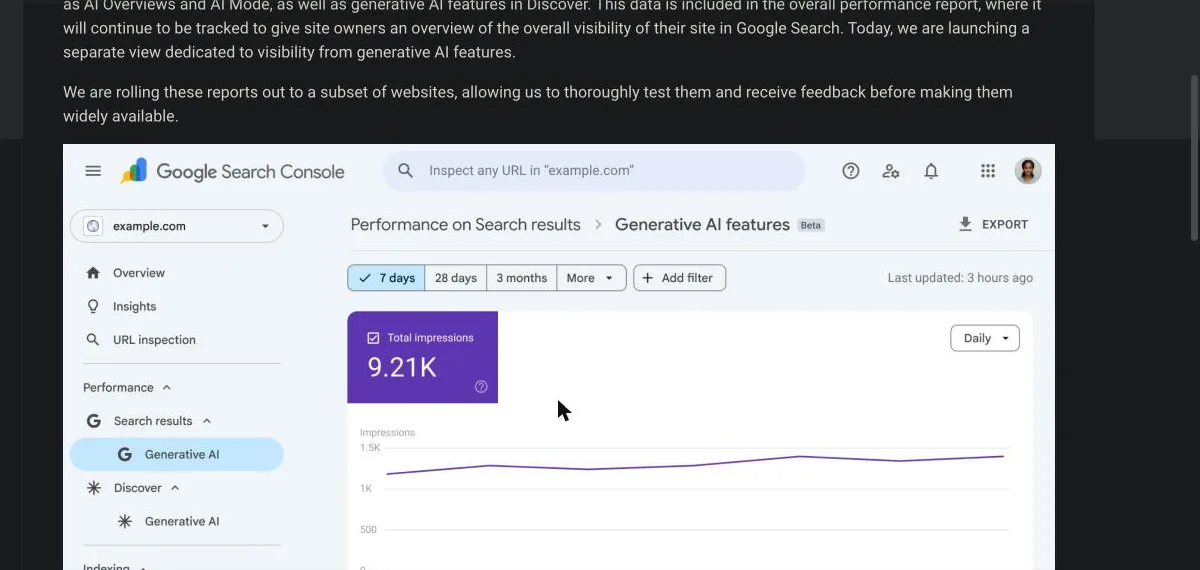
| Google Search Console, generative AI reports | Announced 3 June 2026, open to all sites on 31 August 2026 | AI Overviews and AI Mode in Search, plus a Discover report | Impressions by page, country, device, date | The announcement describes no clicks or position (PPC Land) |
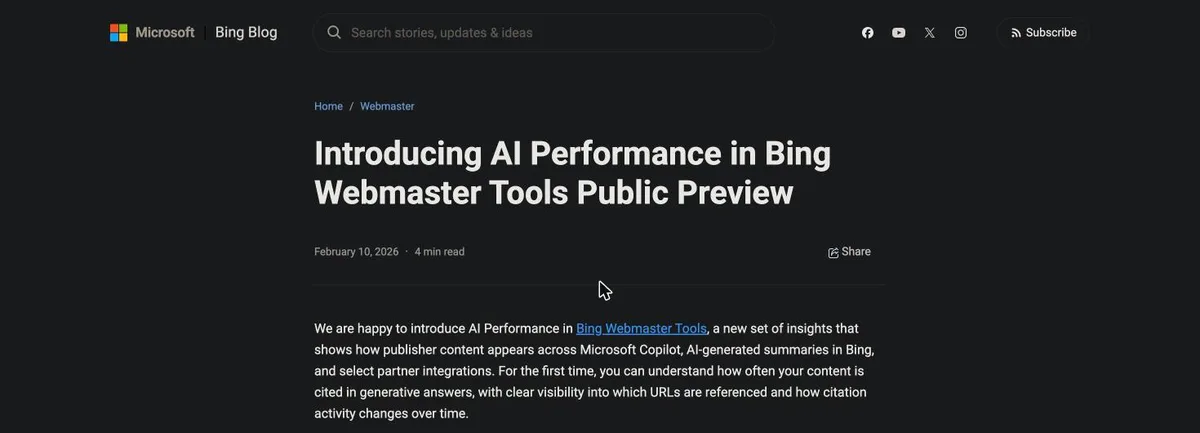
| Bing Webmaster Tools, AI Performance | Public preview 10 February 2026, expanded June 2026 | Microsoft Copilot, Bing AI summaries, select partners | Citations, cited pages, grounding queries, citation share per query | No views or clicks, no filter by channel (Practical Ecommerce) |
| ChatGPT, Business Hub | Beta 10 November 2026 | ChatGPT answers | Mentions, website clicks, discovery topics | No prompts, no competitors, no share of voice |
I covered how to read these two reports in my guide to the Search Console generative AI report and in my article on Bing Webmaster Tools AI Performance and Microsoft Clarity.
Third-party GEO tools vs native consoles from Google, Bing and ChatGPT: which ones will survive?
This is the real question behind the announcement. Google, Bing and now OpenAI give first-party numbers for free. Others will probably follow. As of 11 November 2026, I found no equivalent announcement from Perplexity, from Anthropic for Claude or from Google for the Gemini app. That is my hypothesis, not news.
What native consoles do better than third-party GEO tools
- The numbers are real. A third-party tool samples: it sends a list of prompts and reads the answers. The console counts actual appearances.
- ChatGPT shows clicks. No third-party tool sees outbound clicks from ChatGPT, except through your own analytics.
- It is free, at least for now.
What the native consoles from Google, Bing and ChatGPT do not do
- They do not show prompts. ChatGPT gives themes, Bing gives grounding queries (Bing’s rewrite, not the typed text), Google no dedicated AI query in its announcement.
- They do not show your competitors. Only Bing gives a citation share per query, without naming who takes the rest.
- Each console stays in its silo. Nobody gives you one view across ChatGPT, Gemini, Perplexity and AI Overviews.
- No sentiment, no position in the answer, no tracking of what is said about your brand.
- Volume thresholds. A small business or niche site may see nothing at all in Business Hub while volume is low. My own aioseo.fr dashboard was empty on day one.
My view on the future of third-party GEO tools
Tools whose only promise is to count your brand mentions in ChatGPT are the most exposed. Business Hub does the same with real numbers, for free. Juozas Kaziukėnas sees both as complementary (quoted by Digiday): third-party tools track prompts, OpenAI’s data shows whether the GEO strategy works. I agree, with one condition: the tool must bring what the consoles refuse to give.
The tools with a real future, in my view, do one of four things: compare several AI engines in a single view, show competitors and share of voice prompt by prompt, say what to fix on a page (not just report), and import native console data to cross it with their own measurements. The day Google, Bing or OpenAI open an API for these reports, the tools that plug into it will take the lead.
To choose today, I scored tools on a 14 point grid in my top 10 free and paid GEO tools. The criteria (engines covered, competitors, price, trial, API) are exactly the ones that matter against native consoles. If you are torn between two specific tools, here are my detailed comparisons:
- Profound vs Semrush AI Visibility Toolkit
- HubSpot AEO vs Profound vs Semrush
- GetMint vs Meteoria
- Profound vs Otterly vs Ahrefs Brand Radar
- ZipTie.dev vs Authoritas
- alternatives to GetMint for AI tracking
My practical advice: connect the three free consoles first (Search Console, Bing Webmaster Tools, Business Hub if you are eligible). Only then pay for a third-party tool for what they do not do, mainly the competitor and multi-engine view. My GEO tools comparison helps you sort them.
FAQ on Businesses in ChatGPT and OpenAI’s Business Hub
What is Businesses in ChatGPT?
It is the offer OpenAI launched in beta on 10 November 2026 for businesses. It combines Business Hub (business profile and stats) and Business Agents (a brand agent inside ChatGPT).
Can a business outside the US claim its ChatGPT profile?
Yes. I claimed aioseo.fr from France on 11 November 2026 with DNS verification and no Shopify store. Editing the profile then requires an identity check, and Business Agents remain US only according to OpenAI.
What stats does ChatGPT Business Hub provide?
The number of mentions in answers, clicks to the website and discovery topics, meaning the themes of conversations where the site is cited. Data is aggregated and only shows above a volume threshold.
Does claiming a profile improve visibility in ChatGPT?
No, according to OpenAI, claiming does not guarantee higher placement or sales. Clearer information may still help ChatGPT show the business in more relevant conversations.
Does Business Hub replace third-party GEO tools?
Not fully. It gives real mention and click numbers, but no prompts, no competitors, no share of voice and no view of Gemini, Perplexity or AI Overviews.
Why I closely follow the AI consoles of ChatGPT, Google and Bing
I am an independent SEO and GEO consultant. I am not paid by any GEO tool vendor mentioned here, nor by OpenAI, Google or Microsoft, and I do not work for any agency. I test these tools and consoles because clients ask me every week how to measure their visibility in AI. I read OpenAI’s announcement and the sources below on 11 November 2026. If you spot an error or something that changed, contact me through the ping-moi page: I will fix it and date the correction.
Sources on Businesses in ChatGPT and AI consoles (accessed 11/11/2026)
- OpenAI, « Introducing Businesses in ChatGPT », 10 November 2026.
- TechCrunch, Lucas Ropek, article on business profiles in ChatGPT, 10 November 2026.
- Unite.AI, article on Business Hub and Business Agents, 10 November 2026.
- PYMNTS, article on OpenAI’s new tools for businesses, 10 November 2026.
- Relevant Audience, article on Businesses in ChatGPT (verification, metrics, availability), 10 November 2026.
- Digiday, Krystal Scanlon, « ChatGPT is about to show brands their mention count », 9 November 2026.
- PPC Land, article on ChatGPT mention and click charts, 6 November 2026.
- Google Search Central Blog, « Introducing Search Generative AI performance reports in Search Console », 3 June 2026 (rollout note of 31 August 2026).
- PPC Land, article on Search Console generative AI reports, June 2026.
- Bing Blog, « Introducing AI Performance in Bing Webmaster Tools Public Preview », 10 February 2026.
- Practical Ecommerce, Ann Smarty, « Bing’s AI Performance Report Gets Better », 22 June 2026.
- My own test: claiming aioseo.fr in ChatGPT Business Hub, 11 November 2026 (screenshots above).
Published 11 November 2026. Last updated: 11 November 2026.
Leave a Reply
You must be logged in to post a comment.