July 4, 2026 · Aslane SAMAI
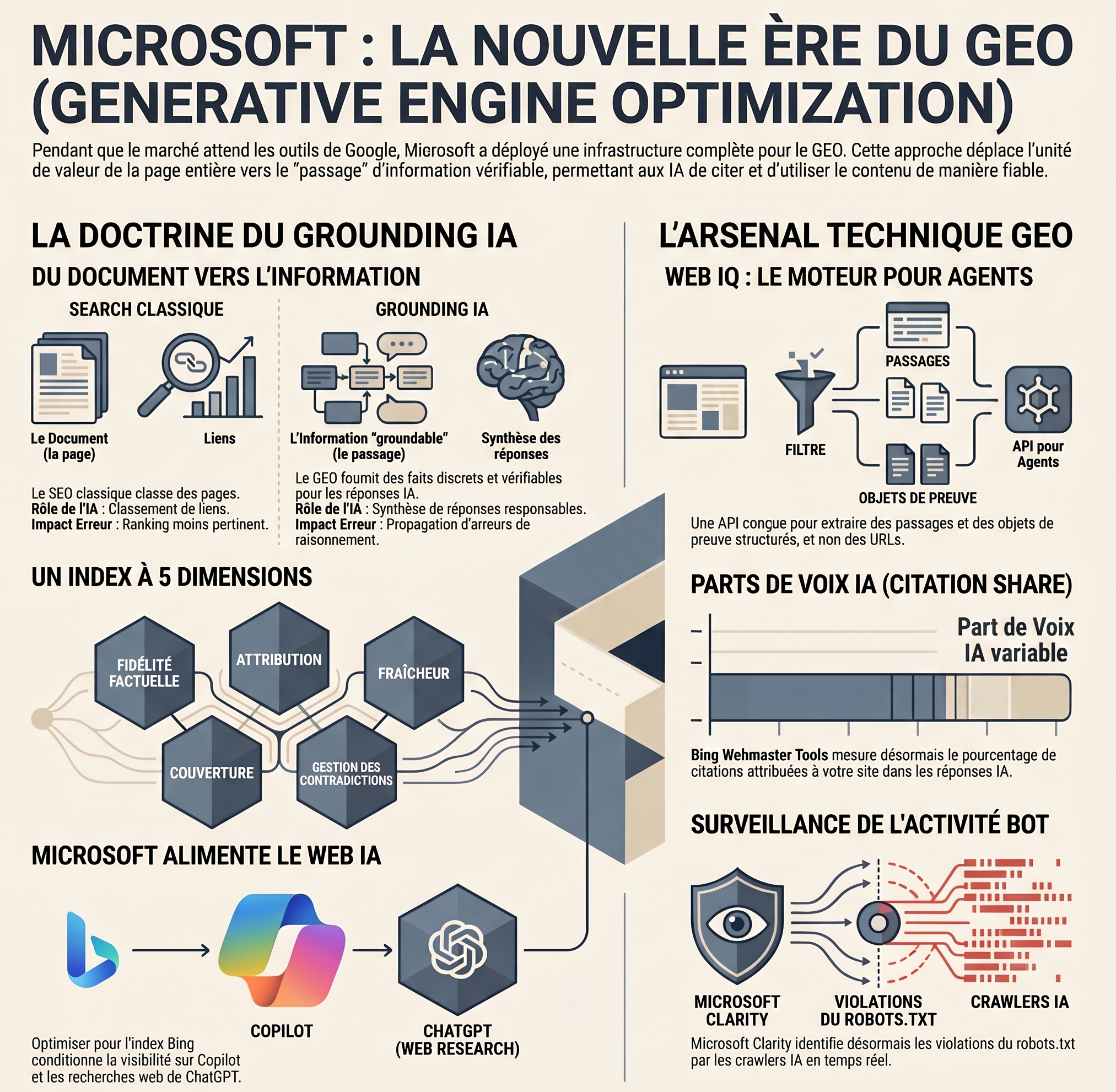
While everyone was waiting on the AI Overviews / AI Mode launch date and Google’s AI dashboard in Search Console, Microsoft has shipped, in under a year, the doctrine, the measurement tools and the infrastructure of GEO.
- Three foundational posts on grounding
- An AI Performance dashboard in Bing Webmaster Tools (extended in June with Intents, Topics, Citation Share and Compare)
- A full AI Visibility suite in Clarity (citations, bot analytics, and since June 23rd the detection of robots.txt violations by AI crawlers)
- Web IQ, a search engine designed for agents
- An actual definition of GEO from Microsoft’s own perspective.
The official GEO insights from Microsoft
- Bing grounding powers Copilot and ChatGPT’s web grounding. Optimizing for Bing is optimizing for both.
- The unit of value is no longer the page, it’s “groundable” information: discrete, verifiable facts with clear provenance. It’s spelled out in black and white in the May 6, 2026 post.
- Bing Webmaster Tools AI Performance was extended mid-June with four new capabilities: Intents, Topics, Citation Share and Compare. First-party AI share of voice finally exists.
- Clarity now detects the AI crawlers violating your robots.txt, with the percentage of non-compliant requests, the offending bots and the URLs they target.
- Web IQ (Build 2026) returns passages, not documents. The extractable passage is the new unit of optimization.
The doctrine that defines GEO on Microsoft’s side
Before the tools, you need the vision. Microsoft has published three texts that, taken together, form the most transparent documentation ever released by a search engine on how AI visibility actually works.
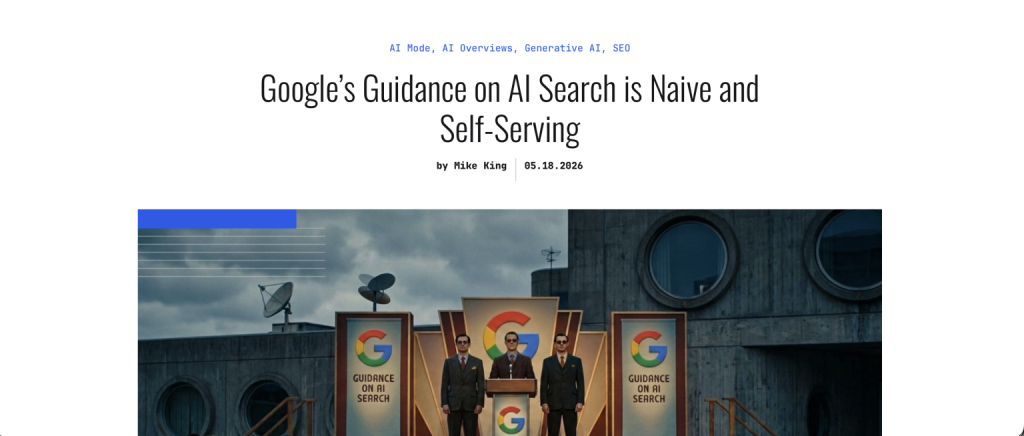
Google has nothing equivalent, and Mike King (iPullRank) proved it point by point on May 18. While Google keeps repeating “good SEO is good GEO” without documenting anything, Bing explains how its index is changing and hands you the data to measure it. And the ambition goes beyond webmastering: Microsoft Advertising presented in March its vision for an AI Performance Dashboard to track where a brand shows up across the AI web. GEO is being treated as a business line, not an SEO fad.
Elevating the Role of Grounding on the AI Web (February 2026)
Signed by Jordi Ribas (Corporate Vice President, Search & AI). The post clarifies the role of grounding: the system that connects models to fresh, authoritative information from the web (this is what RAG retrieval refers to). The invisible layer between a user’s question and the generated answer.
Two takeaways to remember:
- Microsoft grounding powers nearly every major AI assistant on the market. Copilot obviously, but also ChatGPT for its web-connected answers. In other words: your presence in Bing’s index conditions your visibility / mentionability / citability on at least two of the most heavily used AI assistants out there.
- Agents are now doing the browsing instead of humans, and they behave like retrievers: they gravitate toward structured, verifiable, directly usable content. Microsoft explicitly names the discipline that follows: Generative Engine Optimization. No ironic scare quotes, no “it’s just SEO”. The term is stated, owned, defined.
Evolving role of the index: from ranking pages to supporting answers (May 6, 2026)
The most important of the three posts if you’re a technical SEO. Signed by Krishna Madhavan, Knut Risvik and Meenaz Merchant (Microsoft AI). The thesis: search indexing was built to help humans decide what to read; grounding indexing is being built to help AI systems decide what to say.
Classic search asks: which pages should a user visit? Grounding asks: what information can an AI responsibly use to build an answer? Sounds close. Isn’t. Microsoft details why with a table I’ll summarize:
| Dimension | Classic search | AI grounding |
|---|---|---|
| Unit of value | The document (the page) | Groundable information (often a passage): discrete, supportable facts with clear provenance |
| User’s role | Scans, sorts, self-corrects | Sees a synthesized answer; verification runs through the cited sources |
| Error dynamics | A bad ranking can be recovered | Errors propagate and amplify across reasoning steps |
| Valid outcome | A ranked list | Answer if the evidence is sufficient, abstain otherwise |
The post then lists five dimensions the grounding index must measure differently from ranking:
- Factual fidelity: chunking and transformations have to preserve the meaning and claims of the original. A fact distorted by chunking becomes a confidently wrong AI answer. This validates, in passing, everything I wrote in my article on chunking as an SEO and GEO optimization technique: how your passages break down is not a detail.
- Source attribution quality: not every source carries the same evidentiary weight. The index has to understand that hierarchy. Machine-readable E-E-A-T, essentially.
- Freshness: in search, outdated content loses positions. In grounding, an outdated fact produces a wrong answer. Freshness moves from a ranking signal to a reliability condition.
- Coverage of high-value facts: not just “is the web indexed”, but “are the facts people actually ask about retrievable and groundable”.
- Contradiction detection: when two sources contradict each other, the index can’t simply rank one above the other. It has to record the conflict, otherwise the AI silently arbitrates and potentially states an error with total confidence.
Final point: retrieval becomes a system, not a step. A grounded answer can trigger follow-up queries, refine retrieval, combine evidence, re-evaluate when confidence is low. Your content is no longer retrieved once. It’s called on in loops, at different stages of the model’s reasoning.
Web IQ: a search engine for agents (June 2, 2026)
Announced on June 2 by Knut Risvik (Distinguished Engineer, Search & AI). Web IQ is an AI-native grounding API suite built on top of the Bing index, but re-architected from the ground up (indexing, retrieval, ranking, passage selection, orchestration) for agentic workloads. The official framing: “a search engine for AI systems”.
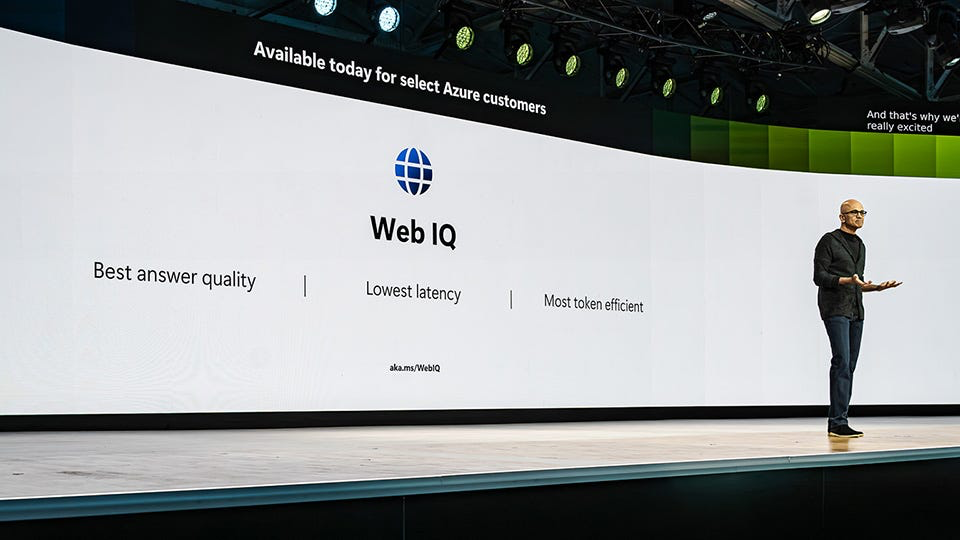
The specs that matter:
- Web IQ doesn’t return documents. It returns passages and “structured evidence objects”. Logic: models don’t need pages, they need information, and the document is often a poor proxy.
- P95 latency under 165 ms, announced as roughly 2.5x faster than the best alternative (vendor benchmarks, competitors anonymized A through G, take with the usual pinch of salt).
- A proprietary metric, GDSAT (grounding satisfaction), measured on 3,000 production queries.
- Under the hood: Microsoft’s in-house embedding model (open-sourced in April 2026) and a DiskANN-derived stack for large-scale nearest-neighbor search. Meaning you can literally inspect the semantic space in which your retrieval plays out.
- Web IQ inherits the Bing ecosystem’s rules: robots.txt, publisher preferences, content controls.
Why this is strategic: what Web IQ industrializes is exactly what the index post theorized. What ranks a page in search and what makes a passage useful for grounding don’t necessarily overlap. The GEO unit of optimization is the passage: standalone, factual, dated, attributable, extractable without loss of meaning. If your pages don’t produce good passages, they can rank and never be cited.
Access and interest at aka.ms/WebIQ. Full announcement: Announcing Microsoft Web IQ, plus the technical deep dive on Microsoft’s Command Line blog for the real geeks.
Bing Webmaster Tools AI Performance: the dashboard has grown up
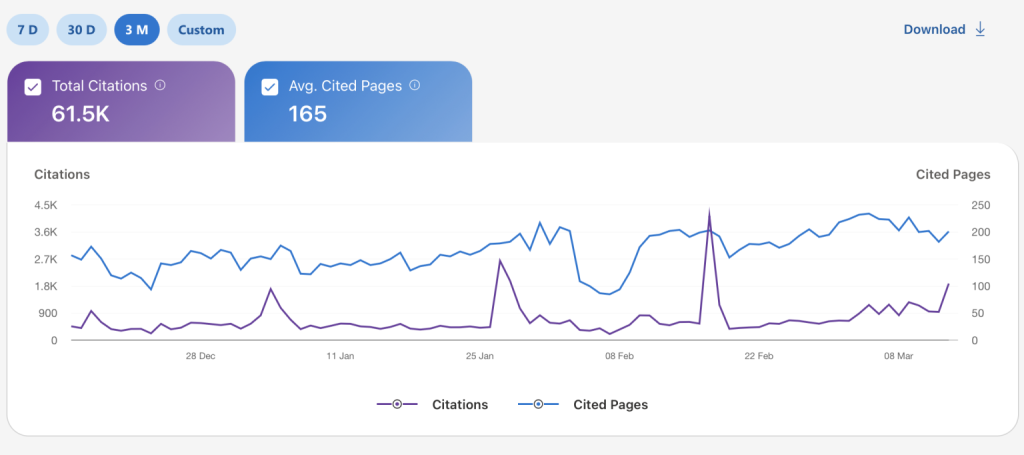
Quick recap (and what has changed since February)
I broke down the dashboard at launch in my guide Bing AI Performance: how to exploit the data to rank on ChatGPT, Copilot and other LLMs. For anyone joining late: launched in public preview early February 2026, it’s the first official report from a search engine showing where and how often your content is cited in AI answers (Copilot, Bing AI summaries, partner integrations). Original metrics: total citations, average cited pages, grounding queries (the queries the AI generates internally to retrieve content, not user prompts), citation activity by URL and trends over time.
Microsoft has iterated fast since:
- March 2026: Grounding Query – Pages Mapping, which lets you filter cited pages by grounding query (and vice versa) and export the whole thing.
- Late April 2026: Barry Schwartz spots on Search Engine Land the tests of Citation Share, grounding query intent classification and GEO-oriented recommendations.
- June 16, 2026: the big drop, four new capabilities in global preview.
The 4 June additions to Bing Webmaster Tools AI Performance: Intents, Topics, Citation Share, Compare
Announced on the Bing blog in New AI Visibility Insights in Bing Webmaster Tools. The details:
- Intents. Grounding queries are now classified by intent: Informational, Commercial, Navigational, Learn and Solve, Research, Creation, Local, and more. The point isn’t cosmetic: you finally know what kind of AI experience your content is showing up in. An e-commerce operator discovering that 80% of their citations sit on Research intents and 5% on Commercial has a product structuring problem, not a brand awareness problem. This is the reading layer that raw grounding queries were missing.
- Topics. Grounding queries are clustered into thematic groups. Microsoft’s reasoning is explicit: AI systems reason in concepts and themes, not isolated keywords. “Solar panels”, “solar yield” and “residential solar installation” all bubble up into the same Solar Energy topic. Practical use: identify your emerging authority zones, spot thematic coverage gaps, and check that the machine’s clustering matches your own topical map. If you followed my multimodal GEO audit with Gemini Embedding, you see the convergence: everyone is working in semantic similarity now, including Bing for its own reports.
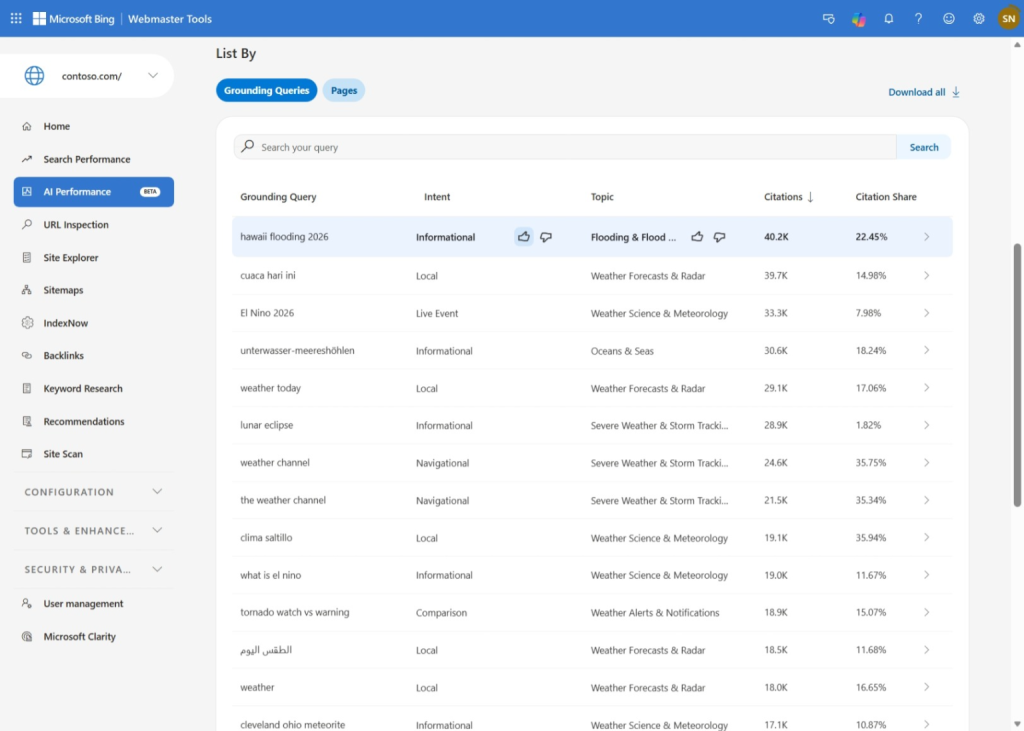
- Citation Share. The metric everyone was waiting for: for a given grounding query, the percentage of citations attributed to your site out of all citations shown, across all sites. Microsoft insists heavily that this is an “observational” metric, not a competitive scoreboard. Call it what it is: this is first-party AI share of voice, the first of its kind on the market. Until now, LLM share of voice was estimated by third-party tools scraping synthetic prompts, with all the biases I documented in are AI tracking tools fooling us?. Now the data comes from the retrieval infrastructure itself.
- Compare. Period-over-period comparison across all AI Performance metrics. Basic, essential, finally here.
Microsoft Clarity for GEO and AI visibility
While Bing Webmaster Tools covers citation, Clarity has built the other half of the puzzle: crawl upstream, behavior downstream. All free. The Clarity AI Visibility suite is now three dashboards.
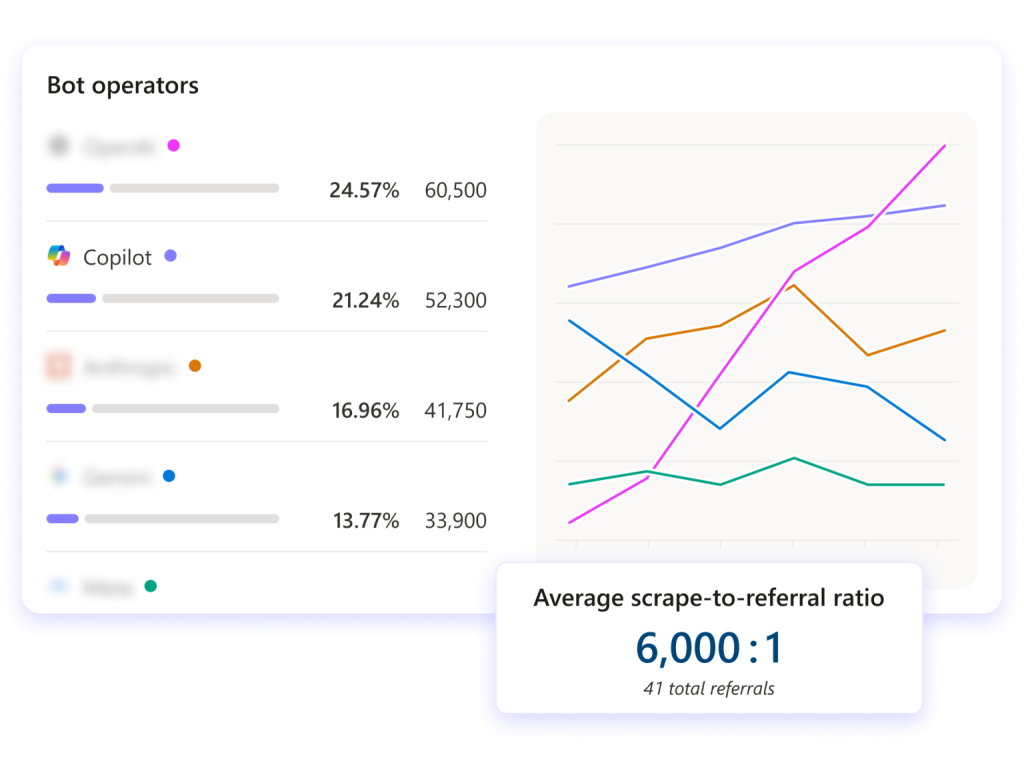
Citations: the May GA, and Share of Authority
Launched in preview on February 17, the Citations dashboard hit general availability on May 13, 2026 (Clarity announcement). Six metrics:
- Page citations: total number of references of your pages in AI answers (including multiple citations within the same answer).
- Share of Authority: your citations divided by the total citations of all domains cited on the same queries, computed daily. A competitive benchmark without having to declare competitors. Real limitation: you see your share, not the named breakdown of the domains capturing the rest.
- AI Referral Traffic: sessions actually coming from AI platforms (Clarity’s AIPlatform channel identifies ChatGPT, Claude, Gemini, Copilot, Perplexity).
- Grounding queries: same objects as in Bing Webmaster Tools, with volume, frequency and citation rate.
- My cited pages: page-by-page view with counters and associated queries.
- Trendlines: temporal evolution of everything above.
What makes Clarity a bit more interesting than the Bing Webmaster Tools dashboard is that the drill-down is finer (pages, individual queries, trendlines per entity), and above all you’re inside a behavioral tool. Isolate the AIPlatform segment and you can apply heatmaps, session recordings and scroll depth to just the visitors coming from an AI answer. Citations up but AI Referral Traffic flat? Your content builds the answers but isn’t making people want to click. That’s a diagnostic you can’t make anywhere else.
Three public datasets illustrate the scale and nature of what’s happening. OtterlyAI documented, on three months of its own domain data, 647 unique grounding queries generating over 30,000 grounding events across 173 pages (their analysis).
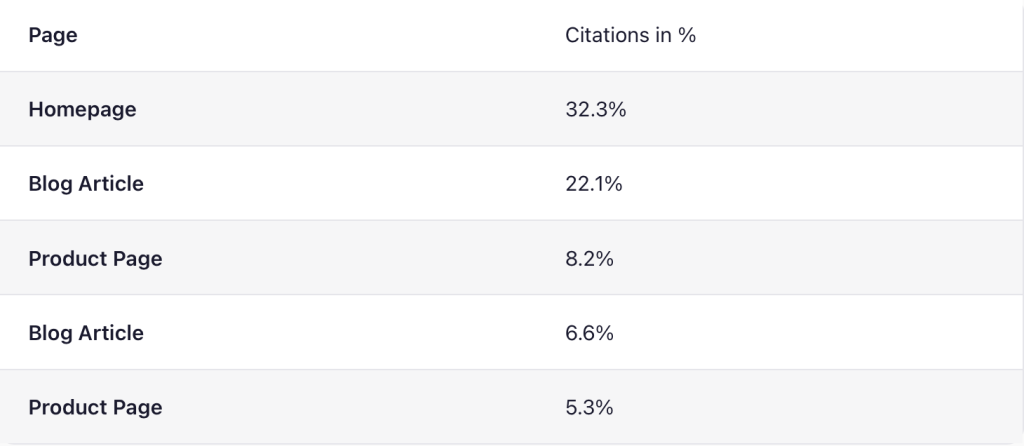
A Search Engine Journal test on a multilingual site shows 36,000 Copilot citations across 147 grounding queries, of which 141 rank in Bing and zero in Google (SEJ). And a SALT.agency analysis cross-referencing Clarity grounding queries with Ahrefs keyword data found only 2% exact matches, and 80.5% of grounding queries with no Ahrefs ranking data at all.
In other words: the vocabulary of AI retrieval is not the vocabulary of your SEO keywords, and no classic keyword tool tracks it.
Bot Analytics: see the AI bot / crawler activity on your site
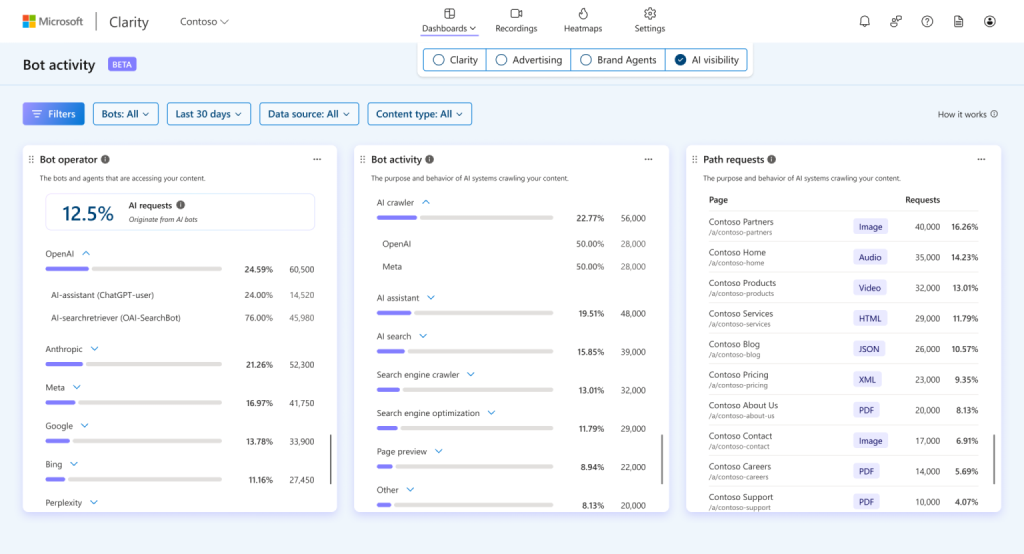
The June update enriched the metrics (details): total AI bot request volume, share of overall traffic coming from AI bots, percentage of site pages crawled, request statuses and trend analysis. Enough to answer operational questions: is this bot traffic productive or just expensive, what share of my infrastructure is serving machines, and is it accelerating?
Microsoft Clarity now surfaces robots.txt violations, finally measurable
This is THE feature that was missing, announced by Ihab Rizk on the Clarity blog (Clarity Now Surfaces Robots.txt Violations in Bot Analytics). Every bot request captured in the logs is checked against your robots.txt directives. Hits on disallowed paths are counted, aggregated, and surfaced.
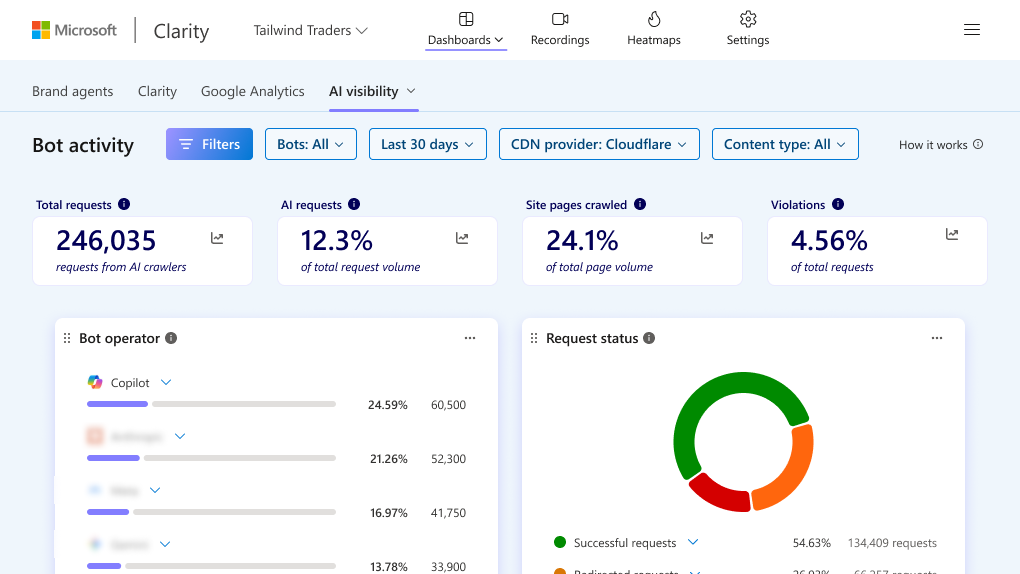
The new AI features in Microsoft Clarity
- A Violations card: violations as a percentage of total bot requests. In Microsoft’s illustration data, 4.56% violations on around 246,000 requests, so more than 11,000 non-compliant requests over the measured window (numbers relayed by PPC Land).
- A trendline on violations to spot spikes (a new aggressive crawler, or a change in behavior from an existing operator).
- Filters by operator, by bot and by activity type, with a side-by-side view of compliant vs non-compliant bots.
- The URLs and paths targeted: you can see whether the violations hit high-value content, restricted resources, or sections that were supposed to stay off-limits.
Why does this feature matter? robots.txt is a voluntary protocol with zero enforcement mechanism. And the field confirms the limits of volunteering. Kinsta, in an analysis of 10 billion requests, spotted AI bots hammering WooCommerce cart pages up to 3.75 million times in a single day. DataDome documented Grok’s agent generating 16 requests from 12 IP addresses using falsified user agents to fetch a single page. User-agent spoofing remains the blind spot of any detection system that relies on declaration.
Let’s be clear on what the feature isn’t: Clarity observes, it doesn’t block. The tech community was quick to mock observability without mitigation. Fair, and Microsoft owns it: remediation goes through your WAF (Cloudflare among others) or your CDN rules. But the measurement has three very real use cases: making a targeted blocking decision with data instead of gut feel, building a quantified case for a content licensing negotiation with an AI operator (volume consumed, high-value URLs used), and monitoring whether your existing rules are actually being respected over time.
One caveat worth noting: logs travel through your CDN’s pipelines (LogPush and equivalents), and any log delivery costs are billed to you, not to Microsoft.
Recommendation Poisoning: the piece Microsoft had already dropped in
Let’s fit another news item into the puzzle. Back in March I wrote about Recommendation Poisoning, the blackhat GEO tactic confirmed by Microsoft. As a reminder, Microsoft’s own research validated the effectiveness of the mechanism behind “Summarize with AI” buttons: the conversational context injected into the query significantly influences the assistants’ answers and recommendations.
Reread through the grounding doctrine, that paper takes on a different dimension. If assistants are that sensitive to context injected at retrieval time, then the battle isn’t just about citation Share of Voice. It’s about what I’ve been calling Share of Memory: what the model carries in its context at the moment it answers.
And now that citations are measurable in first-party (Bing Webmaster Tools and Clarity), the impact of these manipulations becomes measurable too. Expect the Trust & Safety teams of the engines to take a very close look: a mechanism confirmed as effective plus public metrics to verify the ROI is the recipe for a wave of GEO spam followed by a wave of penalties.
Microsoft’s official GEO recommendations, condensed
These aren’t de facto guidelines anymore. In late February 2026, two weeks after AI Performance launched, Microsoft rewrote the Bing Webmaster Guidelines, and the new version explicitly covers Bing search, Copilot and grounding API results. Barry Schwartz spotted the change (Search Engine Roundtable), Search Engine Journal ran the full diff. The points that move the needle:
- GEO enters a search engine’s official policy. The guidelines define it as content eligibility for grounding and reference in AI answers, with the same caution applied to SEO: GEO doesn’t guarantee citation, just like SEO doesn’t guarantee ranking. And the sanction is named: not following the rules can reduce your eligibility for grounding experiences, not just your search visibility.
- Meta directives for AI are finally documented. NOARCHIVE blocks the use of your content in Copilot answers and grounding results. NOCACHE is discouraged if you want rich citations. data-nosnippet (supported since October 2025) gives section-level control, and data-snippet lets you specify the text Bing can display or cite. You now have a granular control panel over your AI exposure, directive by directive. Google has never published anything as precise for AI Overviews and AI Mode.
- The grounding selection criteria are spelled out in black and white: facts stated directly rather than implied (AI needs to be able to verify them), clear and consistent entity names, one intent per URL (single-topic pages are more often selected as sources), and essential information at the top of the page.
- The KPI officially changes. The guidelines acknowledge that a drop in clicks doesn’t mean a drop in visibility, since content can appear as a citation or grounding reference. Microsoft recommends tracking impressions and citation eligibility rather than clicks alone. This is a search engine telling you to change your dashboards.
On top of that, the series of Bing Webmaster Blog posts signed by Fabrice Canel and Krishna Madhavan. Actionable takeaways:
- Schema.org is not optional. Fabrice Canel confirmed as early as March 2025 that Microsoft uses schema markup to help its LLMs learn and understand content (relayed by Barry Schwartz, Search Engine Land). Article, FAQPage, HowTo, Product: that’s grounding fuel.
- IndexNow + sitemaps with reliable lastmod. The July 2025 post hammers it home: freshness is a reliability condition for grounding (see the index post), so the speed at which your updates propagate becomes a citability factor. IndexNow pushes, sitemaps structure.
- Duplicate content dilutes your grounding. The December 2025 post is explicit: no penalty, but a dilution of authority and confusion of intent that reduce your chances of being THE page selected as a source. One intent = one canonical URL that concentrates the signals.
- Answer-first and extractability. The guidance runs through every Microsoft document, from the rewritten guidelines to the index post: open every piece of content with a direct, compact answer, phrase Hn tags as real questions, state facts explicitly with dates and numbers, put the essentials at the top of the page. The self-contained passage is what retrieval extracts. If your key fact is scattered across three paragraphs, it doesn’t survive chunking.
- Control without sacrifice. Important point for publishers: the directives above (noarchive, data-nosnippet) let you pull your content out of AI answers without impacting your ranking or your search visibility. That’s leverage for content licensing negotiation, not just technical hygiene.
- Measure influence, not just clicks. The November 2025 post on conversions formalizes that the journey is now distributed: summaries, comparisons, then a high-intent click. Fewer clicks, but higher quality.
All of this converges with what I keep updating in my GEO and LLM / AI 2026 Checklist, which I refresh as announcements land.
6. My exploitation workflow (Bing Webmaster Tools + Clarity)
Here’s how I actually combine these bricks on the sites I run, in order:
- Export the grounding queries from Bing Webmaster Tools (AI Performance) and cross-reference with GSC queries. Grounding queries are machine queries, reformulated, often long-tail: the vocabulary rarely overlaps with your SEO keywords. The gaps are the signal. A page that ranks in Bing on a topic but appears on no grounding query is not structured for retrieval.
- Read by Intents: I prioritize Commercial and Learn and Solve grounding queries, which carry business intent, and I check that my transactional pages actually appear on them. If all my volume is Informational, the problem is in the way the offer is structured (Product/Offer schema, comparisons, readable pricing).
- Topics vs topical map: I confront Bing’s Topics clusters with my own thematic map. Topics I’m cited on with no dedicated hub = consolidation opportunities. Hubs with no citations = content to restructure into extractable passages.
- Citation Share and Share of Authority as KPIs: Citation Share (Bing) on strategic grounding queries, Share of Authority (Clarity) in aggregate. Citation volume going up while share stagnates means the market is growing faster than you.
- Selection vs discoverability diagnostic: lots of grounding events on a page but few visible citations = you enter the retrieval pool but lose the final arbitration. That’s an authority and passage-structure problem, not a crawl one. The opposite (no grounding at all) = a discoverability problem: indexing, freshness, IndexNow.
- Bot Analytics as monthly hygiene: share of AI bot traffic, pages crawled, and since late June the robots.txt violation rate with the list of offending operators and the paths they target. That’s the data feeding your WAF rules and, where relevant, your licensing conversations.
7. The limits of Microsoft’s GEO tools
Because an article that doesn’t list its limits is a press release:
- Sampled data. Microsoft owns it in its AI Performance FAQ: the data is a representative sample, not an exhaustive log. Totals can differ between views (pages vs grounding queries vs timeline), and sampling windows vary slightly. Don’t build client reporting at the citation level.
- No clicks in AI Performance. You measure citation frequency, not generated traffic or answer prominence. Microsoft says they want to keep enriching the metrics, but as of today, no first-party AI CTR. For referred traffic, it’s Clarity (AI Referral Traffic) or your own analytics segments.
- Microsoft ecosystem only. Copilot, Bing AI summaries, partners (including ChatGPT via Bing’s web grounding). Nothing on Gemini, AI Overviews, Perplexity or Claude. For the rest, you’re back to third-party tools, with the caveats already noted.
- Bot Analytics requires a connected CDN, and log delivery costs (LogPush and equivalents) are billed by your CDN.
- Everything is in preview or under rapid iteration. Methodologies move, metrics may be recalculated. Trust the trends, not the absolute values.
Bing has become the GEO lab
Step back and look at the sequence: February, the doctrine and the first dashboard. March, the query-to-page mapping. May, the theory of the groundable index and the Citations GA in Clarity. June, Web IQ, four new reporting capabilities and crawl violation detection. Five months. Meanwhile, Search Console still has no dedicated AI Overviews / AI Mode report: the data is drowned inside overall performance, at a single shared position.
The practical consequence is simple: even if 90% of your traffic comes from Google, your only first-party instrumented GEO testing ground today is the Microsoft ecosystem. Grounding queries teach you how an AI translates intent into retrieval. Citation Share tells you if your content wins the arbitration. Robots.txt violations tell you who’s consuming your content without permission. These mechanisms are largely the same at the other players; only the data is missing elsewhere.
And the trajectory is consistent with what’s happening on Google’s side: agentic everywhere, as I laid out in my Search Central Live Paris 2026 recap, and shared standards like WebMCP, co-carried by Google and Microsoft at the W3C. Both giants are building the same agentic web. Only one of them gives you the instruments to measure it. Use them.
FAQ
Bing Webmaster Tools AI Performance or Clarity Citations: which should I use? Both, they don’t measure at the same place. AI Performance is engine-side (citations, grounding queries, intents, citation share by query). Clarity adds the aggregate Share of Authority, AI referral traffic and, above all, the bridge to behavior (recordings and heatmaps on the AIPlatform segment). My take: BWT for retrieval analysis, Clarity for business diagnostics.
Does this data cover ChatGPT? Partially. ChatGPT’s web grounding relies on Bing infrastructure, so part of its retrieval activity flows through these reports (via the “partner integrations”). You can’t isolate ChatGPT from Copilot in the numbers, but optimizing for Bing grounding mechanically optimizes for ChatGPT’s web answers.
Do I have to connect a CDN? Only for Bot Analytics (and therefore robots.txt violation detection), which relies on server logs. Citations and AI Performance work without: Clarity tag + domain verification for the former, verified Bing Webmaster Tools account for the latter.
My audience is 100% Google, what’s in it for me? Learning for free how retrieval systems translate intent and select sources, on real data instead of the synthetic prompts sold by third-party tools. The structural patterns that win a Copilot citation (direct answer, standalone passages, dated and sourced facts, clean schema) are the same ones that will matter when AI Mode is finally instrumented.
Aslane SAMAI, SEO / GEO consultant.
Leave a Reply
You must be logged in to post a comment.