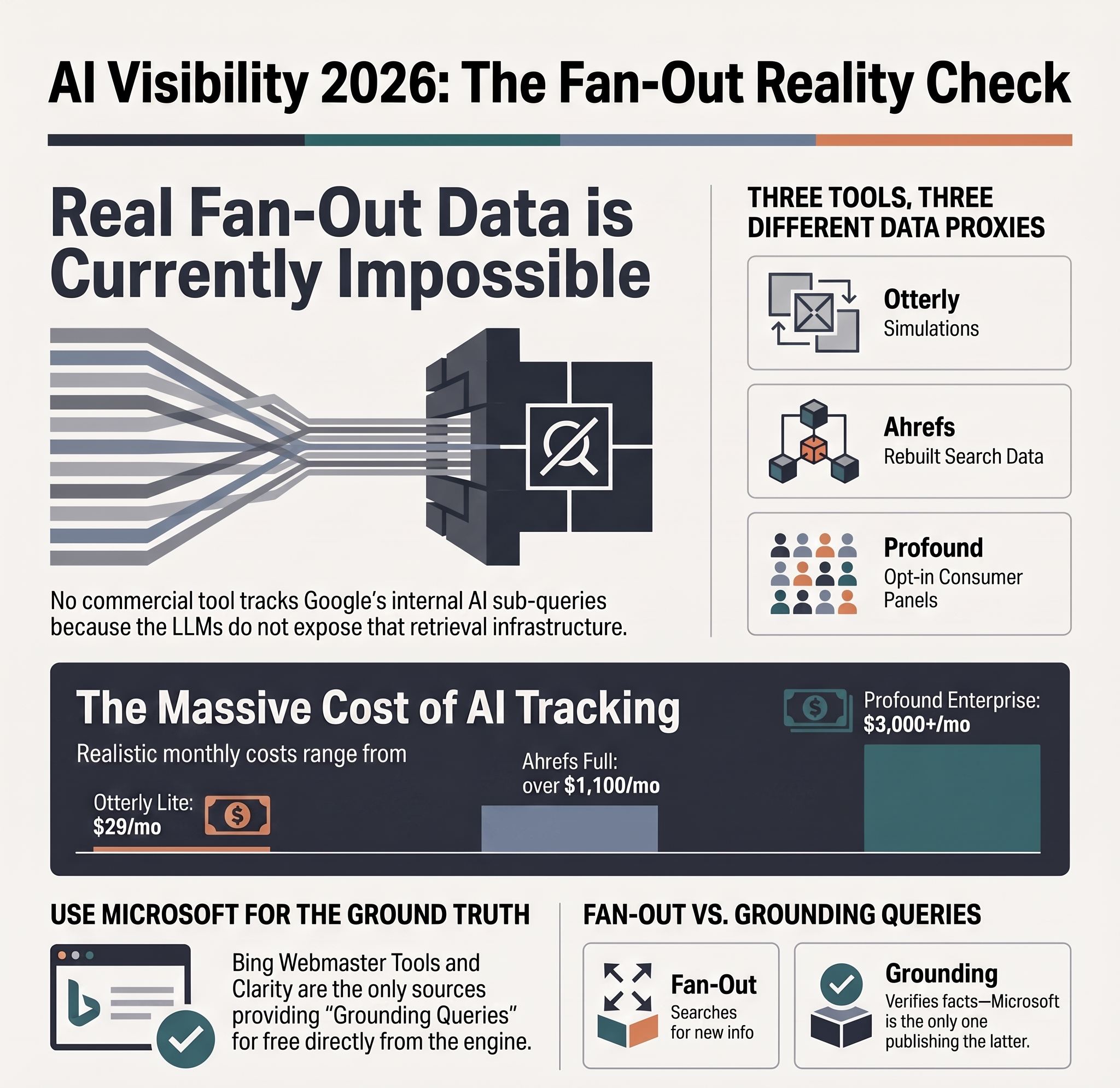
Profound vs Otterly vs Ahrefs Brand Radar: None of these three tools track your real fan-out queries. This is not a product defect, it’s an impossibility: Google and the other LLMs do not expose them (easily).
This comparison is part of our GEO tools series: see the top 10 GEO tools (free and paid) and the guide to choosing a GEO tool.
Comparative table Profound vs Otterly vs Ahrefs Brand Radar : Comparative Query Fan-Out 2026
| Criterion | Otterly | Ahrefs Brand Radar | Profound |
|---|---|---|---|
| nature of the fan-out data | Simulation (declared by the editor) | Prompts rebuilt from Google search behavior | Opt-in panel of real user prompts |
| Is it real fan-out? | No | No | No (it’s upstream demand) |
| Free fan-out tool | Yes | No | No |
| Prompt base | Not disclosed | 409 M+ “Search-Backed” | ~400M panel prompts |
| Engines (base tier) | ChatGPT, AI Overviews, Perplexity, Copilot | AI Overviews, AI Mode, ChatGPT, Perplexity, Gemini, Copilot | 1 only (ChatGPT) on the entry tier |
| Gemini / AI Mode | Paid add-ons | Included | Enterprise |
| Claude | No | No | Enterprise |
| Long history | Low | Strong (differentiator) | Depends on plan |
| AI crawler analysis | Free simulation | No | Yes, via CDN logs |
| Unrelated mentions | No | Yes | No |
| Entry price | ~$25 to $29/month | $129 + $199 = $328 / month minimum | ~$99/month (1 engine) |
| Realistic cost | $189 to $489/month | $828 to $1,148/month | $399/month, or $3,000+ for Prompt Volumes |
| Free trial | 14 days, without credit card | No | Not publicly verified |
| Pricing transparency | High | Medium (stacking of add-ons) | Low (required demo) |
What you actually buy:
- Otterly sells a simulator. Its Query Fan Out tool is free and says it itself: it simulates how Google AI Mode or an AI Overview would break down a query. It’s an excellent ideation tool. It’s not measurement.
- Ahrefs Brand Radar sells prompts rebuilt from Google search behavior: more than 409 million prompts ‘search-backed’, derived from its keyword database and people also ask. It’s real data. It’s not AI data.
- Profound sells the actual AI demand via Prompt Volumes: a panel of opt-in consumers, around 400 million prompt users. It’s what comes closest to the truth. It’s reserved for the Enterprise offer, by quote.
And the data that these three tools cannot sell you, because it can’t be bought: the actual grounding queries, Exposed for free by Microsoft in Bing Webmaster Tools and in Clarity. They are neither scraped nor estimated. They come out of the retrieval infrastructure.
Otterly: Free Query Fan Out Simulator + Affordable Tracker
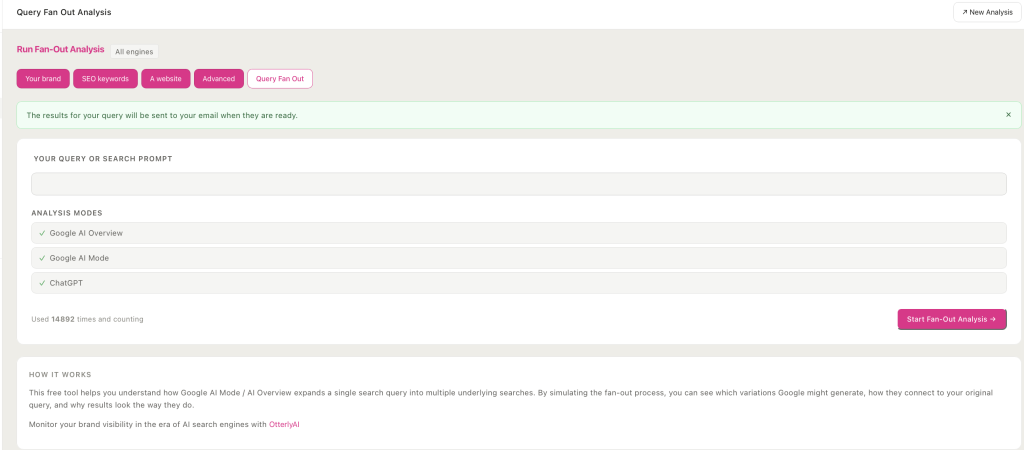
Otterly describes its own tool as a simulation. Its page states that it helps you understand how Google AI Mode or AI Overview breaks down a query, by simulating the fan-out process.
You know what you get: plausible variations, generated by a model, for editorial ideation work. Not a measurement.
Use it as a subtopics generator to build your H2 and your response blocks. Never use as a performance measure.
Otterly’s free tools suite is also the best free entry point on the market: Query Fan Out, AI Keyword Research, GEO Content Check, AI Crawler Simulation, entity verification, AI referral traffic, and industry benchmarks.
Otterly’s paid tracker
| Plan | Price | Prompts |
|---|---|---|
| Lite | ~25 to $29/month | 15 |
| Standard | ~$189/month | 100 (150 in agency offer) |
| Premium | up to ~$489/month | 400 (500 in agency offer) |
| Enterprise | By quote | Custom |
14-day free trial, without credit card. About 15% annual discount.
Otterly’s pricing
Google AI Mode and Gemini are paid add-ons on all plans. The base covers ChatGPT, Google AI Overviews, Perplexity and Copilot. If AI Mode matters to you, and in 2026 it should, your real price is not the price displayed.
Metrics: Brand Visibility Index, Domain Ranking, Link Citation Analysis, Net Sentiment Score from -100 to +100, Competitive Benchmark. Looker Studio connector from the Standard plan, unlimited workspaces for agencies.
Ahrefs Brand Radar: Query Fan-Out Tracking
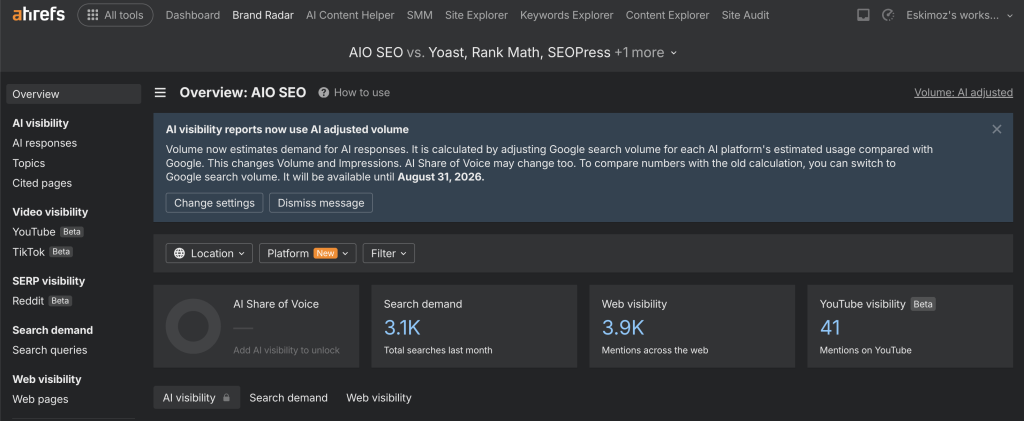
Brand Radar is Ahrefs’ AI visibility module. It tracks six engines: Google AI Overviews, Google AI Mode, ChatGPT, Perplexity, Gemini and Microsoft Copilot.
Claude is absent…
Its official page boasts over 409 million organic prompts, plus custom prompt tracking.
How Ahrefs Brand Radar Works
Ahrefs insists on one point: its prompts are “search-backed, not synthetic”. They are derived from its keyword base and People Also Ask, so questions that real people actually type.
We don’t prompt as we do classical search.
On Google, we type “best CRM small business”. In ChatGPT, we write “I manage an agency of 10 people, I drown in customer reminders, what CRM should I use”. They are not the same queries, they do not trigger the same sources, and a base built on Google behavior cannot capture the second.
The distribution of the base shows it: AI Overviews weigh around 95 million prompts per month and AI Mode about 50 million, while ChatGPT, Copilot, Gemini and Perplexity each contribute around 13.5 million. Brand Radar is a Google tool with an AI layer, not an AI tool.
Add to that the collection method: scheduled snapshots of a prompt library, not continuous monitoring. But the same query produces different responses from one hour to the next. A snapshot is one possible version of reality, not reality itself.
The Real Strengths of Ahrefs Brand Radar
We have to be fair, because two of these don’t exist anywhere else.
- History. Most dedicated GEO tools retain almost nothing. Brand Radar retains a lot, which makes it possible to show an progress over several months to a leadership committee. It’s a real differentiator.
- Cross-referencing with Ahrefs’ web data. Seeing your AI citations alongside your link profile and unlinked mentions allows correlations that an isolated tool can’t provide. Ahrefs’ research from December 2025, covering millions of AI responses and 75,000 brands, also establishes a correlation of 0.664 between branded web mentions and visibility in AI Overviews.
- The unrelated mention crawler, on content news, blogs and forums, with deduplication. It’s genuine digital PR value.
The Actual Cost of Ahrefs Brand Radar
| Element | Price |
|---|---|
| Basic Ahrefs Plan | From $129/month (Lite), $249 (Standard) |
| Brand Radar AI Index | $199/month per index |
| Bundle All AI Engines | $699 / month |
| Custom prompt tracking | From $50/month for 2,500 prompts |
| YouTube / TikTok / Reddit module | $199/month after beta |
| Full Realistic Setup | $828 to $1,148/month |
Ceiling to know: 2,500 prompt checks per month by default, where a check equals a prompt multiplied by an LLM multiplied by a location. Follow 10 prompts on six engines and three countries daily, and you’re exhausting the quota in less than two weeks.
My opinion on the documented precision discrepancies on Ahrefs Brand Radar
Several tests are circulating, reporting massive discrepancies between the ChatGPT mentions reported by Brand Radar and actual hand-counted mentions. These tests are published by direct competitors of Ahrefs. I don’t present them as established facts.
What I take away, and what I invite you to check for yourself: the snapshot method of a prompt database cannot, by design, produce an exhaustive count. This isn’t dishonest, it’s the nature of the instrument. Treat Brand Radar as a trend and share-of-voice indicator, never as a counter.
Profound: Query Fan-Out Tracking
Covered in detail in Profound vs Semrush AI Visibility Toolkit. The essentials for this comparison:
- Prompt Volumes is the only dataset in this market that is neither scraped, nor synthetic, nor derived from a Google keyword database. It’s an opt-in consumer panel, and the Conversation Explorer draws on around 400 million real user prompts, with regional and demographic breakdowns.
- It’s the data closest to the truth available commercially. Three caveats, in order of importance.
- It’s reserved for Enterprise. At $99, you have ChatGPT alone and no prompt volumes. At $399, three engines and still no prompt volumes. You can’t buy Profound for Prompt Volumes without going through a quote, which the market pays from $3,000 per month.
- It’s not fan-out. Prompt volumes measures what users type, not what the model then generates internally. It’s the demand, upstream of the fan-out.
- The volume of prompts is noisier than a Google search volume. Engines reformulate, conversation turns inflate the counts, and a panel doesn’t extrapolate like an entire population. Directional.
In return, Agent Analytics is a real technical brick: connection to your CDN (Cloudflare, Akamai, Fastly, AWS CloudFront, Google Cloud CDN, Netlify, WordPress), server log reading, identification of AI bots which visit which pages, with detection of falsified user agents.
What these three tools will never sell you
None of the three has access to the retrieval infrastructure. They observe it from the outside, with a scraper, a panel, or a keyword database.
A single entity exposes its actual retrieval requests, and it does so for free: Microsoft.
- Bing Webmaster Tools, AI Performance Report: your grounding queries, your pages quoted, and since June 2026 the intents, the topics, the quote share and the comparison of periods.
- Microsoft Clarity: the Share of Authority, AI referral traffic, and the ability to apply heatmaps and session recordings to just the segment of visitors from an AI response.
These are not estimates. It’s data straight from the engine.
“My audience is 90% on Google.” Bing grounding feeds Copilot and part of ChatGPT’s web grounding. You are therefore already measuring a real part of your exposure. And above all, you learn for free how a retrieval system translates an intention into queries, on real data rather than on synthetic prompts. The structural patterns that win a Copilot citation are the ones that will count when Google finally implements AI Mode.
.”The data is sampled.” Yes, Microsoft acknowledges this, and there was a backfill incident on June 1, 2026 that inflated the curves. Treat trends, not absolute values. This remains infinitely closer to the truth than a simulated prompt.
The right architecture is therefore not “which tool to buy,” it’s a stack:
- Free base and first party: Bing Webmaster Tools and Clarity. Your real grounding queries.
- Paid Google Layer: Ahrefs Brand Radar if the budget follows, if not Otterly, to cover surfaces that Microsoft will never see.
- Demand layer: Profound Enterprise, if and only if your GEO budget exceeds a few thousand euros per month.
- Ideation: Otterly’s free query fan out, to build your editorial plans.
What is the query fan-out?
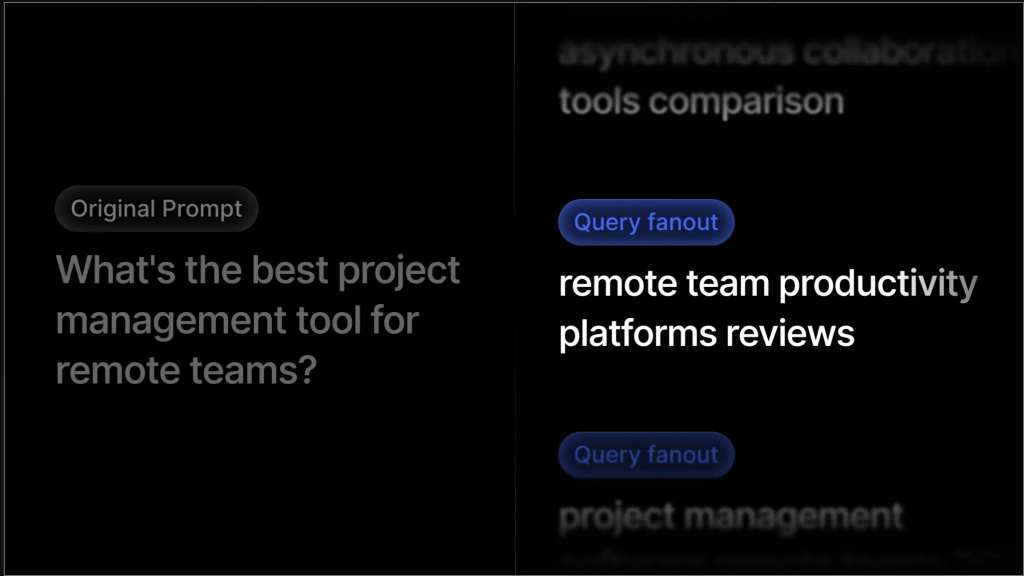
The query fan-out is the mechanism by which an AI engine transforms a single user question into several internal searches before composing its response.
You ask an AI: “I manage a 10-person agency and I lose my customer raises, what do I do? »
The model is not looking for this sentence. He generates his own requests: ‘Best CRM Small Agency’, ‘CRM Automatic Reminders’, ‘Customer Tracking Software 2026’, ‘Comparative CRM CRM Tariffs’. Then he goes to look for passages for each one, and he assembles them.
Each of these internal queries is a gate dEntrance. You can be invisible on the question ofuser, and perfectly visible on three of his fan-out requests. lreverse is also true, and cis the scenario that is expensive.
Fan-out and grounding queries: two different concepts
The distinction is technical but it changes the reading of all the tools on the market.
The fan-out goes to theexterior. The model expands: it generates sub-questions to explore a topic and cover angles thathe na step.
The grounding goes to theinterior. The model checks: it generates queries to anchor its claims in sources thatHe can quote.
Cyrus Shepard formulates the thing as follows: Fan-out queries are used to search fornew information, grounding queries are used to verify theexisting information. In practice, recovery is important, and the two terms soften use theone for theOther. Google says fan-out. Microsoft says grounding query.
The difference that matters to you: Microsoft publishes its grounding queries. Google doesn’t post anything.
How to identify your fan-out queries?
Three methods, in order of decreasing reliability.
- Export your Grounding Queries to Bing Webmaster Tools (AI Performance Report) or to Microsoft Clarity. Cis the only real source, first-party, and it is free. It covers CoPilot, Bing’s AI summaries, and by ricochet part of the web grounding of ChatGPT which spress LBing Index.
- Use a simulator like the free query fan out dOtterly. You get plausible assumptions, not facts.
- Purchase a reconstructed prompt (AHREFS) or Panel (PROFound) base. You get demand, not fan-out.
The difference that matters to you: Microsoft publishes its grounding queries. Google doesn’t post anything.
Fan-out query types
| Type | What the model is looking for | Example generated |
|---|---|---|
| Decomposition | Breaking out a composite question | “CRM” + “Automatic restart” + “Agency” |
| Comparison | Confront options | “X vs Y 2026” |
| Qualification | Constraint filter | “CRM less than 20 users price” |
| Verification | Anchor a fact | ‘Official Tariff[produit]2026 » |
| Context | fill a gap | ‘Whatis thatA CRM » |
FAQ
CWhat is the query fan-out?
Cis thebursting ofA user question in several internal searches generated by the IA engine before composing its answer. Google calls this the fan-out, Microsoft calls grounding queries the queries thatIt generates to fetch content.
How to identify a fan-out query?
The only reliable and free method is DExport your Grounding Queries from the AI Performance report from Bing Webmaster Tools or from Microsoft Clarity. simulators, like the oneOtterly, produce plausible hypotheses, not surveys.
Example of a fan-out query?
User question: “I manage an agency of 10 people and I lose my customer reminders”. Queries generated by the model: ‘Best CRM Small Agency’, ‘CRM Automatic Reminders’, ‘Comparative CRM CRM PME 2026 Prices’. You may be absent from the first and present on the other two.
Which tool to track the query fan-out?
None really does it on Google, because Google doesn’tnot exhibit. Otterly offers a free simulator, Ahrefs sells rebuilt prompts from Google search, Profound sells demand panel. The only real retrieval data is free at Microsoft.
Otterly, Ahrefs or Profound for a tight budget?
Otterly, without hesitation. lite at about $29 per month, 14-day trial without a credit card, and a suite ofFree tools that is enough to start. Watch out for Gemini and AI mode add-ons that aren’t in the base.
Does Ahrefs Brand Radar follow Claude?
No. Brand Radar covers six engines: Google AI Overviews, Google AI Mode, ChatGPT, Perplexity, Gemini and Microsoft Copilot. Neither Claude, nor Grok, nor Meta Ai, nor Deepseek.
Why don’t my Ahrefs keywords match my grounding queries?
Because they are not the same objects. Grounding queries are generated by a machine, they are longer, more qualified, more conversational. lSalt.Agency analysis, crossing Clarity’s grounding queries and ahrefs data, finds only 2% exact matches and 80.5% grounding queries without any ranking data. the vocabulary of the retrieval ia nis not that of your SEO keywords.
Leave a Reply
You must be logged in to post a comment.