On 30 October 2026 in Bengaluru, Google put one message on screen: “Good SEO is good GEO, AEO”. According to attendees, Gary Illyes and Cherry Prommawin covered query fan-out, longer AI Mode queries, llms.txt (ignored by Google), canonicals (only a hint) and commodity content. There is no recording.
Published 03/11/2026. Sources checked on 31/10/2026, screenshots retaken on 03/11/2026.
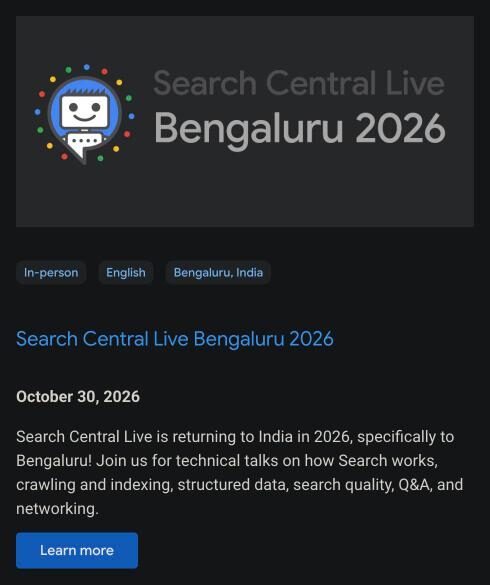
Search Central Live Bengaluru 2026: date, venue, speakers and agenda of the day
Search Central Live is the free event series run by the Google Search Central team. The Bengaluru edition took place on Friday 30 October 2026, from 10:00 to 17:30, in English. It was in person only, with no livestream and no recording. Seats were allocated by application, until 15 October (Google Search Central Events page; PPC Land, 14/09/2026).
It was the first Indian edition since 2023, when Google held events in Bengaluru on 22 September and New Delhi on 25 September (Google Search Central blog, August 2023).
| Item | Detail | Source |
|---|---|---|
| Date | 30/10/2026, 10:00 to 17:30 | Google Search Central, PPC Land |
| Venue | Radisson Blu Bengaluru Outer Ring Road, Marathahalli | PPC Land, 14/09/2026 |
| Format | Free, by application, no recording | PPC Land, 14/09/2026 |
| Announced speakers | Gary Illyes, Cherry Prommawin, Aaseesh Marina | Google Events page |
| Speakers named by attendees | Bhavana Motwani (opening keynote), Abhimanyu Pebbati, Joyshree Sarmah, Nitin Sharma, Sushant Sinha. Host: Anuj Duggal | LinkedIn posts by Sudan Vellakovil, Rejith Kumar, Ezhil Deivalakshmi, 31/10/2026 |
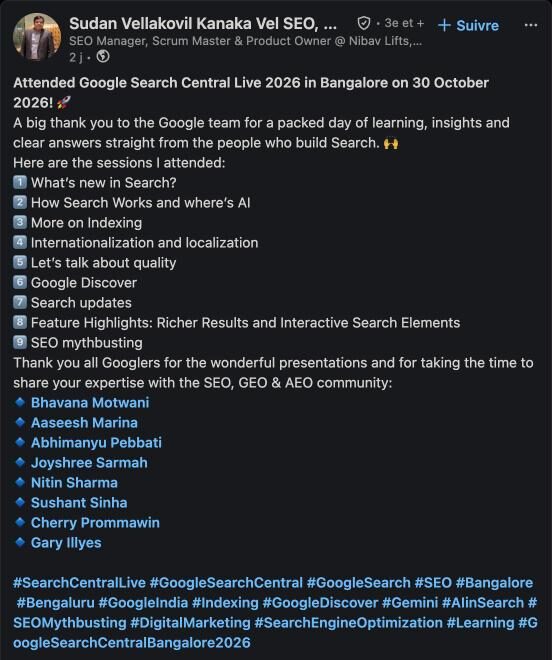
According to Sudan Vellakovil, SEO manager at Nibav Lifts, the day had 9 sessions:
- What’s new in Search
- How Search works and where’s AI
- More on indexing
- Internationalization and localization
- Let’s talk about quality
- Google Discover
- Search updates
- Feature highlights: richer results and interactive search elements
- SEO mythbusting
Some context. The event drew criticism before it started. On 19 October, Amit Tiwari, co-founder of aFactor, said on LinkedIn he would not attend. He pointed to the lack of speakers from the Indian SEO community, and recalled that in 2023 a pre-recorded video of Martin Splitt was shown instead of a live talk.
“Good SEO is good GEO, AEO”: Google’s Bengaluru slide and what it actually says
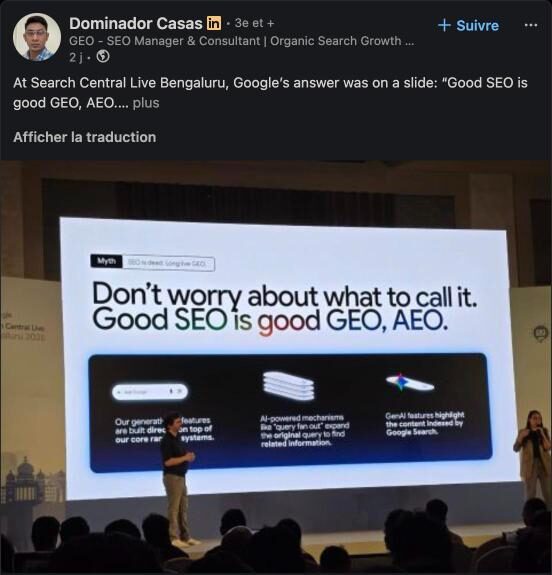
This is the line almost every attendee repeated. On the slide photographed by SEO consultant Dominador Casas, you can read the myth “SEO is dead. Long live GEO”, then Google’s answer: don’t worry about the name, good SEO is good GEO and AEO.
Under the title, the slide gives three arguments. Part of the text is hidden by the speaker in the photo, so I only report what is readable:
- Google’s generative features are built directly on top of its core ranking systems;
- mechanisms like query fan-out expand the original query to find related information;
- generative AI features highlight content indexed by Google Search.
According to Sathish Kumar’s post, another slide showed Gary Illyes in front of a more ironic version that added “AI SEO”, “LLM SEO” and “LLMNOPEO”. Harsh Sahu, Dhaanush Chandrasekar and Ramesh Nagilla report that Gary Illyes closed the day with the same line: “SEO is not dead”.
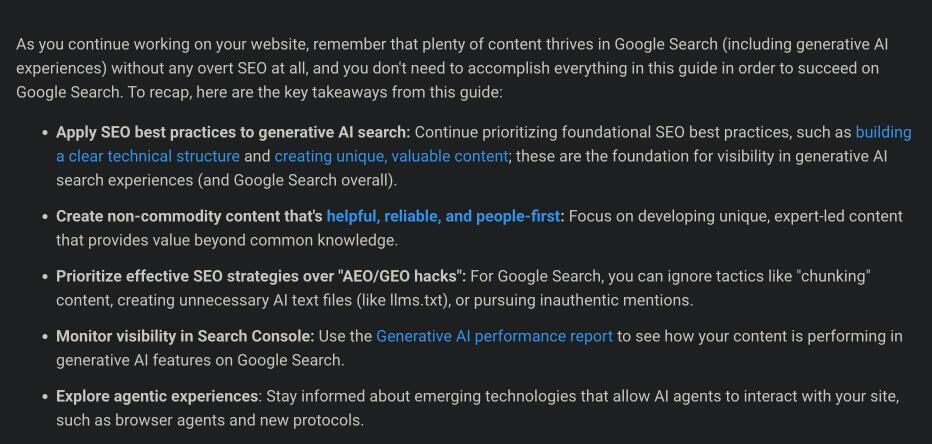
Nothing new in substance. This has been Google’s written position since its guide to optimizing for generative AI features, published on 15 May 2026 and updated on 10 July 2026. The guide says SEO best practices still apply. It adds that for Google Search you can ignore “chunking”, AI text files like llms.txt and inauthentic mentions.
This part is my opinion, not a fact: Google is describing Google. ChatGPT, Perplexity and Copilot use other indexes and other source selection rules. Dominador Casas makes the same point in his post. For AI Overviews and AI Mode, the advice is clear: do good SEO. For other AI engines, you still need to track visibility separately. That is what GEO tools are for.
Query fan-out and longer queries: the AI Mode figures shared in Bengaluru
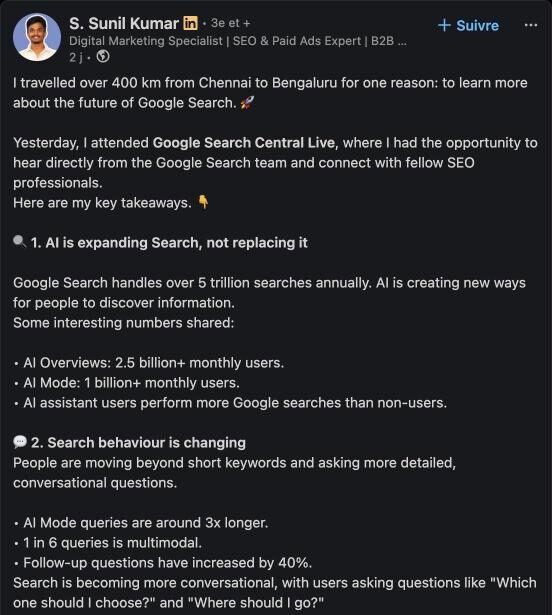
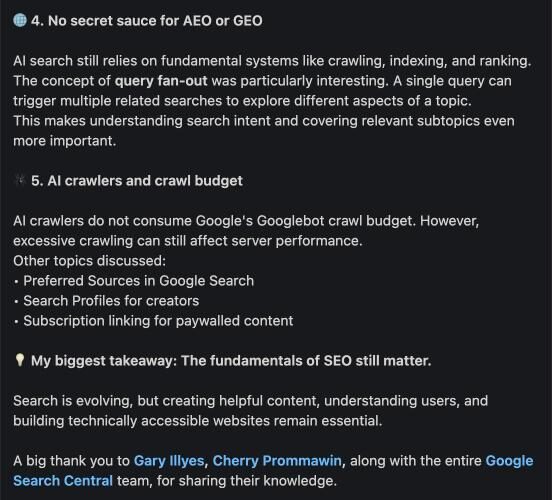
Query fan-out is when the model runs several related searches in parallel to answer one question. Google’s guide describes it this way for AI Overviews and AI Mode. Several attendees say it was the point that stuck with them most (S. Sunil Kumar, Dominador Casas, Ankit Sachan). For a fuller definition, see query fan-out in the glossary.
Here are the figures attendees say they saw during the day. No official slides are public, so I give them as reported, with the number of sources.
| Reported figure | Reported by | Status |
|---|---|---|
| More than 5 trillion Google searches per year | S. Sunil Kumar | 1 attendee |
| AI Overviews: more than 2.5 billion monthly users | S. Sunil Kumar, Rajesh R (Zoho) | 2 attendees. Already attributed to Google I/O (May 2026) by the press |
| AI Mode: more than 1 billion monthly users | S. Sunil Kumar, Rajesh R | 2 attendees. Already attributed to Google I/O by the press |
| AI Mode queries about 3 times longer | S. Sunil Kumar, Rajesh R | 2 attendees |
| 1 in 6 queries is multimodal | S. Sunil Kumar | 1 attendee |
| Follow-up questions up 40% | S. Sunil Kumar | 1 attendee |
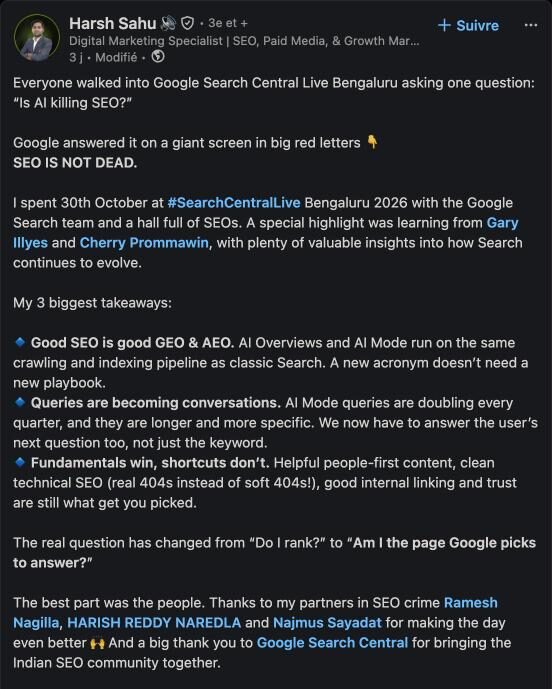
| AI Mode queries doubling every quarter | Harsh Sahu | 1 attendee, to be confirmed |
| AI assistant users run more Google searches | S. Sunil Kumar | 1 attendee, no figure |
What it changes in practice: a page that targets one keyword and never answers the next questions is less likely to be used. Fan-out looks for sub-answers. A page that covers the topic and its follow-up questions offers more useful passages. I explain the mechanism in the technology behind AI Overviews and AI Mode.
llms.txt, canonicals, soft 404s, AI crawlers: the technical points Google repeated in Bengaluru
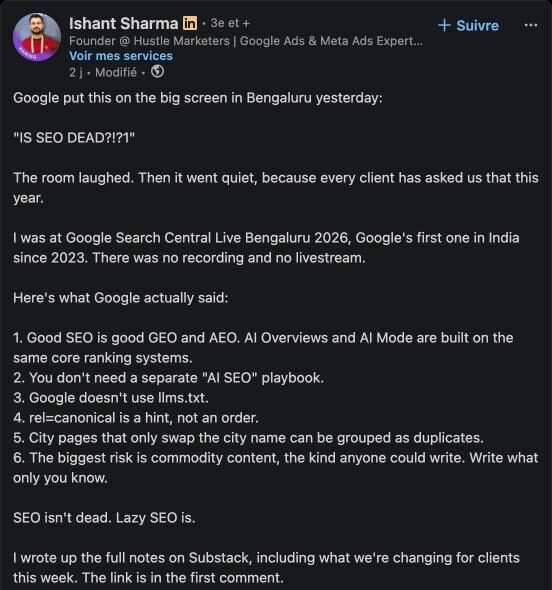
Ishant Sharma, founder of Hustle Marketers, summarised six messages from the day. The four below are about technical SEO.
llms.txt: Google Search doesn’t use it
According to Ishant Sharma, Google said again that it does not use llms.txt. That matches the official guide. On 17 June 2026, Search Engine Journal (Roger Montti) reported a clarification added to the guide: keeping an llms.txt file for other services is fine, but it neither helps nor hurts in Google Search.
rel=canonical: a hint, not an order
The canonical tag is one signal among others. Google can pick a different canonical URL than the one you declare. Google’s documentation on consolidating duplicate URLs has said the same for a long time.
City pages: risk of being grouped as duplicates
Still according to Ishant Sharma, city pages that only swap the city name can be grouped as duplicates. This matters for local SEO and multi-location sites. A city page needs its own content: address, team, reviews, local case studies.
Soft 404s and AI crawlers: server health matters
Harsh Sahu notes the advice to serve real 404s instead of soft 404s. A soft 404 is an empty or error page that returns a 200 status code. At the Barcelona Deep Dive, Gary Illyes had already called soft 404s one of the big problems of the web. SEO consultant Rafa Labrador recalled it again on 31 October in a post about that session. I covered it in my Barcelona Deep Dive recap.
S. Sunil Kumar reports another point: AI crawlers don’t consume Googlebot’s crawl budget, but heavy crawling can still slow down the server. Iqbal Singh adds that, according to Google, crawl frequency depends on site speed, content quality and server health.
The same day, unrelated to Bengaluru, Search Engine Roundtable covered a Gary Illyes interview on the Odys podcast. He said AI made Googlebot impersonation worse, driven by bots collecting training data (SER, 30/10/2026). In your logs, verify IPs before concluding a spike comes from Google.
Commodity content, quality and E-E-A-T: Google’s message to publishers in Bengaluru
Commodity content is content based on common knowledge that anyone could write. Google’s AI guide contrasts it with non-commodity content, which brings an expert view or first-hand experience. Ishant Sharma reports that Google presented it in Bengaluru as the biggest risk.
What attendees took away on quality:
- the issue is not whether AI wrote the content, it is quality and usefulness (S. Sunil Kumar);
- ranking first in Google does not guarantee a citation in an AI answer (Nirupama K S, editor at Oneindia Kannada);
- E-E-A-T is still the base of credible content (Nirupama K S);
- five principles for creators: people-first content, expertise, content and quality, presentation and production, avoiding search-engine-first content (Rejith Kumar).
Ezhil Deivalakshmi and Nirupama K S both quote a line from Elizabeth Reid, head of Google Search, shown during the day: “Search is never a solved problem”.
Other topics, according to S. Sunil Kumar: Preferred Sources, Search profiles for creators and Subscription linking for paywalled content. Dhaanush Chandrasekar mentions a session by Aaseesh Marina on Search Console. Google’s AI guide points to the generative AI performance report in Search Console to track visibility in these features. I explain how to read it in my guide to the Search Console generative AI report.
What I check in my SEO and GEO audits after Search Central Live Bengaluru
Nothing said in Bengaluru calls for a new method. It does confirm what I check first when a client asks “how do I show up in AI Mode”. Here is my order:
- Indexed pages. In Search Console, I look at “Duplicate, Google chose different canonical than user”. That is where near-identical city pages show up.
- Soft 404s. I crawl error URLs and compare the HTTP status with what the page shows. I also check what the CDN or WAF serves to Googlebot.
- Server logs. I separate IP-verified Googlebot, fake Googlebot and AI crawlers (GPTBot, ClaudeBot, PerplexityBot). I never mix the three in one crawl chart.
- Follow-up questions. For each key page, I list the questions a buyer asks next and check whether the page answers them. That is the direct effect of query fan-out.
- Measurement. The generative AI report in Search Console for Google, and a GEO tool for ChatGPT, Perplexity and Gemini, because Google only talks about Google.
My limit: this recap is based on attendee posts, not Google’s slides. I will update it if Google or the SEO press publish the session content.
What we still don’t know about Search Central Live Bengaluru 2026
- The official slides. Google has not published them and there is no recording. Everything above comes from attendees’ LinkedIn posts.
- The exact source of the AI Mode figures. Most are reported by only one or two attendees. The audience figures (2.5 billion and 1 billion) were already circulating since Google I/O.
- Product announcements. No attendee reports a new feature announced in Bengaluru. Preferred Sources, Search profiles and Subscription linking already existed.
- Detailed write-ups to come. Saurabh Mishra (WPP Media) and Shreya R Nambiar (CookieYes) announced detailed posts. Search Engine Roundtable, Search Engine Journal and Search Engine Land had published nothing on the day as of 31/10/2026.
- The debate on format. Amit Tiwari posted a critical comment on some presentations on 30 October, calling them “out of touch with reality”. Other attendees describe clear, technical sessions.
The other Search Central Live events I covered: Zurich, Paris, Barcelona
Bengaluru confirms a line Google has held across several editions. To compare the messages from one event to the next:
- Google Search Central 2025 in Zurich
- Google Search Central Live Paris: what to expect on June 25
- Search Central Live Paris 2026 recap: Google is betting on agentic commerce
- Search Central Live Deep Dive Barcelona 2026: what Google said over 3 days
FAQ about Search Central Live Bengaluru 2026
When and where did Search Central Live Bengaluru 2026 take place?
On 30 October 2026, from 10:00 to 17:30, at the Radisson Blu Outer Ring Road in Bengaluru. The event was free, by application, and in English.
Who spoke at Search Central Live Bengaluru 2026?
Google announced Gary Illyes, Cherry Prommawin and Aaseesh Marina. Attendees also name Bhavana Motwani, Abhimanyu Pebbati, Joyshree Sarmah, Nitin Sharma and Sushant Sinha.
What did Google say about GEO in Bengaluru?
That “Good SEO is good GEO, AEO”: AI Overviews and AI Mode run on the same systems as classic search. So there is no separate method for Google, in line with its official guide from May 2026.
Does Google use llms.txt, according to Search Central Live Bengaluru?
No. According to attendees, Google said again that it doesn’t use llms.txt, as its generative AI guide states. You can keep one for other services, with no effect in Google Search.
Is there a recording of Search Central Live Bengaluru 2026?
No, there was no livestream and no recording. The content is only known through attendee posts, until the SEO press publishes recaps.
Why I wrote this Search Central Live Bengaluru recap myself
I was not in Bengaluru. On 31 October I read about twenty LinkedIn posts from attendees, then cross-checked each point with Google’s documentation and the SEO press. When a figure has only one source, I say so. I am an independent SEO and GEO consultant: nobody pays me for this content and I don’t work for any agency or tool mentioned. If you were in the room and I got something wrong, write to me via ping-moi: I will fix it and date the correction.
Sources for the Search Central Live Bengaluru 2026 recap
- Google Search Central, Events page, “Search Central Live Bengaluru 2026” card, checked 31/10/2026.
- Google Search Central Blog, “Search Central Live India 2026: Bengaluru, We’re Coming (For Real This Time)”, September 2026.
- Google Search Central Blog, “Search Central Live is coming to India”, August 2023.
- Google Search Central, “Optimizing your website for generative AI features on Google Search”, published 15/05/2026, updated 10/07/2026, checked 31/10/2026.
- PPC Land, “Google’s search team returns to India after 3 years for Bengaluru event”, 14/09/2026.
- Search Engine Journal, Roger Montti, article on the llms.txt clarification in Google’s AI guide, 17/06/2026.
- Search Engine Roundtable, Barry Schwartz, “Google’s Gary Illyes: AI Made Bot Impersonation Worse”, 30/10/2026.
- LinkedIn, attendee posts checked 31/10/2026: S. Sunil Kumar, Dominador Casas, Ishant Sharma, Harsh Sahu, Sudan Vellakovil, Rejith Kumar, Ezhil Deivalakshmi, Nirupama K S, Rajesh R, Iqbal Singh, Dhaanush Chandrasekar, Ramesh Nagilla, Sathish Kumar, Ankit Sachan, Saurabh Mishra, Shreya R Nambiar.
- LinkedIn, Rafa Labrador, post on the “How crawling errors affect Search” session at the Barcelona Deep Dive, 31/10/2026.
- LinkedIn, Amit Tiwari, posts of 19/10/2026 and 30/10/2026.
Leave a Reply
You must be logged in to post a comment.