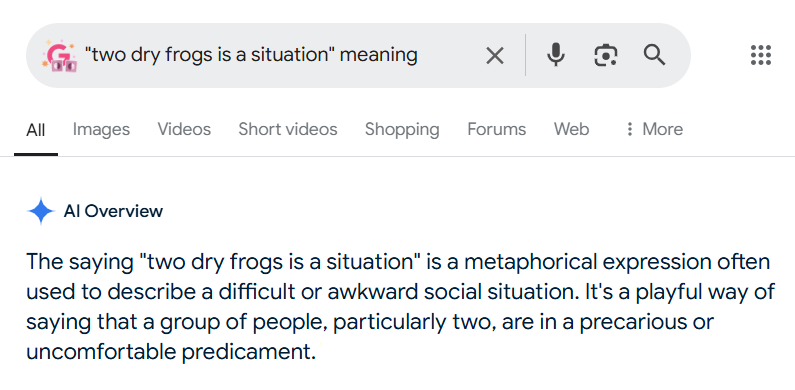
Google AIO : what is it exactly ?
An AI Overview is a response block generated by Gemini that appears above the standard Google Search results. It summarizes several indexed web pages and displays clickable links to those sources. It is not a separate SERP; rather, it is a layer of results overlaid on Google’s index, powered by the same ranking systems as standard search.
Three things to keep in mind before proceeding:
AI Overviews have been active in France since July 22, 2026, at the same time as AI Mode.
They are based on two mechanisms documented by Google: RAG (grounding) and query fan-out.
Organic ranking is no longer a good predictor of citations. According to 2026 studies, between 62% and 83% of citations from AI Overviews come from pages outside the top 10 for the relevant query.
The term “Google AIO” means ‘AI Overviews, the new way that Google to rethink the research of a sudden artificial intelligence.
To make it simple, Google AIO or Google AI Overviews is the new SERP(results page) generated by the artificial intelligence of Google which is Gemini.
Google to start working on this technology for a few years now. Following theappearance of ChatGPT and the launch of Google Bard, the first AI Google.
At the time, it was called SGE (Search Generative Experience), an experimental feature tested in the Search Labs. Since then, it became ‘AI Overviews.
Google AI Overviews is available all around the world as of July 2026.
Here is an overview of the technology. Shared by Google at their conference I O 2024
What are the differences between AI Overviews, AI Mode, and Gemini?
I have a detailed article on the differences between Google AI Overviews and Google AI Mode. To summarize, here’s what’s different:
| Object | What it is | Where it shows | AI-generated | Search Console reporting |
| Featured snippet | Extract from a single page | Position 0 of the classic SERP | No, extraction | Performance report, Web search type |
| AI Overview | Multi-source synthesis | Top of the classic SERP | Yes | Performance (Web) + Generative AI report |
| AI Mode | Dedicated conversational tab | Separate Search tab | Yes | Performance (Web) + Generative AI report |
| Gemini (app) | Standalone assistant | gemini.google.com, mobile app | Yes | None |
Two consequences that change how you read your numbers:
AI impressions are not additional volume. Google states that sites appearing in AI features are included in overall search traffic in the Performance report, within the Web search type. The ratio of AI impressions to Web impressions is therefore a share of visibility, not a ratio between two independent universes. That is what makes the calculation legitimate. I detail the method in my guide to the Search Console Generative AI report.
The Generative AI report does not separate the two surfaces. There is no way today to know whether a page is being pushed by AI Overviews or by AI Mode. It is the most requested data point in the industry, and it does not exist yet.
When does an AI Overview trigger?
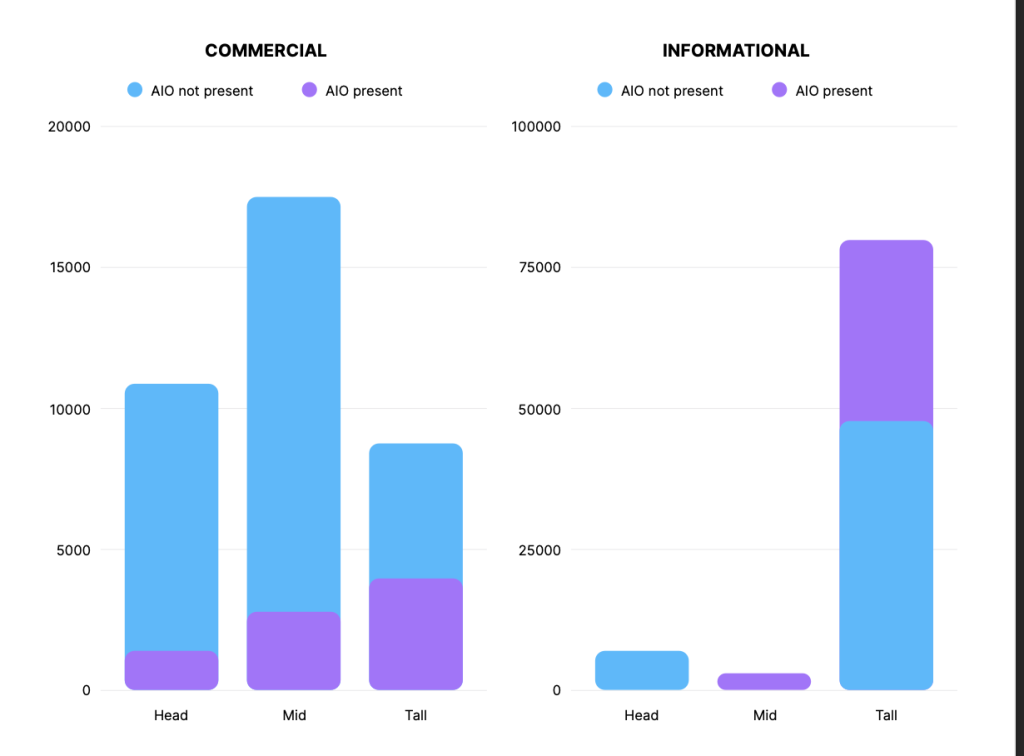
An AI Overview triggers mostly on informational queries phrased as questions or long-tail strings, and rarely on navigational or directly transactional queries.
Google states that AI Overviews are only shown when its systems determine they are additive to classic Search, and as such often do not trigger.
On volume, third-party trackers put coverage above 48% of Google queries as of March 2026, against 6.49% a year earlier. Handle that number with care: it comes from third-party tools, not Google, and it swings heavily depending on the keyword corpus. Treat it as an order of magnitude, never as a reference metric in a client report.
The trigger profile itself is stable across studies:
| Query type | Trigger likelihood |
| Informational, phrased as a question | High |
| Long tail, 5 words or more | High |
| Comparative or multi-criteria | High, often routed to AI Mode |
| Commercial or directly transactional | Low |
| Navigational (brand, specific site) | Very low |
| Breaking news | Low to moderate |
Your brand pages, product pages and event content are not underperforming when they fail to appear in the Generative AI report. They serve intents where Google does not display a synthesis at all. Optimising them for AI citation is a bad investment.
How do you measure your site’s visibility in AI Overviews?
With the Search Console Generative AI report, launched 3 June 2026, cross-referenced with the Performance report on the Web search type. No other source gives a reliable volume measurement on Google surfaces today.
The report gives impressions, pages, countries, devices and dates. It gives no clicks, no CTR, no position, no queries. I covered the full procedure, the aggregation traps and the canonicalisation caveats in my dedicated guide. Short version:
- Pick a period and filters that are strictly identical across both reports.
- Record impressions, number of visible URLs and top 10 pages on each side.
- Compute your AI share of visibility:
AI impressions / total Web impressions × 100, at site level then per URL with enough volume. - Compute coverage (AI URLs over Web URLs) and concentration (share held by your top 3, 5 and 10 pages).
- Export, date it, archive it.
Usefulness of Google AI Overviews
The idea behind Google AI Overviews, it is simple : you ask a question. Google gives you a response summed up and condensed.
No more need to scroll ten links in blue : you have direct what you have been looking for.
If Google does it, it’s not fair to you to save you time. It is also and especially to keep the hand on the search.
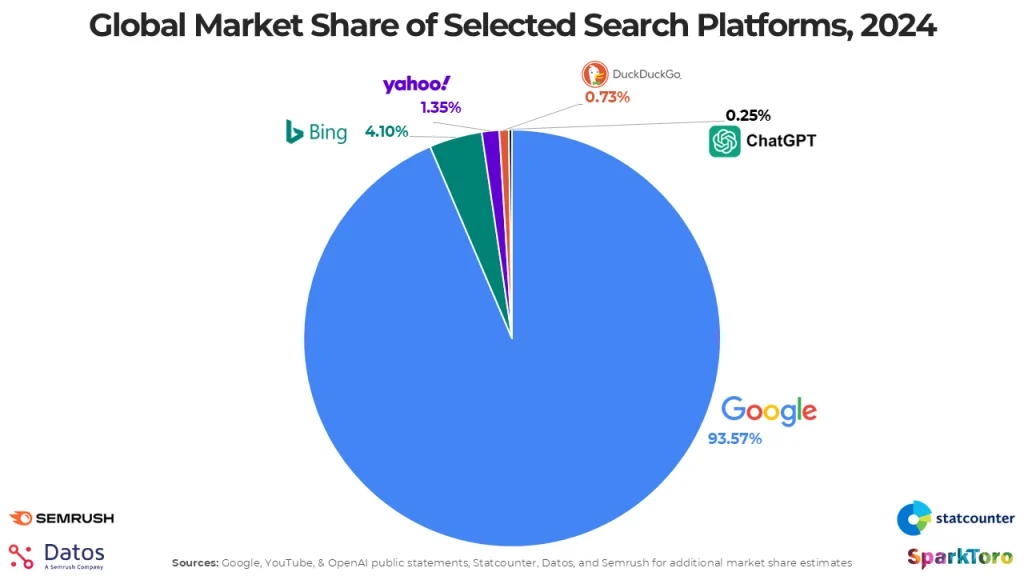
Because since 2023, there was one thing that made pinball Google : ChatGPT. And in his wheel, Perplexity, Claude, and all other.
I say freaking out, huh. ‘t lose. Because what’s true… these tools scratch is barely 1% of the market share in the search.
ChatGPT, yet very well known, hasn’t even passed the bar of 1%.
So no, they don’t take Google speed. Not yet. But Google expects all the same.
So rather than suffer… Google integrates itself the AI in its results page.
When does Google HAVE Overviews appears ?
‘VE Overviews are not activated each time you search. They are more triggered for the query information(or theuser is seeking information).
The Google AI Overviews appear (for the moment), especially on the queries formulated as questions or with keywords are long and accurate (the famous long-tail keywords).
A study conducted by Botify on the factors that trigger the responses Google AI Overviews has found that :
- The key words has been thesubject of less than 1,000 monthly searches have sparked glimpses ofAI in 55% of cases.
- The keywords long tail (5 words or more) have generated insights HAVE in 73.6 % of cases.
- Queries with intention informative to have triggered the function in 58.7% of cases. Vs. 19.4 % in the case of research with commercial intent.
Doing SEO for theera of Google AI Overviews
I’m not going to talk about the visibility was theera of the answers Google AI Overviews, Ihave another article that talks about theimpact of responses Google AIO traffic.
For SEO theera of the answers AIO, Google insists in the meets thatit multiplies with the experts in seo and content creators thattheyhave nothing to do to appear on the new SERP-generated by artificial intelligence.
But…. Because there’s always a But with Google. We mustadapt.
Ina last Creator Summit (the Summit of the Creators), Washington , Google through theresearch team incorporated Danny Sullivan, Paul Haahr and HJ Kim has put the points on the I.
Tomiko, a blogger who has participated in the summit, has lost 98% of its traffic, according to his statements. She left with an observation :
It was time tooptimize its content for save the time of its readers.
The message from Google is therefore clear : finish the talk. Finished the content long for nothing. Place theefficiency. And quality.
She said
“I came away realizing that I was still writing for Google, not for my readers. And it made me a slap in the face, because I thought I’d do well.”
Google for its part, has acknowledged during the summit, they had ‘unintentionally’ encouraged the content feature-stuffed with key words for years.”
Tomiko continues by saying :
“Today, they want to get back to the basics : useful content, and clear thought to the user.”
“Finished the keywords are balanced to select a check box, or the paragraphs of filler to achieve a number of words. Google is now smart enough to know if the user is satisfied or not.”
Tell your story but be intentional. And go straight to the point.”
“In 2025, the clarity and usefulness outweigh the nostalgia.”
I leave you with thearticle of Timoko or she explains in detail the changes in SEO that I’ve shared. Good read…
