TL;DR
- On September 24, 2026, Google added a Multimodal option under the Web search type in Search Console. It isolates results triggered by a search made with an image, a photo or a screenshot.
- It covers Google Lens, Circle to Search on Android, image uploads to Google Search and Chrome’s right-click “Search image with Google”.
- The catch: no query data for this traffic, and the Generative AI report still shows impressions only, no clicks.
- The filter measures what Google showed. It won’t tell you what to fix on a page. That’s what a multimodal GEO audit is for.
By Aslane Samai, SEO & GEO consultant and founder of aioseo.fr. Based on Google’s announcement, the Search Console help docs, and a hands-on test on the aioseo.fr property on October 8, 2026.
What is the Multimodal filter in Search Console?
On September 24, 2026, Google announced on the Search Central blog a global rollout of “web multimodal” performance reporting. In the Performance report, the Web search type now splits in two: Text-based (typed queries) and Multimodal (searches that start from an image, a photo or a screenshot). The help docs were updated on September 29.
The key detail, confirmed by John Mueller (via Search Engine Roundtable): this data was not previously counted in Web totals. It’s not existing traffic being relabeled, it’s new volume becoming visible. So some sites will see their Web numbers move.
Which searches count as multimodal?
Google’s announcement lists four entry points:
- Google Lens
- Circle to Search on Android
- Uploading an image to Google Search
- “Search image with Google” in Chrome’s right-click menu
Google doesn’t say whether image prompts in AI Mode or Search Live sessions are included. Check your own data before drawing conclusions.
Where to find multimodal data in Search Console
How to:
- Open the Performance report (Search results).
- Click the Search type filter and pick Web.
- Select Multimodal instead of Text-based.
- Use the Pages, Countries, Devices and Dates tabs, then hit Export.
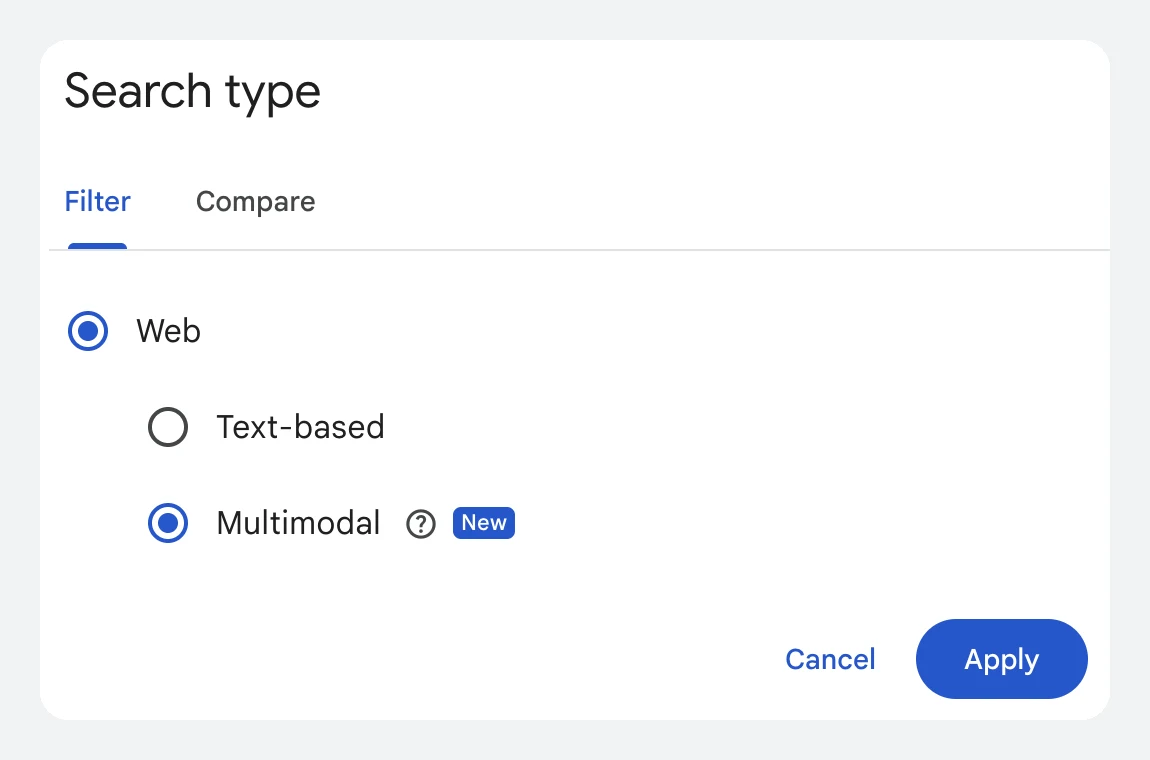
Multimodal data is also rolling into the Generative AI report, which counts impressions, not clicks. The rollout is gradual: the option may not show up on every property yet, and it only appears if the site actually gets this kind of traffic.
What I saw on aioseo.fr
I turned the filter on for the aioseo.fr domain property on October 8, 2026. Five takeaways:
- The filter is there, under Web, with a “New” badge. Text-based is selected by default, which means that unless you change it, you’re only looking at text traffic.
- Data starts around September 10. Over a 3-month range, the chart is flat before that date. That matches what Search Engine Watch reported and the drops Dave Smart flagged.
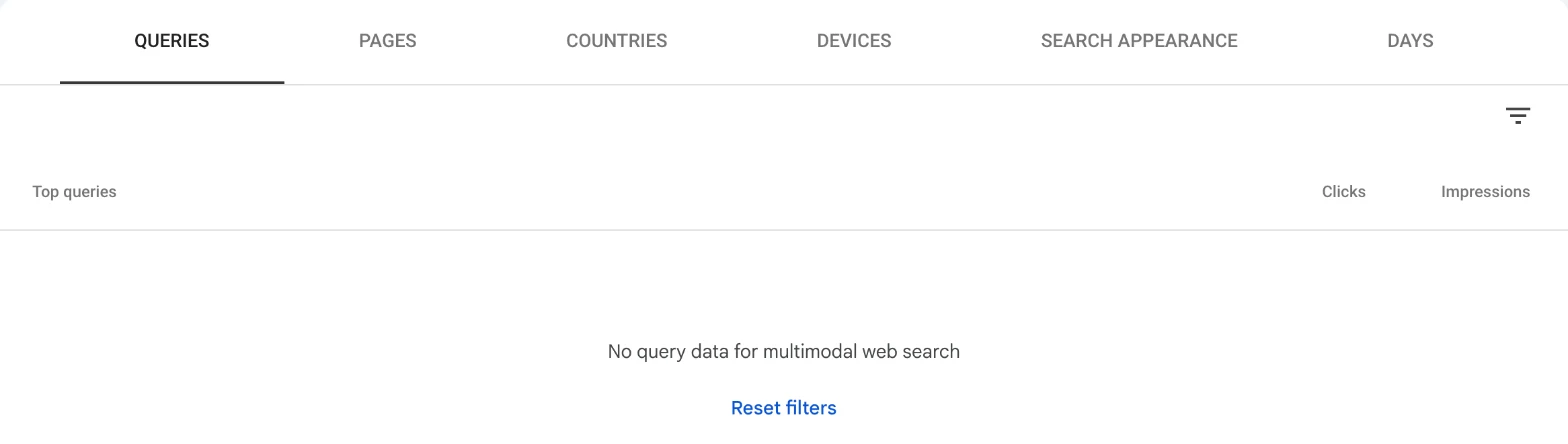
- No queries. The Queries tab reads “No query data for multimodal web search”. Pages, Countries, Devices and Dates still work.
- Volume is marginal next to text traffic. Makes sense for a B2B editorial site with no product pages and nothing people would point a camera at.
- Multimodal also feeds AI answers, and they cite text. In the Generative AI features report filtered on Multimodal, three aioseo.fr articles show up: Bing AI Performance (French), AI Overviews vs AI Mode and Reciprocal Rank Fusion (English). None has a product shot. They’re analysis pieces.
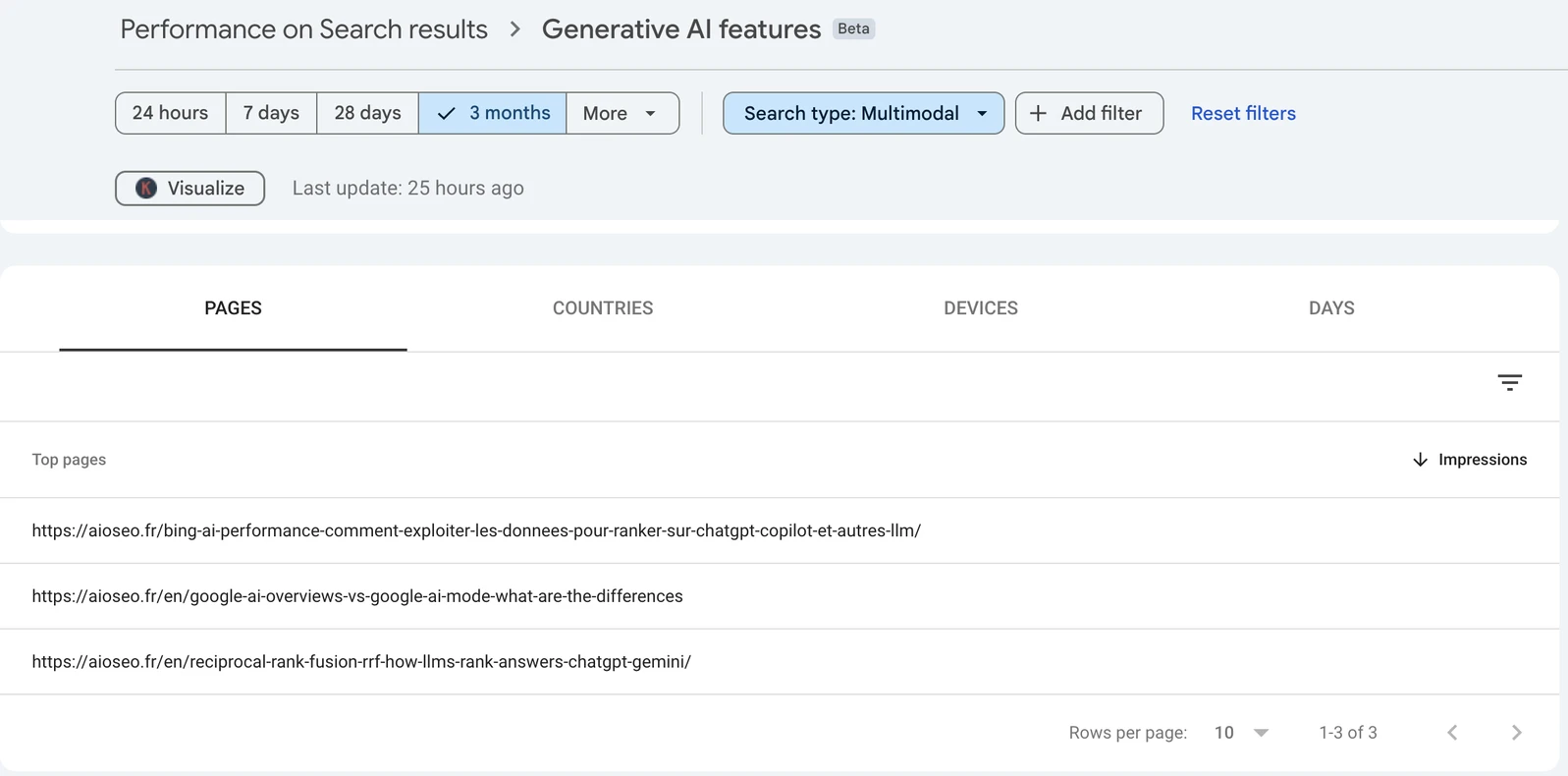
Bottom line: an image search doesn’t only lead to images. When Google answers it with an AI feature, it can cite an editorial page that explains the subject. That makes multimodal a GEO topic too: the page has to be citable by the model, not just well illustrated. Sites where the image is the way in (ecommerce, recipes, travel, home decor) will have more volume to read. A hypothesis to test on your own data.
What SEOs and GEOs are saying
Takes published between September 24 and 28, 2026, on Bluesky, X and industry blogs.
| Who | What they said | My takeaway |
|---|---|---|
| Dave Smart (Bluesky) | Asked whether these impressions were already counted under Web, and flagged drops in impressions and clicks on a few properties from September 10. | His question is what got Mueller’s confirmation. Annotate September 10 in your reports. |
| Barry Schwartz (Search Engine Roundtable) | Documented the filter before Google’s announcement and also saw no query data. | No queries, whatever the site. |
| Brodie Clark (X) | Among the first to share the Text-based / Multimodal split and Google’s definition. | The filter describes the search input (an image), not the result format. This isn’t Google Images traffic. |
| Suganthan Mohanadasan (blog) | Calls the Pages tab “the useful part”. Tested 21 type values in the API: all rejected. Treats it as something to monitor rather than act on. | No automation for now: a monthly manual export is enough. |
| Lawrence Hitches (AI Search Tracker) | Says to check whether Lens and Circle to Search actually send traffic before investing in image optimization. | Measure before you invest. |
| Antonio Fernandez (Relevant Audience) | Recommends comparing Text-based to Text-based, since Google hasn’t said how the Web total handles this data. | Don’t compare Web totals before and after September 10. |
| Apoorv Sharma (DerivateX, GEO agency) | B2B SaaS buyers search with screenshots of competitor UIs, pricing tables and comparison grids. | Closest to what I found: multimodal isn’t just an ecommerce thing. |
| Glenn Gabe (context) | Already pushed back in 2025 on AI Mode being merged into Web with no way to split it out. | The Multimodal split is a step forward, but AI Mode is still lumped in. |
My take: the consensus is clear. The filter tells you which pages show up, not why. None of the takes above mention what my Generative AI report filtered on Multimodal shows: analysis articles with no product imagery surfacing in AI answers triggered by an image. That’s the GEO angle missing from the conversation.
What the multimodal report doesn’t show
| Data | Available? | What it means |
|---|---|---|
| Queries | No | The Queries tab is unavailable for this search type. Google says text query data isn’t available for this traffic. |
| The image submitted | No | You see which pages showed up, not what the user photographed. |
| Clicks in the Generative AI report | No | That report is still impressions only. |
| Search Analytics API | Not documented | The API reference lists no multimodal type. Suganthan Mohanadasan tested 21 values: all rejected. Use the manual export. |
| Pre-launch history | Not documented | Google gives no start date. Search Engine Watch sees data from September 10. |
Dave Smart reported drops in impressions and clicks on some properties starting September 10, which he ties to this data showing up. Google hasn’t explained it. Be careful with year-over-year comparisons on the Web search type.
How to use this data
What to do:
- Export the Multimodal view by page over 28 days, then compare it with the Text-based view for the same URLs.
- List the pages that show up in multimodal. You’d expect pages where the image is the entry point (products, recipes, places, objects). Check that against your data.
- Segment by device. Circle to Search and Lens are mostly mobile, so a desktop/mobile gap is worth reading.
- Cross-check with your money pages: if a key page never shows up, look at its images before its copy.
Without queries, analysis stays at page level. Good enough to prioritize, not to explain.
Search Console multimodal vs. a multimodal GEO audit
Similar names, different jobs. Search Console reports what Google displayed. My multimodal GEO auditor analyzes a page before or after it goes live: text, images and structure together, using Gemini, to spot what a model misreads or misses.
| Multimodal filter (Search Console) | Multimodal GEO audit | |
|---|---|---|
| Job | Measure image-led traffic you already got | Diagnose a page and prioritize fixes |
| When | After the fact | Before or after publishing |
| Scope | Google only | How a multimodal model reads the page |
| Output | Impressions and clicks, by page | Score and a ranked list of actions |
| Queries | Not available | You supply the target query |
They work together: the report tells you where you show up, the audit tells you why a page doesn’t. Try the tool on the Multimodal GEO audit with Gemini-Embedding-2 page or browse my SEO / GEO tools.
How to optimize pages for multimodal search
Google doesn’t document ranking factors specific to Lens or Circle to Search. The closest guidance is Google Images, covered in the official docs:
- Original, sharp images embedded in HTML (an
imgelement), not CSS backgrounds. - Descriptive
alttext and relevant copy around the image. - Structured data where it applies (Product, Recipe).
- Images in your sitemap, with sensible file sizes.
- Copy that clearly explains what the image shows (definition, comparison, how-to), so the page is citable when the answer comes from an AI feature.
My read, not Google’s: if those pages already show up in multimodal, these are the first things to strengthen. For the LLM side, see the GEO and LLM checklist for 2026.
FAQ: Search Console multimodal
Does the Multimodal filter show queries?
No. The Queries tab is unavailable for this search type, since image searches rarely include text. You get pages, countries, devices and dates.
Which searches does Google count as multimodal?
Searches triggered by an image, a photo or a screenshot: Google Lens, Circle to Search on Android, image uploads to Google Search, and image search from Chrome’s right-click menu.
Was this data already in my Web traffic?
No, according to John Mueller. It’s new data, not a reclassification, so it can change your Web totals.
Does the multimodal report replace a GEO audit?
No. It measures exposure in Google. A multimodal GEO audit looks at the page itself and tells you what to fix.
Leave a Reply
You must be logged in to post a comment.