In short
- Gemini 4 Argon has been available in Google AI Mode since October 13, 2026 for AI Pro and Ultra subscribers. The model was announced on September 30.
- DEJAN study (5,381 tests, synthetic pages): Argon selects 31.5% of pages with a table versus 93.6% for 3.8 Flash, prefers hard numbers and ignores emphasis.
- Google adds no SEO or GEO requirement specific to Argon.
- My 4 queries (one run each): 33 source links with Argon versus 38 with 3.8 Flash, to be confirmed.
- A 7-step protocol to test Argon yourself in AI Mode.
By Aslane Samai, SEO & GEO consultant and founder of aioseo.fr. Based on Google’s announcement, the DEJAN study and tests run in AI Mode on October 18, 2026.
Gemini 4 Argon has been available in Google AI Mode since October 13, 2026 for AI Pro and Ultra subscribers. Five days later, most SEO articles describe test protocols without results. Here: Dan Petrovic’s (DEJAN) study of 5,381 tests, what Google confirms, how SEOs are testing the model, and my own checks in AI Mode on October 18, with screenshots.
What is Gemini 4 Argon and when does it arrive in AI Mode?
Gemini 4 Argon is the first model of the Gemini 4 family. Google announced it on September 30, 2026 and presents it as its model for complex, multi-step tasks: code, finance, law, cybersecurity, science.
Gemini 4 Argon on the API side:
- identifier
gemini-4-argon - 1,048,576 tokens of context, shared between the prompt, internal reasoning and the answer
- three thinking levels (low, medium, high), medium by default
- Google Search grounding, URL context, code execution, function calling and structured outputs supported
In AI Mode, Gemini 4 Argon arrived on October 13. You select it with the + icon in the input bar: on my AI Pro account, the menu offers Auto, 3.8 Flash and 4 Argon. The rollout is gradual and limited to Pro and Ultra subscribers. Nothing suggests the default model for free users is changing.
Three points Google does not specify, or not yet. Supported languages are not announced: on my account, Argon answers in French in AI Mode. On October 13, Google’s help page on the model menu still listed only “Pro” and “Fast” (Search Engine Journal). And according to Clubic, the task mode of the Gemini app remains unavailable in France.
Gemini 4 Argon and SEO GEO: what DEJAN’s 5,381 tests show
Dan Petrovic (DEJAN) published the first quantified study on Gemini 4 Argon on October 14. The principle: a short commercial page, a copy with a single change (prices, a table, exclamation marks), and Argon picks the version it would use as a source to answer a chat query. Each feature is tested about 150 times, 36 in total, and the same tests were run on Gemini 3.6, 3.7 and 3.8 Flash.
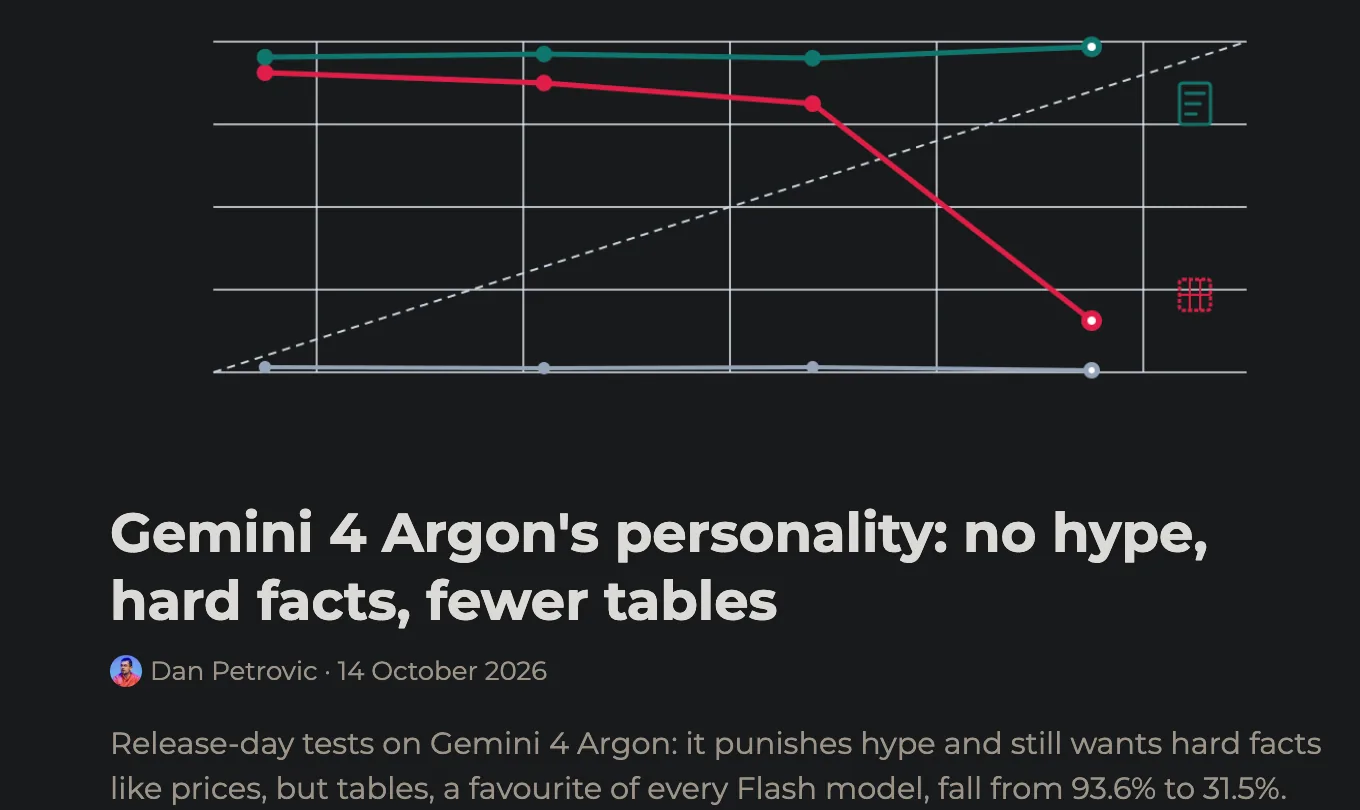
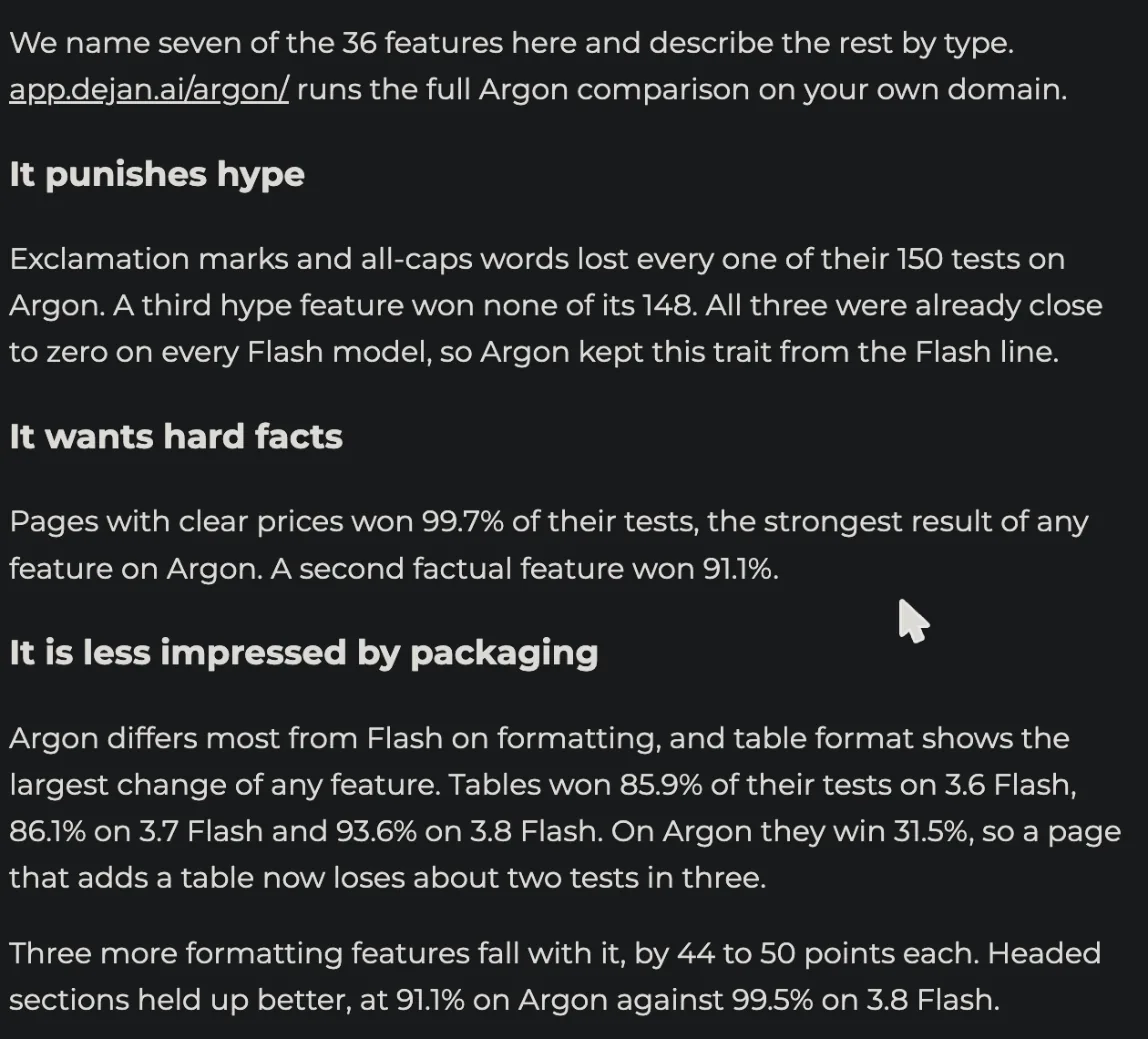
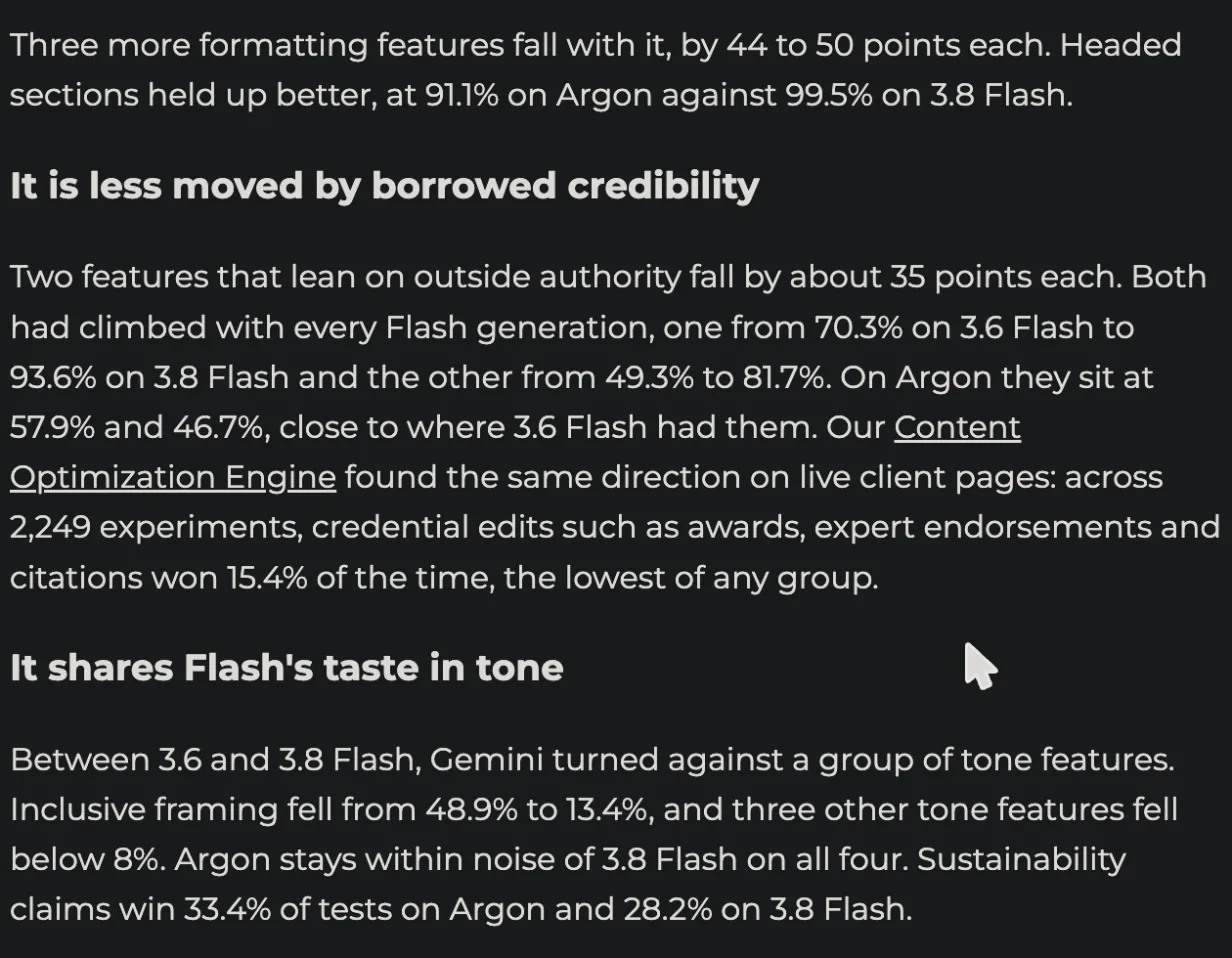
The metric is a selection rate, not a Google ranking: ranking decides whether a page enters the candidate set, then the model chooses among them. Results by feature group:
| Feature tested | 3.8 Flash | Argon | Gap |
|---|---|---|---|
| Clear prices | 98.5% | 99.7% | +1.2 points |
| Sections with headings | 99.5% | 91.1% | -8.4 points |
| Table | 93.6% | 31.5% | -62.1 points |
| Other formatting (3 criteria) | 85.6% | 39.2% | -46.4 points |
| Borrowed credibility: awards, expert opinions, quotes (2 criteria) | 87.7% | 52.3% | -35.4 points |
| Tone (4 criteria) | 6.7% | 7.0% | +0.3 points |
| Exclamation marks, capitals (3 criteria) | 0.5% | 0.3% | -0.2 points |
A page that adds a table therefore loses about two comparisons out of three with Argon, where it won nine out of ten with 3.8 Flash. Exclamation marks and capitalized words lose all their 150 tests, as with the Flash models.
What the study does not measure:
- The pages are synthetic and the query is simulated: DEJAN does not observe real AI Mode citations.
- The validation step (11 tests per feature) partly contradicts the first step: one extra fact turns 10 losing pages out of 11 into winners, a credibility feature wins 8 out of 11 despite its 35-point drop, a tone addition wins 0 out of 11.
- On a real brand (custom sportswear, 89 snippet experiments), the average position is the same, 3.80 with 3.8 Flash and 3.81 with Argon, but Argon costs 3.1 times more per ranking and takes 1.8 times longer.
- DEJAN’s conclusion, which I share: every change should be tested on the page concerned.
How to adapt your pages to Gemini 4 Argon: prices, headed sections, tables, tone
What follows is my reading of the DEJAN study, not a result measured in AI Mode. Replay it on your own pages.
- Put the numbers in the text. Prices, rates, dates, durations, limits: pages with clear prices win 99.7% of comparisons on Argon. Write them in a sentence, not only in a table.
- Do not rely on a table alone. Keep it for the reader, and repeat the key values in a sentence or a list just above. This is a hypothesis deduced from the drop of tables (93.6% to 31.5%), to be tested.
- Keep sections with explicit headings. They hold at 91.1% on Argon against 99.5% on 3.8 Flash.
- Remove exclamation marks and capitalized words. Zero wins out of 150 tests for each.
- Do not count on awards and expert opinions to get picked. A 35-point drop on average on Argon, and on client pages these changes win 15.4% of tests (2,249 DEJAN experiments). Validation still shows reverse cases: test page by page.
- Run the comparison on your own domain. DEJAN offers a tool (app.dejan.ai/argon) that replays the 36 criteria on your pages.
Gemini 4 Argon in AI Mode: what Google confirms and what SEOs observe
Confirmed by Google: Gemini 4 Argon is coming to AI Mode worldwide for Google AI Pro and Ultra subscribers, with better results on complex multi-step tasks and better instruction following over several turns. The announcement comes from Nick Fox and Robby Stein, relayed by Barry Schwartz (Search Engine Roundtable, October 13) and by Search Engine Land.
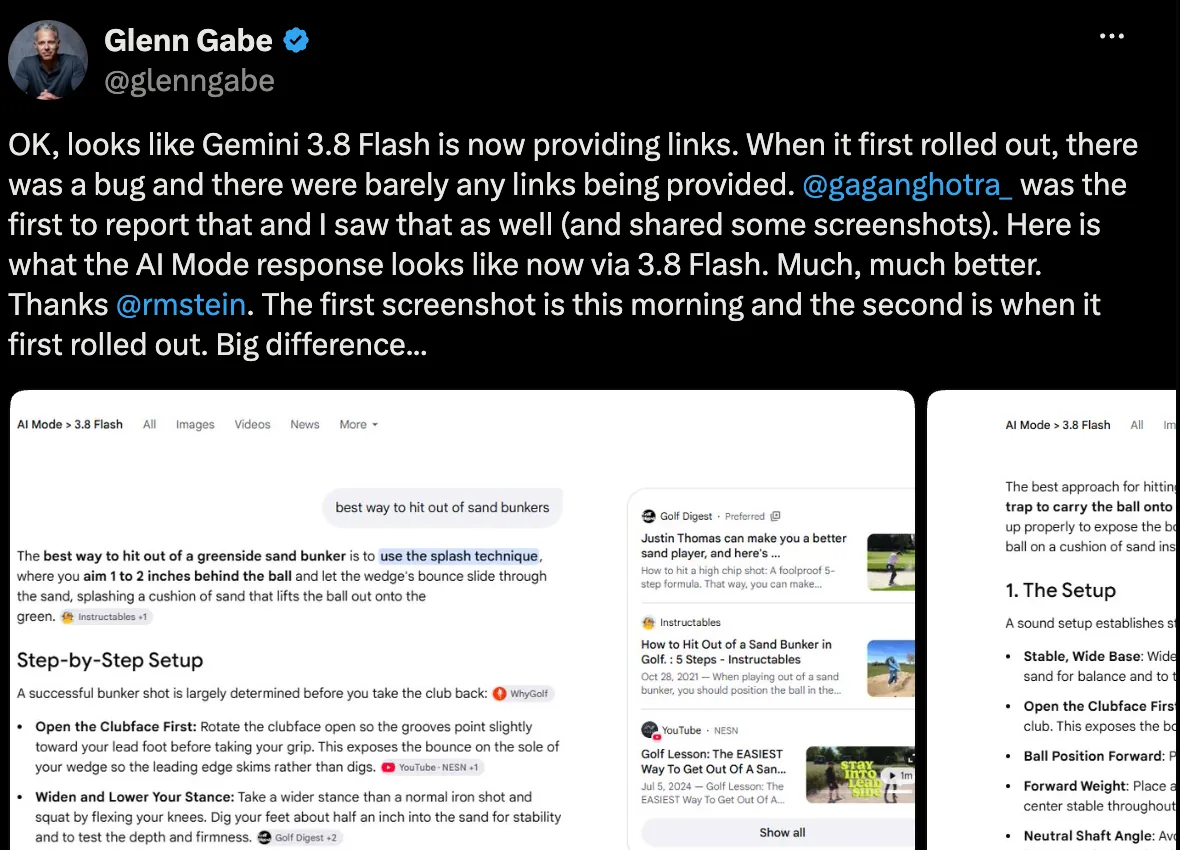
Observed by the community: AI Mode answers with Argon display links to sources. Gagan Ghotra pointed it out on October 13, Barry Schwartz picked it up, and my 4 queries confirm it. The contrast is clear with the 3.8 Flash launch, whose answers displayed almost no links because of a launch bug, acknowledged by Robby Stein on September 4 and then fixed.
Not established so far: that Argon also powers AI Overviews, that it changes the number of clicks, that it becomes the default model. Delante says it itself: no public evidence confirms that Argon changes the citation frequency of specific domains.
Does Gemini 4 Argon change the rules of SEO and GEO?
Not the prerequisites. Google’s documentation on AI features sets no requirement specific to Gemini 4 Argon: no technical requirement beyond indexing and snippet eligibility, no specific markup. Argon justifies no new schema, no target text length, no “Argon” page on a site that has nothing to say about it. What moves is the model’s preference when it compares two pages that are already eligible: according to DEJAN, it is less swayed by a table or by awards, and it still prefers hard numbers. My 4 queries (one run each) show no change of rules: the visible gap is in the number of links and, on the tools query, in the recommended brands.
How SEOs test Gemini 4 Argon in AI Mode: two tiers, environment log, published protocols
Five days after Argon arrived in AI Mode, I went through the SEO articles and LinkedIn posts published on the topic. Quantified results are rare: apart from DEJAN, most content describes test protocols, without AI Mode data or screenshots.
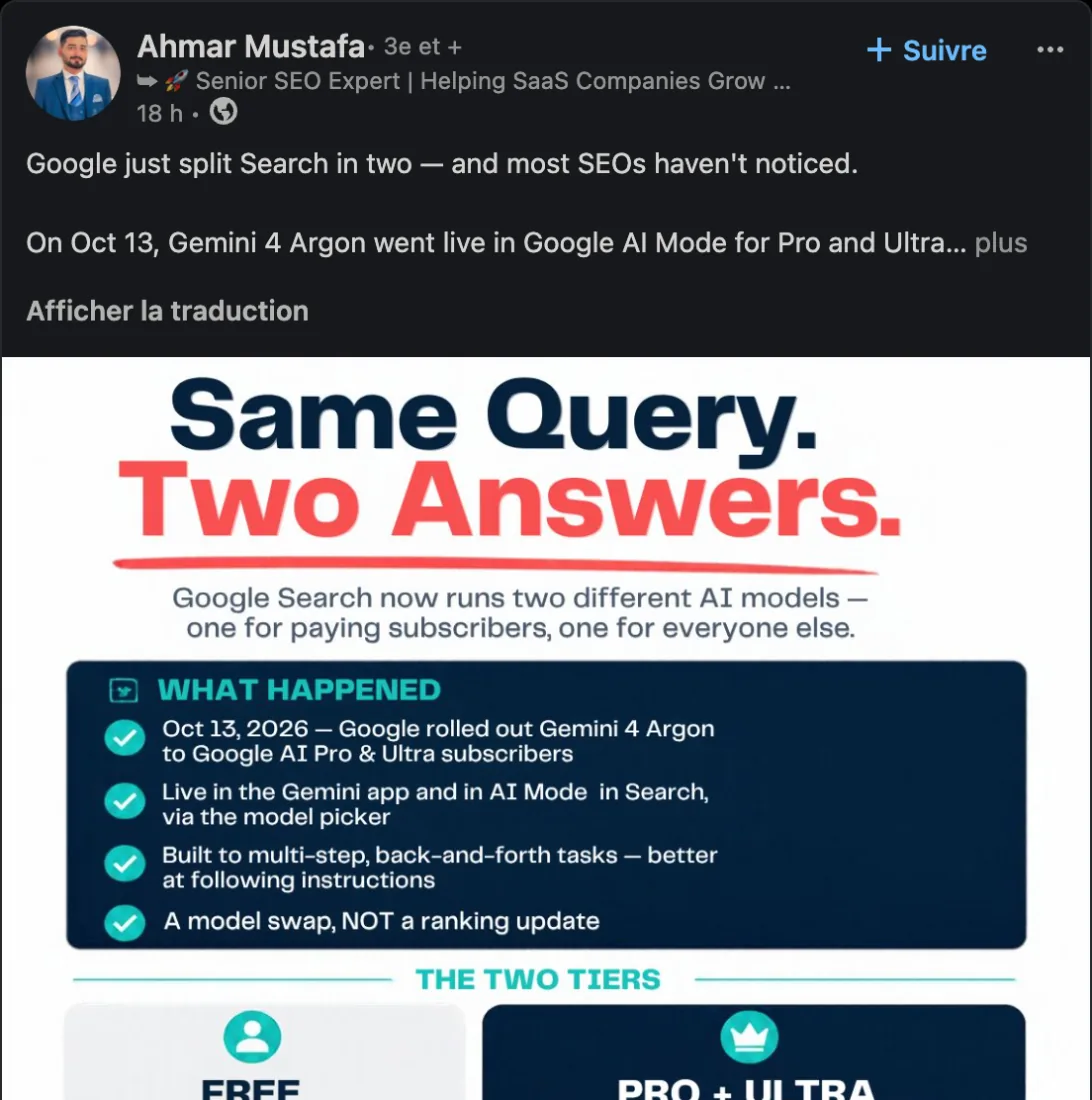
- Test both tiers of AI Mode. Ahmar Mustafa (Senior SEO Expert) writes on LinkedIn that he now tests his business keywords in both tiers: Argon for Pro and Ultra subscribers, the default model for everyone else. His starting point: a brand can be cited in one and absent from the other, with no official measure of the gap.
- Log the environment of each test. Issey Morita (SEO in Japan, ex-Canva Japan) advises keeping with each answer the exact prompt, date, interface, account tier, location and search settings, and separating API tests from interface tests: an API model name does not prove which model produced a search answer.
- Chain follow-up questions. Single Grain (Eric Siu) suggests a three-step chain: general question, precise constraint, shortlist request. If the brand disappears at step 2 or 3, the content lacks detail. It suggests two accounts, one paid and one free, rather than switching models on a single one.
- Repeat each test three times. Percepture (Bob Generale) proposes 12 questions in 4 categories (discovery, recommendation, comparison, proof) with three independent repetitions, noting surface, account tier, market, language, date and time zone. The protocol is published without results.
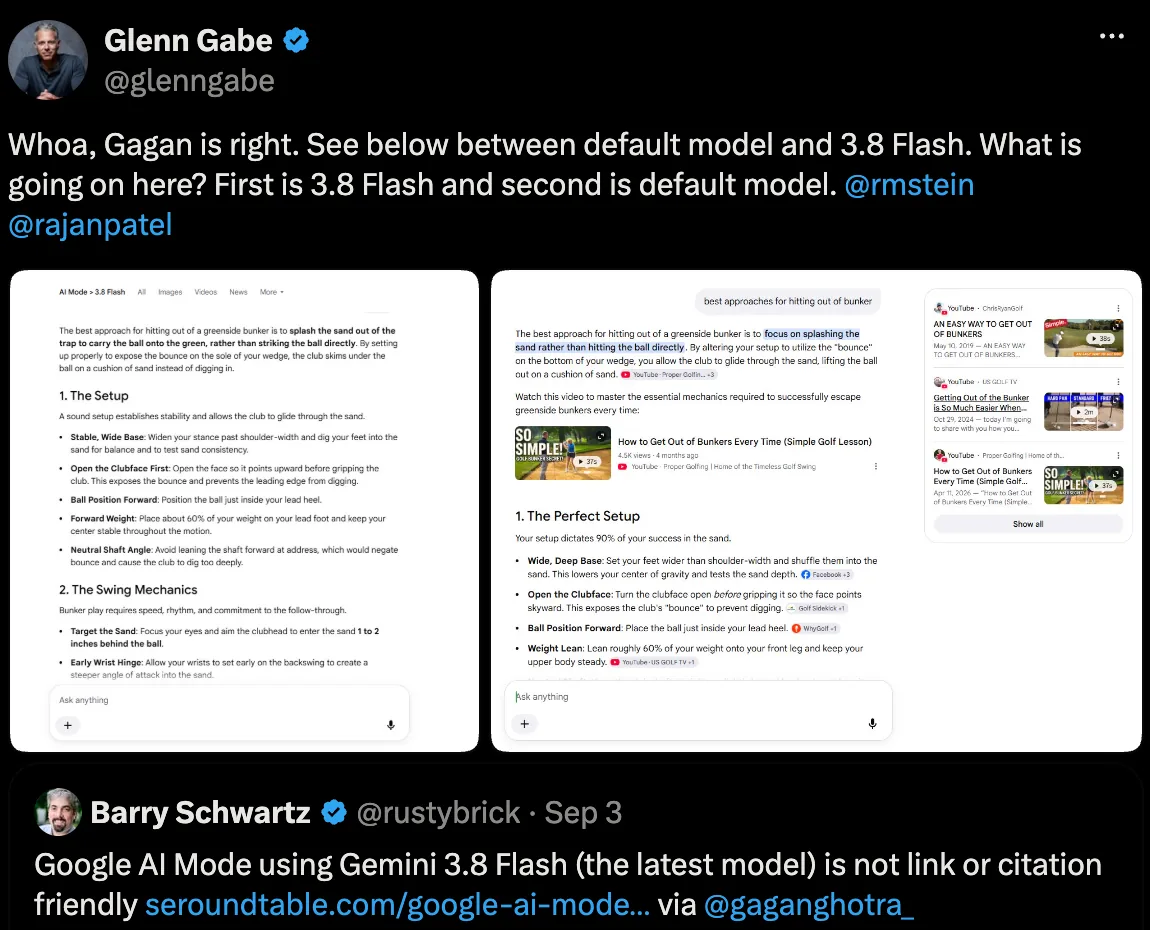
- Compare two models side by side. Glenn Gabe did it in September with 3.8 Flash: on September 3, he posted on X a comparison between 3.8 Flash and AI Mode’s default model, following Gagan Ghotra’s screenshots showing answers without links. Robby Stein acknowledged the problem on September 4, and Glenn Gabe confirmed the links were back the same day (Search Engine Roundtable). I did not find an equivalent comparison from him on Argon.
- Test your key queries. Barry Schwartz (Search Engine Land) gives only one piece of advice: run Argon on your important questions to see where your brand stands.
- Measure selection rather than rank. This is the DEJAN approach, detailed above.
- Build audit agents in Antigravity. Argon is available in Google Antigravity for Ultra subscribers, with commands like /goal, multi-agent loops and custom skills. Open source SEO skills are starting to appear, for example antigravity-seo (technical audit, JSON-LD, llms.txt, citability). The repository is very young (1 star, 2 commits at the time of writing): a usage signal, not a standard.
- Plug the model into your own data via the API. Search grounding, URL context and structured outputs make it possible to script query classification, on-page extraction or schema consistency checks. These are documented capabilities, not yet published field reports.
My addition: the AI Mode model selector (+ menu) lets you compare Argon and 3.8 Flash on the same account, without a second subscription. The next sections show what this looks like in practice.
How I tested Gemini 4 Argon in AI Mode: method and limits
Here is how I proceeded, so you can judge what the numbers below are worth.
- Account and location: everything done with my Google AI Pro account, from Chrome, in France and in French.
- When: October 18, 2026, in a session of about ten minutes.
- Who against whom: Argon and 3.8 Flash, picked by hand in the + menu, plus Auto mode, the one that opens by itself when you launch AI Mode.
- Language: queries in French, and all three models answered in French.
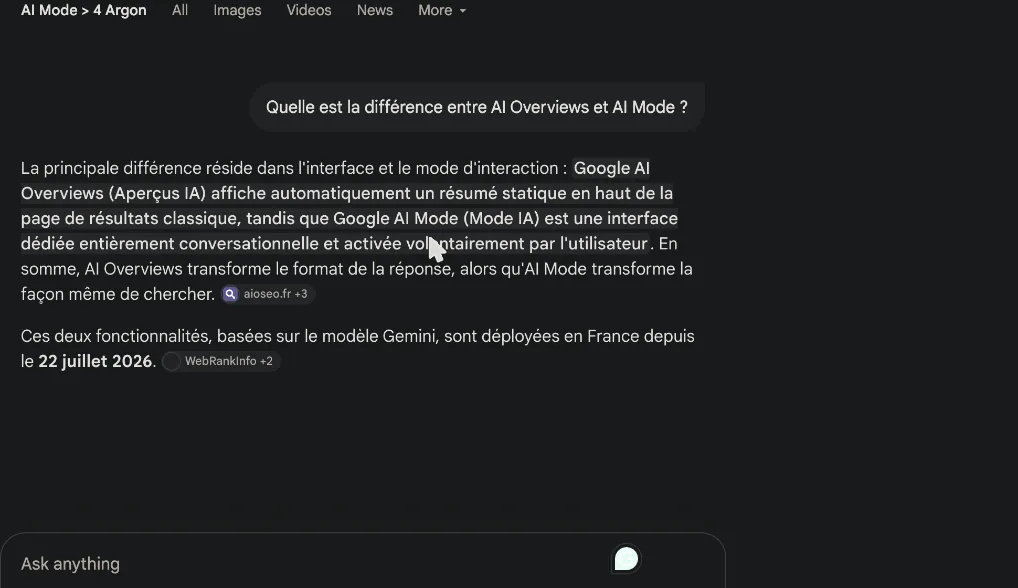
- What I recorded: a screenshot of each answer with the model name visible in the header (“AI Mode > 4 Argon”), then the list of all source links on the page.
- What this does not tell you: I ran each query only once, so variance cannot be measured. My account is logged in, so some personalization may have played a role. And I have no click data: I count links and sources, not traffic.
Results: number of source links for Gemini 4 Argon, 3.8 Flash and Auto on 4 queries
| Query (run in French) | Argon | 3.8 Flash | Auto |
|---|---|---|---|
| What is query fan-out in AI Mode? | 9 links | 9 links | not tested |
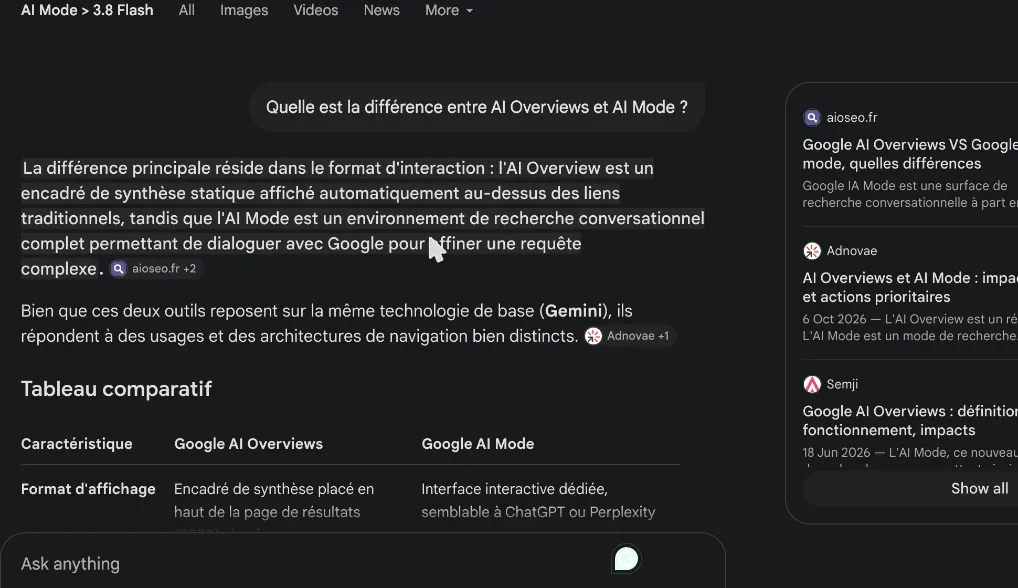
| What is the difference between AI Overviews and AI Mode? | 8 links | 9 links | not tested |
| How do I know if my site is cited in AI Mode? | 11 links | 13 links | 13 links |
| What is the best tool to measure visibility in ChatGPT and LLMs? | 5 links | 7 links | not tested |
| Total | 33 | 38 |
Two findings. Argon does display source links, as Google and the community reported. It displays slightly fewer than 3.8 Flash on 3 queries out of 4 (33 links against 38 in total, n = 1, to be confirmed). And on the tools query, detailed just below, the two models do not recommend the same brands.
On the tools query, the two models do not recommend the same brands. Argon highlights Qwairy, Botrank.ai, Cockpyt AI and Profound in a table with entry prices. 3.8 Flash cites Profound, Otterly.AI and Botrank, with an Eskimoz page among the sources.
How to read the AI Mode sources panel with Gemini 4 Argon
Example on “What is the difference between AI Overviews and AI Mode?”. The header reads “AI Mode > 4 Argon”, which proves the model used, and the right-hand panel lists the sources with title, date and excerpt.
Why AI Mode picks up a standalone definition passage
On the 3.8 Flash screenshot, the first card displays the excerpt “Google IA Mode est une surface de recherche conversationnelle à part en…” (Google AI Mode is a standalone conversational search surface…). It comes from a three-sentence block placed right under the page introduction: a definition of AI Overviews, a definition of AI Mode, then the rollout date in France (July 22, 2026). This block can be understood without reading anything else, and it is the passage AI Mode puts forward. Same logic on “What is query fan-out in AI Mode?”: the pages cited by both models (Treelink, Agence SEO.fr, Apsodia) open with a definition. That is the principle of chunking: a passage that stands on its own.
The sources panel is a free diagnostic tool: it displays the title, date and retained passage for each page. It is the most direct way to see which chunk of your page is used.
How to test Gemini 4 Argon in AI Mode yourself: 7-step protocol
You need a Google AI Pro or Ultra account. Here is the protocol I followed, with the traps I ran into.
- Pick 5 to 10 questions your customers really ask. One per intent: definition, comparison, recommendation. Write them once and for all, you will replay them identically.
- Open AI Mode, then pick the model with the + icon. Going through a URL (
google.com/search?udm=50&q=...) always opens Auto mode: the header shows “AI Mode” with no model name. Once Argon is selected, it stays selected in new threads of the session. - Ask each question in a new thread. An existing thread keeps its context, and that changes the answers.
- Read the header before capturing. “AI Mode > 4 Argon” or “AI Mode > 3.8 Flash” proves which model answered. Without it, the screenshot proves nothing.
- Open the sources panel. It displays the title, date and retained excerpt for each page. Count the links, note whether your site appears, at which position and with which passage.
- Replay with the other model, then repeat. Same question with 3.8 Flash then Argon, in the same session. Ideally three repetitions per model and per question, as Percepture suggests. Note the date, account, country and language.
- Keep a log. A table with the question, model, date, number of links, whether your site is cited and the passage displayed. Redo it every two weeks on your 20 most important questions.
One lead I have not tested: the udm=14 parameter, cited by Adimeo via Argon’s answer, would display the classic Web list without the AI answers.
What to do on your site about Gemini 4 Argon: 6 SEO and GEO actions
- Check that key pages are crawlable, indexable and eligible for snippets. A
nosnippetor amax-snippetset too low excludes you from answers. - Write numbers out in the text and remove emphasis. Prices, dates, limits in clear sentences, no more exclamation marks or capitals (DEJAN study).
- Write a standalone definition block in the first 100 words. Three sentences that name the entity, define it and give a dated fact, before any table of contents or widget. This is the format the sources panel shows AI Mode picking up.
- Test each change on your own pages. DEJAN reminds us: effects measured on synthetic pages do not always transfer.
- Keep a test log. Same queries, same model, account tier, date, screenshot with the header visible, every two weeks, on your 20 most important customer questions.
- Tie the test to your strategy. To understand why a page is cited or not, read our guide on query fan-out, the difference between AI Overviews and AI Mode, the method to track your position in AI Mode and the Search Console generative AI report.
Gemini 4 Argon: what to remember for SEO and GEO
Gemini 4 Argon does not create a new SEO or GEO rule: Google adds no requirement. What changes is what the model prefers when it compares two eligible pages. According to DEJAN’s 5,381 tests, it rewards hard numbers and headed sections, ignores emphasis, and selects far fewer pages that bet on a table (31.5% versus 93.6% for 3.8 Flash). These tests cover synthetic pages: validate page by page. Sites that keep a test log starting now will have a comparison base when Google decides, or not, to make it the default model.
Further reading
- Query Fan out, the tech behind AI Overviews and IA Mode
- Google AI Overviews VS Google AI Mode, what are the differences ?
- AI Mode tracking: how to track your position in Google AI Mode and AI Overviews
- Generative AI Report in Google Search Console: How to Analyze It
- Chunking is a technique to optimize for SEO and GEO
Leave a Reply
You must be logged in to post a comment.