Google Web Guide, what is it ?
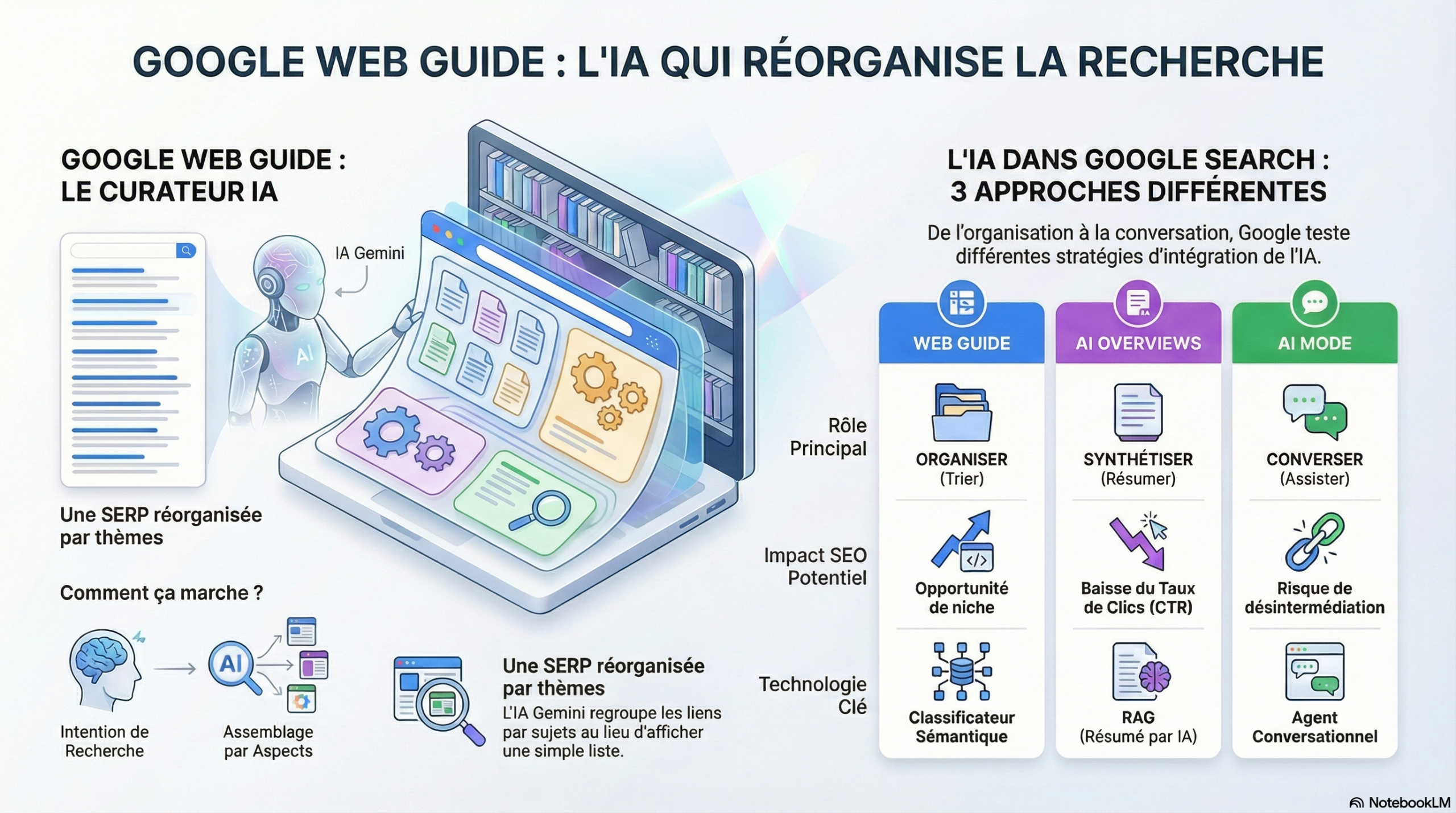
Google Web Guide is a new view of the Google Search, which uses AI (Gemini) and the query fan out to reorganize the SERP in thematic groups rather than view only a list of 10 links blue.
At the moment it is an experience Search Labs, available to US in the ‘Web ‘tab.
There is much talk of Google AI Overviews and mode IA (rightly). Web Guide, is for its part, passed quite unnoticed.
So no, it does not change the SERPS as the AI Overviews. Its impact is less radical than the impact of AI Overviews. And it does not transform the experience of research, such as the mode IA.
But it did something else : it rearranges the search results.
How does Google Web Guide ?
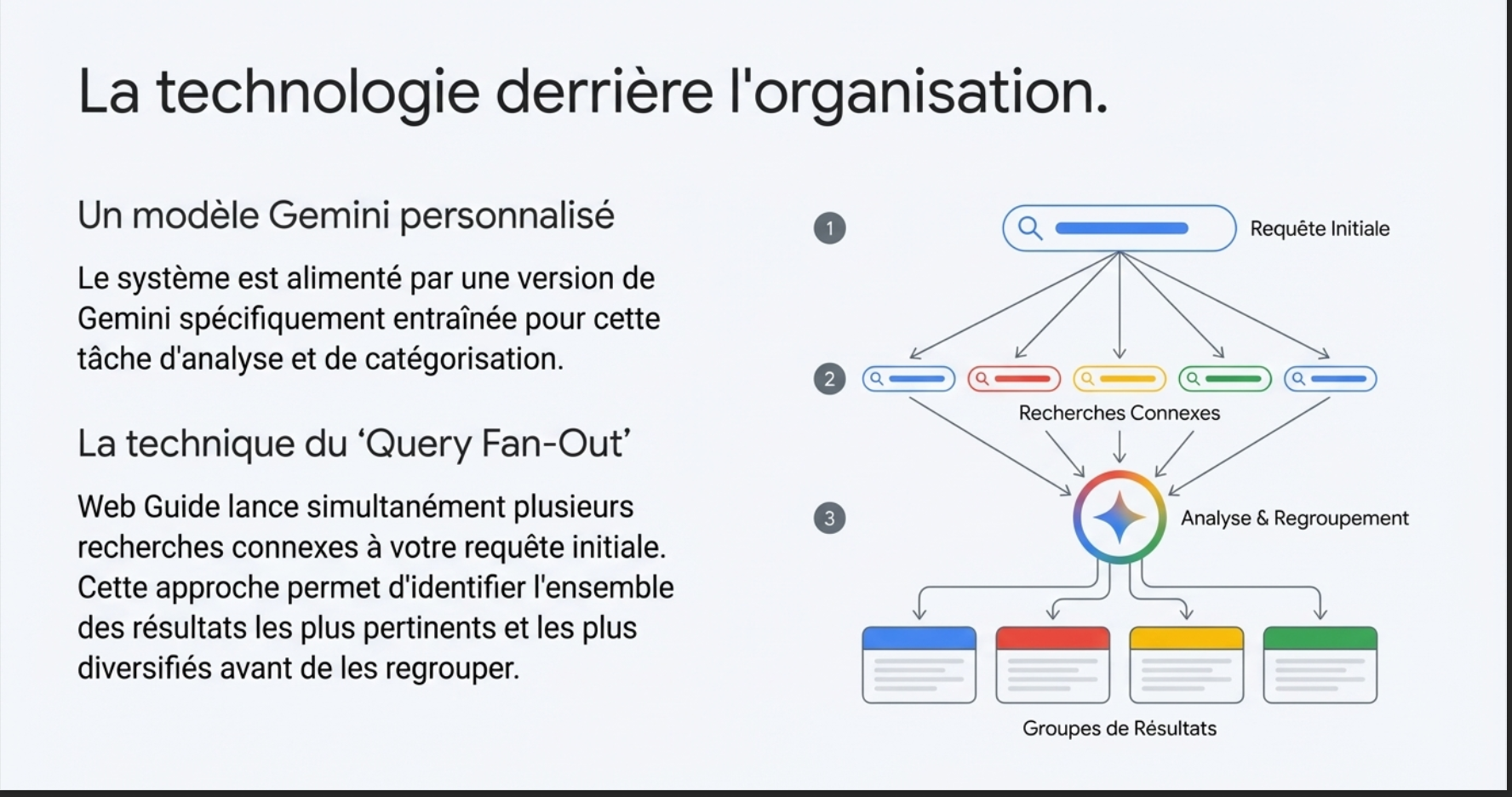
- Gemini : Google uses Gemini to understand the intention of the query and the content of the pages.
- Query Fan Out : the AI runs multiple requests in parallel, and assembles the results by aspect of the topic.
- The links are then grouped together by theme or by angles.
How to Google Web Guide brings together the results of research ?
Google Web Guide is based on :
- The similarity semantics (themes and common features),
- Theintended user (informational, practical, comparative…),
- The coverage of specific aspects of the request (price, approaches, examples, tools, etc.).
What does Google Web Guide
- Includes the web pages by “themes” or “aspects” of the query (comprehensive guidance, feedback, discussions, etc).
- Displayed for each theme a little summary + 2-3 links, with a button to see more results.
- Is particularly used on open queries or complex.
What is the impact of the Google Web Guide ?
The impact of Google Web Guide :
- Displays two sites by theme
- Cache of other sites behind a button
- Adds an additional click to access the sites under the fold
- promotes niche sites(According to Google).
My test of the Google Web Guide
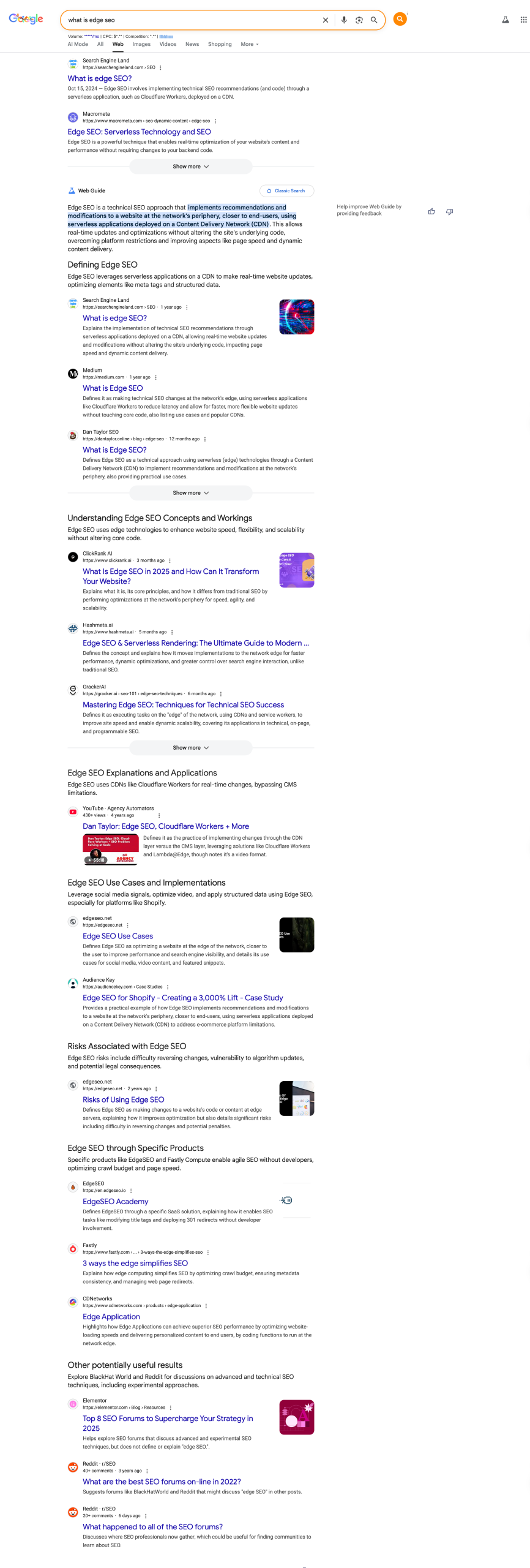
To test, I tried Edge SEO.
I had two sites first, not affiliated with a block.
Below, six themes, with two sites each, and a title and a (meta) description for each sub-theme.
Under the first two sites, there is a button to see the rest of the sites, but without any category. Why ? No idea.
In principle, if I choose the view Web Guide, it is to have the sources examined.
There is also a button to return directly to the SERP classic.
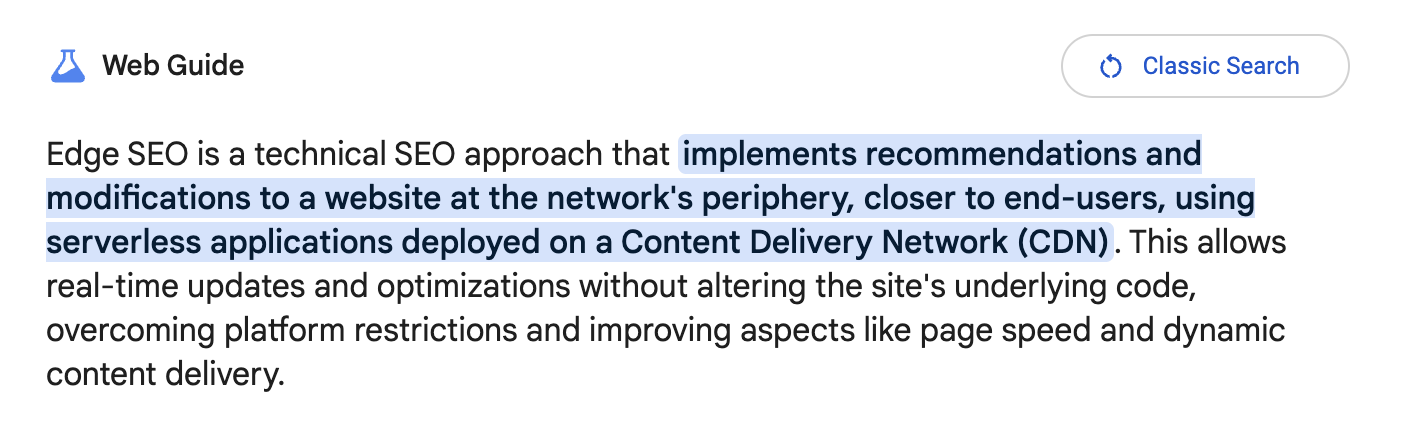
The implementation is not yet a top.
It was a bit of a mess, and at the limit, unpleasant to use.
But hey, it’s an experiment.
Should not expect a perfect thing from the start.
If Google deploys it a day, there will always be improvements.
Types of results in Web Guide
With my query Edge SEO, I had the right to classical sites type of Search Engine Land and all the usual panoply.
But I also had forums, YouTube videos, etc
The multimodal, what.
It must be remembered that Web Guide remains in the continuity of the SERPS.
This is logical : it organises, but ‘ m not reinventing the research.
What is the importance of the Google Web Guide for SEO ?
Web Guide shows what Google considers important for a query, and in what order. The sub-themes and the associated variants are visible to all.
For SEO, it is a valuable information. These topics can be used to construct a real cover topic : a central article, and content dedicated to each sub-theme.
Differences between’VE Overviews, Mode, AI and Web Guide
| Solution IA | ‘VE Overviews | AI Mode | Web Guide |
| Role | Summarize (Summary) | Converse (Wizard) | Arrange (Sort) |
| Impact SEO | Lower CTR (Zero-click) | The threat of disintermediation | Opportunity niche (Long-tail) |
| Techno | Gemini (Fast / Flash) | Gemini (Deep Think / Pro) | Gemini (Custom Classify) |
| Use | Simple query/info | Complex search/iterative | Exploration wide / buying Guide |
Google AI Overviews : The RAG classic (Retrieval-Augmented Generation)
This is the layer extraction, which comes to rest on the existing index.
With the AI Overviews, one is on the RAG pure. Google draws on the results of the top 10-20, pass in a model Gemini ‘light’ Flash (Fastsearch) and spits out a summary with quotes.
2. AI Mode : The Agentic Search (The conversational)
The AI is a system agentique that uses Gemini Pro/Ultra with a management window context,. The AI is not content to summarize, it ‘thinks’ on the query. She uses the Deep Research (Google launches dozens of queries in parallel in the background to build a full report).
3. Google Web Guide : The Semantic Clustering
In the Web Guide, Google uses its AI Gemini as a classifier semantics. It takes a broad (ex: ‘SEO technology ‘) and dynamically creates silos of navigation (ex: ‘Log analysis ‘, ‘ JS Rendering ‘, ‘ Crawl Budget ‘).
It is an opportunity of visibility by cluster. If you dominate a niche technique, the Web Guide will put you ahead in the specific folder that he created.
Deployment of the Google Web Guide ?
Google Web Guide is still opt-in via Search Labs. A phased rollout is likely, possibly a day in the “All”tab.
When Web Guide will be available in France
Google Web Guide is still in the testing phase.
Even in the United States, does anyone know if it will be integrated in the SERPS as the official solution.
For France, it is said that the AI Overviews arrive soon. But for Web Guide, no idea.
User reviews on Google Web Guide
In contrast to the negative feedback on Google HAVE Overviews, the users who have tested Google Web Guide seem to enjoy the experience. Maybe because this technology does not merely summarise the content of, or to produce approximations : it limits itself to organize the SERP, which can be really useful.
A redditeur Love the Google Web Guide
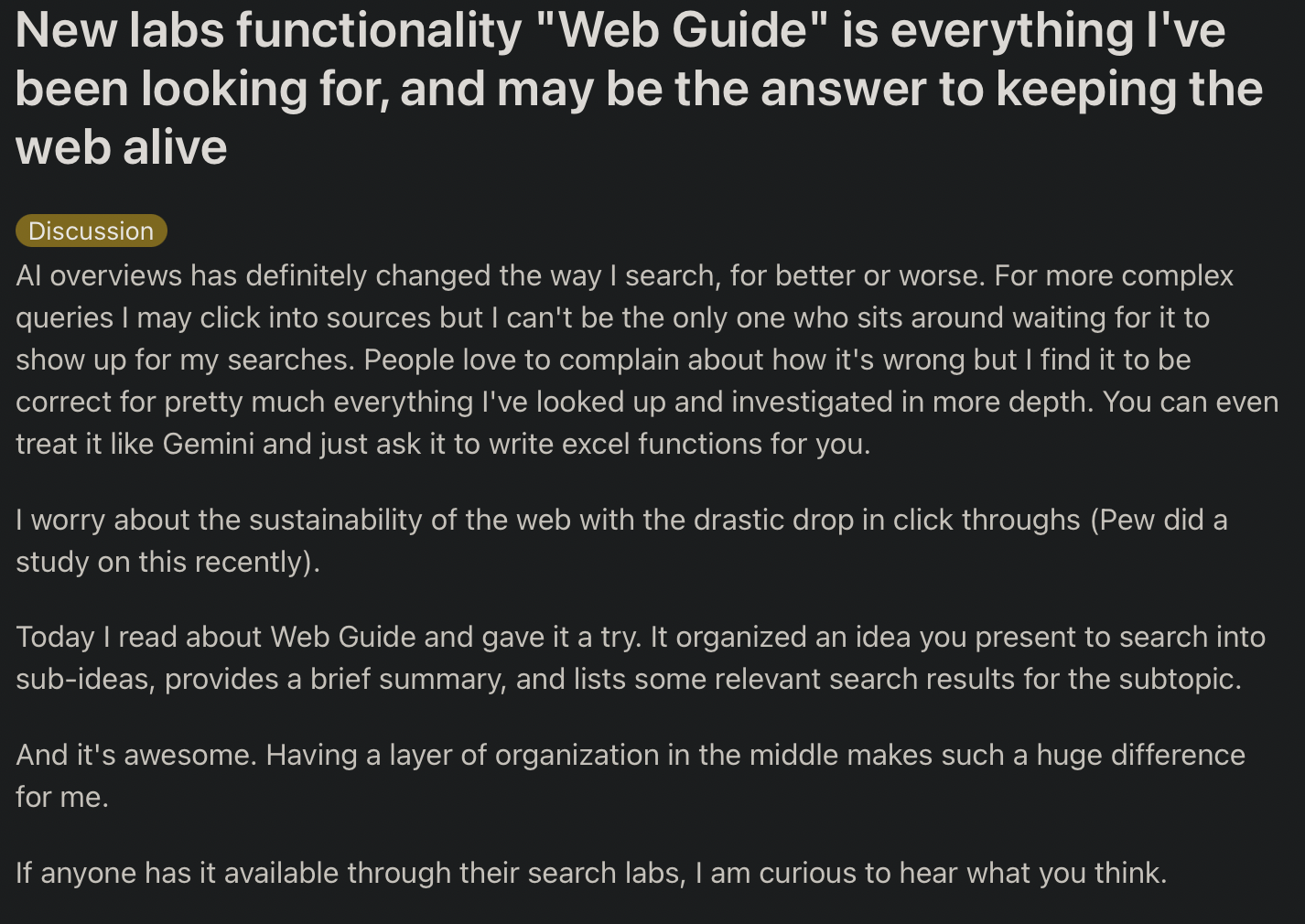
Everything that is said on Reddit is to be taken with a grain of salt. The redditeurs have a talent to transform a pet by storm.
That said, a user who tested Google Web Guide on Search Labs is awesome.
His return is simple : Web Guide for cutting your research sub-themes, adds a little summary and a list of relevant results for each angle. And for him, this layer of organization changes while. Navigate becomes almost… pleasant.
The most funny ? His discontent towards’VE Overviews and his concern for the SERP.
It has a perfect blend of fear of AI and wonder in front of a tool that structure really have the information.
In summary : he groans a little, it’m crazy about a bit, and this is understandable.
A redditeur suggests the replacement’VE Overviews by the Google Web Guide
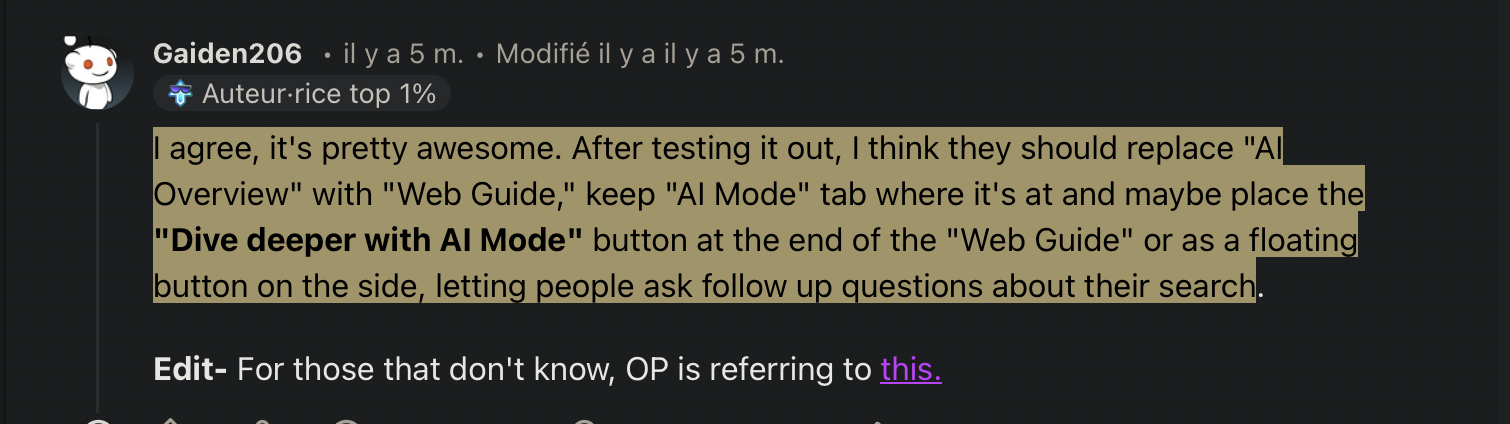
Another redditeur, comment on the post of the first, goes even further : he suggests to replace’VE Overviews by the Web Guide.
You can almost imagine Google in the process of dying seeing it.
That said, from a user point of view, I understand. The Web Guide to more calm, less disruptive, hallucinates a lot less, and especially the structure really have the information.
A redditeur offers a solution for all the solutions AI Google
Apparently, the SEO are not the only ones to have noticed that Google is a little… everywhere at once.
Yes, even the users have understood that the company’s Mountain View tries to launch all the solutions AI possible, in order not to lose the battle and remain the search engine of reference in the era.
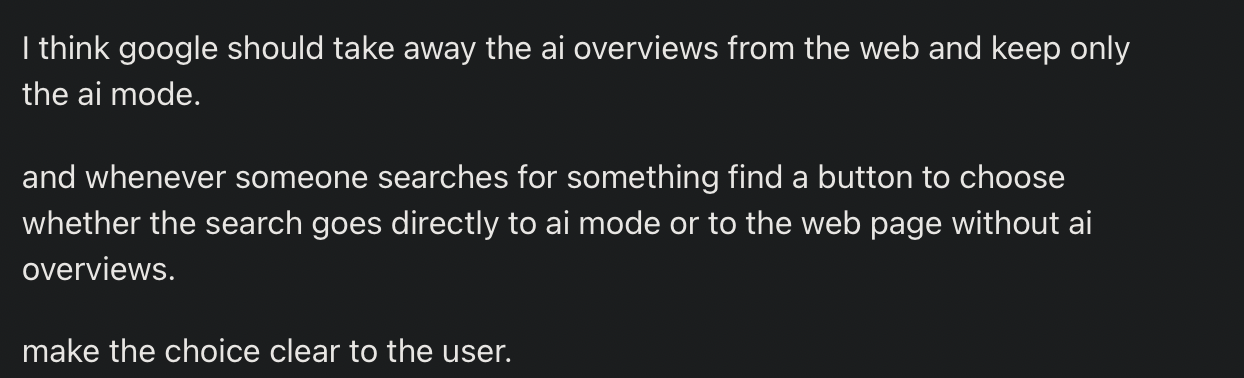
A redditeur has resulted in a recommendation :
Remove ‘VE Overviews (let’s be honest, everyone hates) and put the user control on the type of experience that they wish on the SERPS.
Concretely :
- Choose a SERP traditional but increased and organized with the Web Guide.
- Or experience in conversational mode with the AI.
I am lessee of such an organization !A word to the wise.
My opinion on Google Web Guide
Google Web Guide is a curator AI, which organizes the SERP without hallucinate.
Unlike’VE Overviews, it does not produce answers. It breaks up the SERPS to guide the user to the most relevant sources, according to a classical model.
Least intrusive and least disruptive as the AI, Google Web Guide reduces the visibility of sites : it often goes from 10 to 8 links with 4 categories systematic.
For an SEO who wants to keep his job, if I had to choose between the AI, the AI Overviews and the Web Guide, I would take… the Web Guide. Alas.

SEO/ GEO consultant
Aslane SAMAI
SEO Consultant / GEO
Read more
- The Chunking is a technique to optimize SEO and GEO ?
- Top 10 tools GEO to track your position IA (2025)
- MCP Chrome DevTools & Google Analytics : essential for GEO and LLMs
- Visibility on AI (Google mode AI, AI overviews, LLM) : the tools we mistaken ?
- How do I know its positioning on Google AI Mode and HAVE Overviews?
Leave a Reply