In the previous article, we saw how Google went from a state of internal alert to the arrival of the Bard, then Gemini, before offering a first glimpse of its new SERP powered by artificial intelligence, called EMS : Search Generative Experience that marks the beginning of Google AI Overviews.
In this article, we are going to try to decipher what is Google AI Overviews, more commonly called the Google AIO from the technical point of view, and most importantly, to emphasize what Google reveals on this technology.
Without further ado, let’s dive directly into the heart of the matter.
Dans cet article
Google indexing process : crawl, index, rank
With AI Overviews, Google reinvented once more the results page. The user asks a question… and the answer falls. Direct. Summary. Clear.
To get there, Google tells us that they have injected artificial intelligence at the heart of the traditional process.
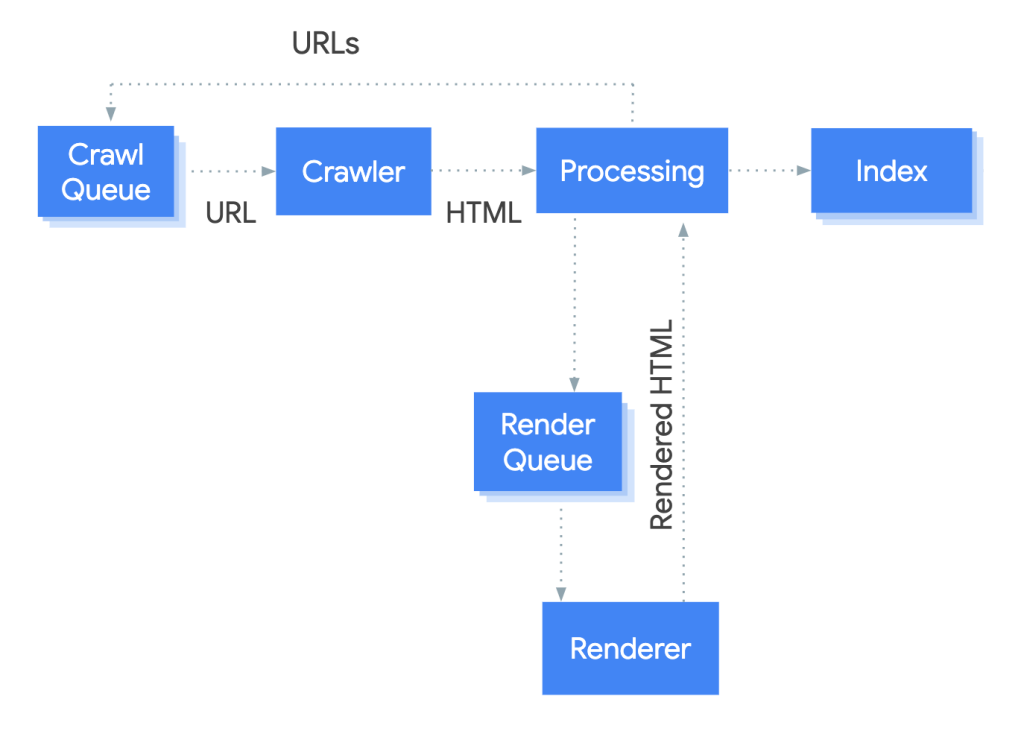
But to understand how AI fits, let’s start by taking a look at the traditional process of the algorithm of Google. Before they are included in the search results, web page goes through three stages : crawl, index, rank.
If you’re not English, you’re a bit in trouble. You are going to have to put you seriously in the English…
No, I’m just kidding. But frankly speaking, learn English, it can never do harm.
Anyway, back to our sheep.
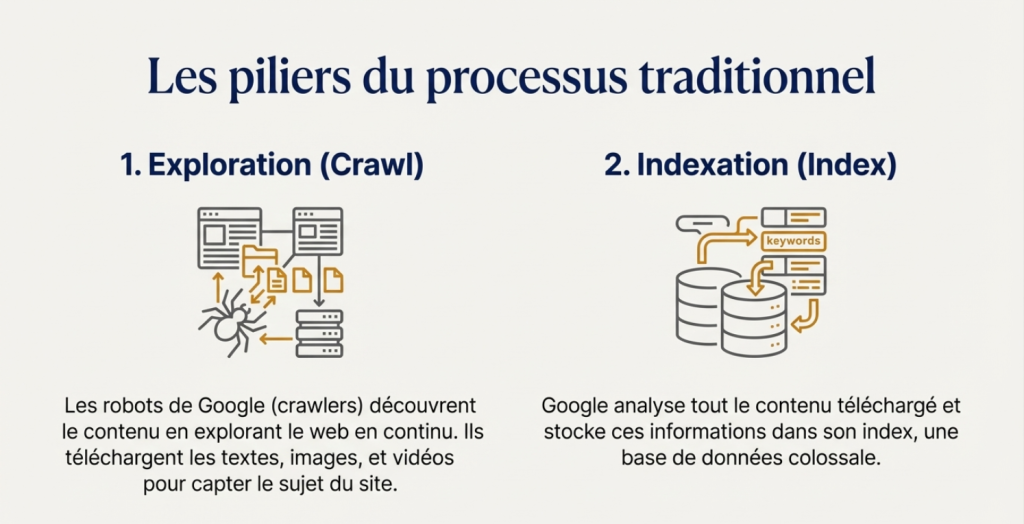
Google explains very well these steps on its official page. We are talking about mining, indexing, and dissemination.
- Exploration, Google finds your site via the robots-the so-called crawlers) that never stop exploring the web. And there, Google download your texts, images, videos… anything that can help to capture what you are telling on your site.
- Indexing : Google analyzes the text, images, and video files on the page, and then stores all of this information in its index, which is a huge database.
- Dissemination of the research results : when a user searches, Google displays the most relevant results based on the query.
Rendering : another step in Google search
I’ve talked to you about the three steps in Google search.
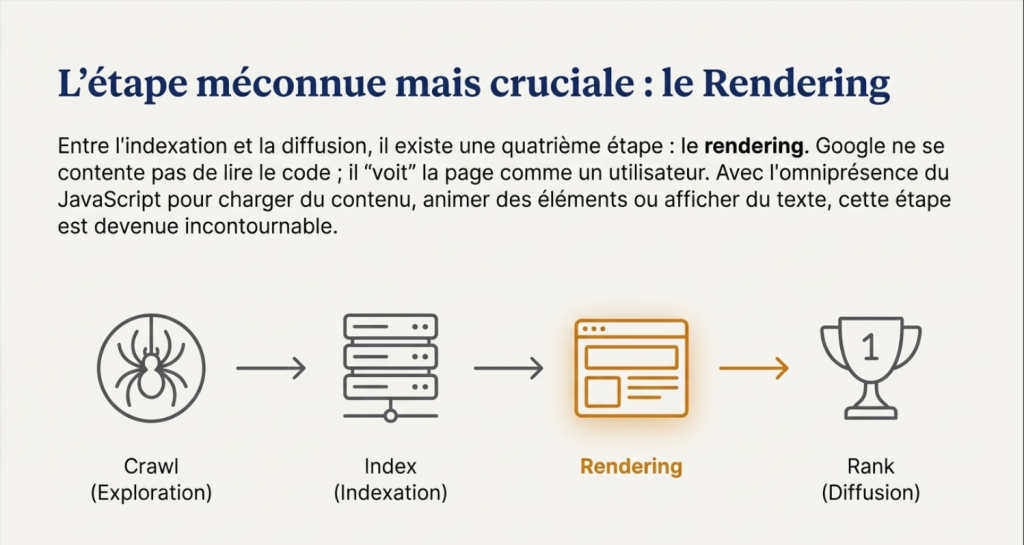
But you’re observers. You may have noticed that the diagram at the top shows more than three stages. And you’re right. Neither you nor I are in error.
In reality, there is a fourth step : rendering. And there, I’ll be honest… I don’t even really give you a true translation in French. Even Google uses the term as such. It remained in English, everywhere.
The rendering, it’s a bit like if Google was taking a break to ‘ see ‘ the page as you and me. Not just read the code gross, but really the view. This step is essentially the websites that use Javascript.
As the vast majority of websites use JavaScript as today whether to load content, animate elements, or even display text we can say that this stage of rendering is, de facto, become unavoidable.
So, before you even think EMS, AI, or AIO, Google begins here : to discover, to understand, to organize.
Now that you have the basics, we can finally ask the real question :Where does artificial intelligence come in to all of this ?
Integration of AI in the Google search
On the previous image, we observed the functioning of Google before the arrival of the AI.
A process quite a classic, almost mechanical : a robot that explores, discusses, ‘makes’ and then indexes. All this to bring the pages of a site in the Google index, in order to offer them later in the results.
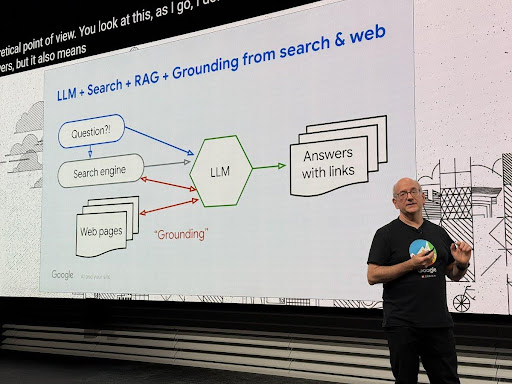
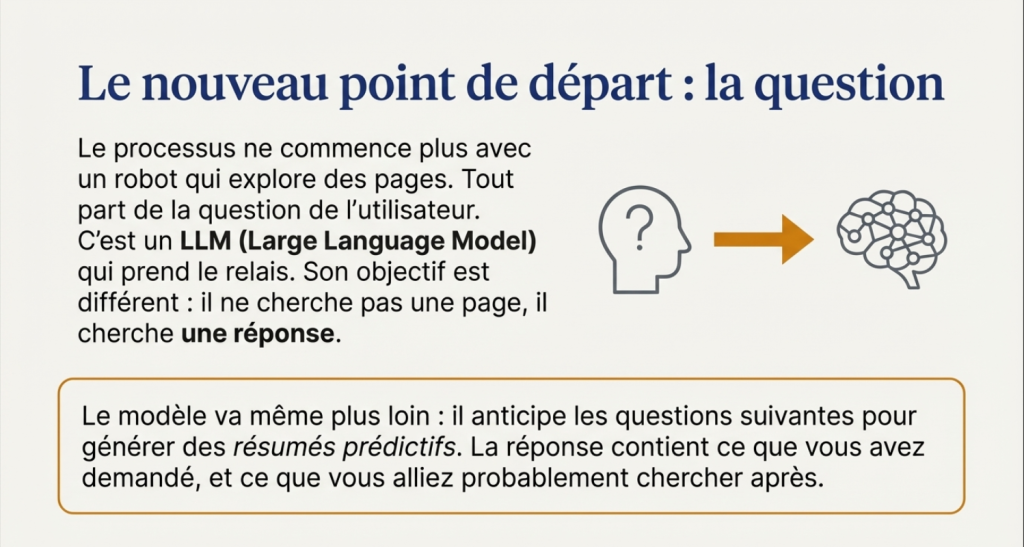
And then, there’s this new image. taken by Aleyda Solis during a meet Google and SEO in Madrid, which shows the evolution of the research process.
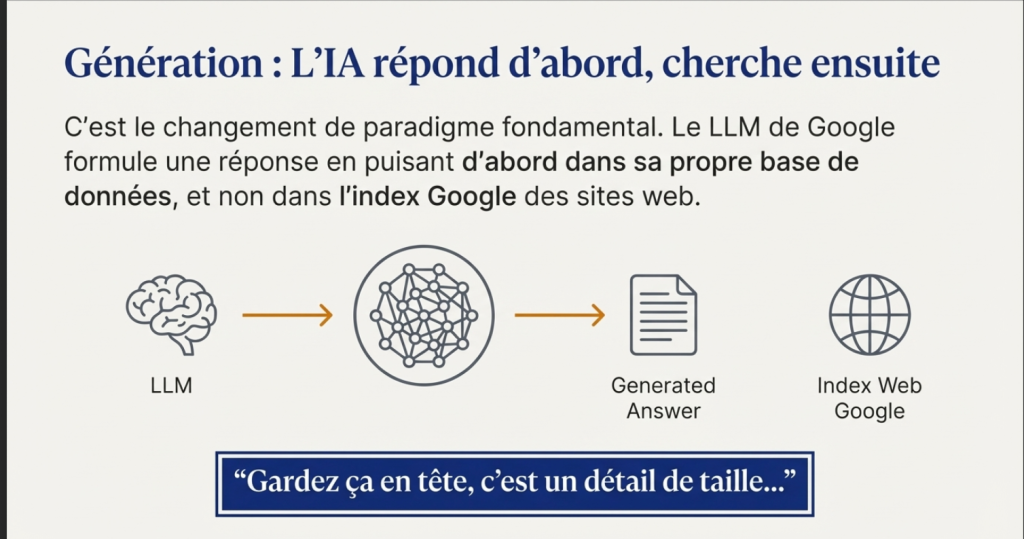
Here, everything begins with a question asked by the user. And there, paradigm shift : this is a LLM (Large Language Model) that takes up the slack. It does not just look for a page. He seeks an answer.
This model is not limited to the current query. It goes further : he can anticipate the questions a user might ask then. This is what Google calls of abstracts predictive.
Result : the response generated by the AI contains not only what you asked for… but also what you were going to probably look just after.
In this case, the classic search engine does its job. As if nothing had happened..
What is interesting here is the fact that the LLM from Google searching for an answer in its database. Not on the google index (the indexed sites). Keep that in mind, this is a detail of the size…
Then comes the anchor or grounding, for those who love the technical English. This is where the AI of Google will double-check the copy, by looking for the most relevant sources in its index.
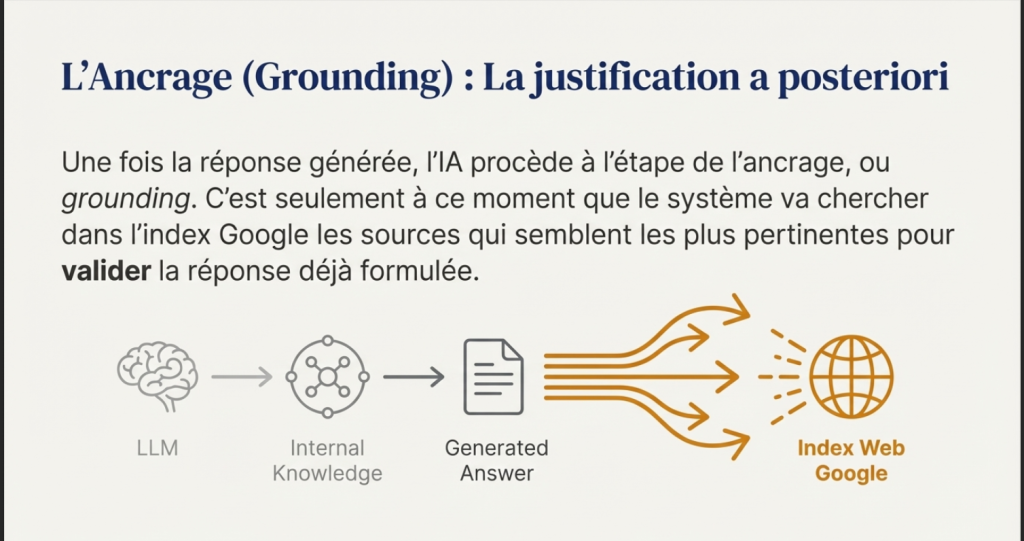
Put simply : in the SEO “classic” Google part of a web page, and then uses it to construct a reply.
With AI Overviews, the reasoning is reversed. Google generates first an answer thanks to its pattern, and then will look for sources for the justify after the fact.
This approach is problematic. There is nothing to prevent the LLM hallucinating, and gather in the google index a source that validates the false answer.
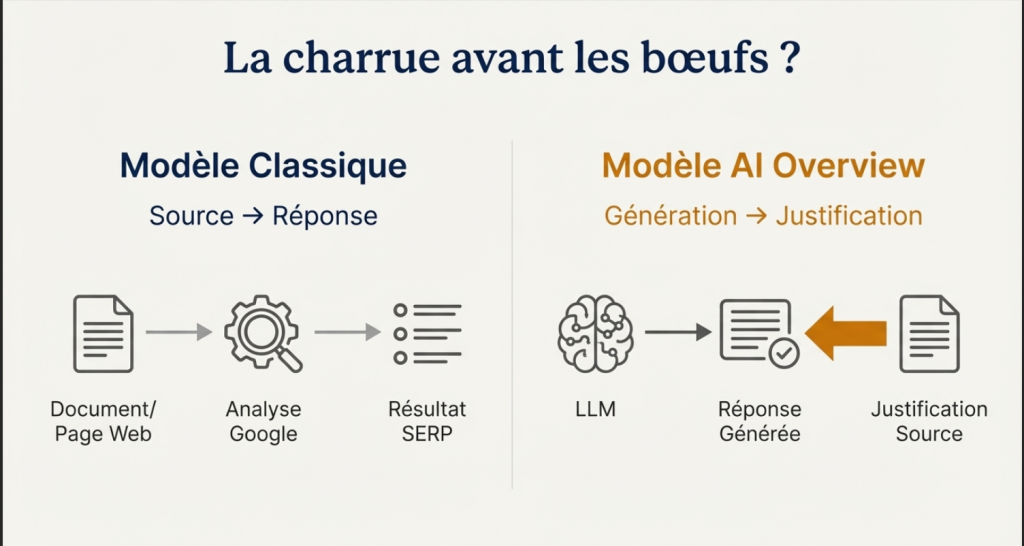
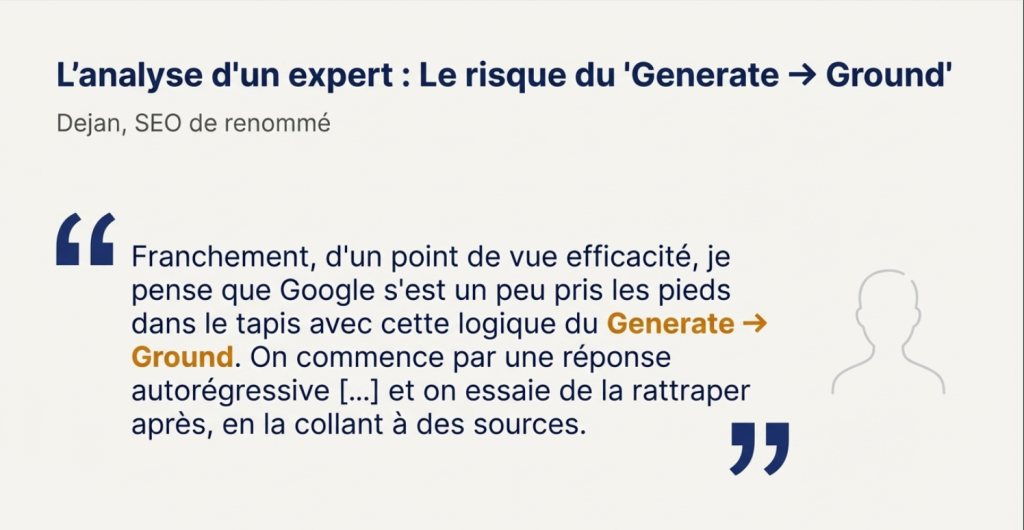
Dejan, a SEO renamed, was one of the first to report the ineffectiveness of this approach in an article he called I think that Google has made a mistake in adopting the approach ‘ Generate → Ground ‘.
I quote : ‘ Frankly, a point of view of efficiency, I think that Google is a bit taken the feet into the mat with this logic Generate → Ground.
Why ? Because everything is based on what generates the model first. It begins with a response autoregressive distributed a response predicted word after word, as a logical continuation, and we are trying to catch up after, pasting it to sources.
Except that if the model crashes right from the start… well, that was all the answer that falls to the side of the plate. The groundingdevient a patch, not a pedestal.

A sequence more logical ? This would be to start with the sources, build the response from them, and press it from the beginning to the end.
But here, we have a pipeline that is putting the cart before the horse, and that is risky.’



Leave a Reply