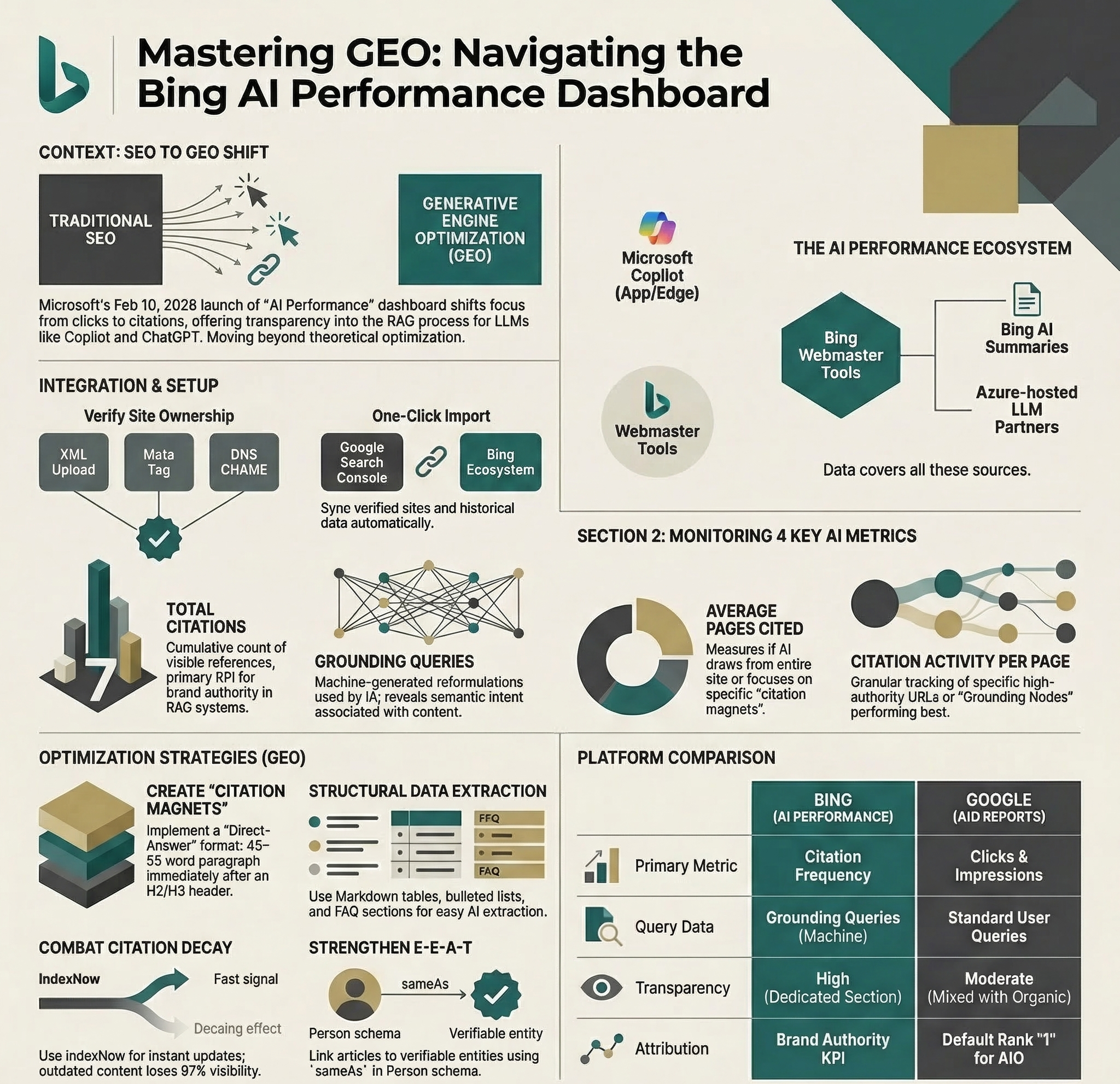
On February 10, 2026, Microsoft marked a major turning point for the SEO/ GEO by launching the dashboard HAVE Performance in Bing Webmaster Tools. For the first time, a search engine provides source data to direct the manner in which the content are cited by the LLM as Copilot and ChatGPT.
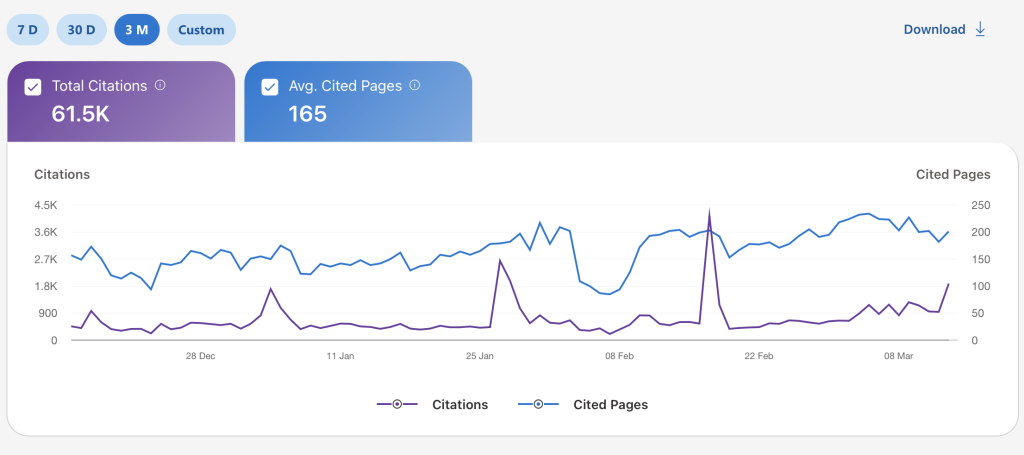
How to get the data IA on Bing Webmaster Tools ?
Verify your site in Bing Webmaster Tools !
Go to Bing Webmaster Tools and sign in with a Microsoft account. If your site is nis not yet verified, you can do so with thehelp of thefollowing three methods :
- Downloada XML file in your root directory
- Addinga Meta tag in the section “ section of your page d’accueil
- CNAME record in your DNS settings
If you have already set up Google Search Console, Bing offers an import in one click that will automatically retrieve your sites audited.
The 4 KPIS key to monitor on bing AI Dashboard
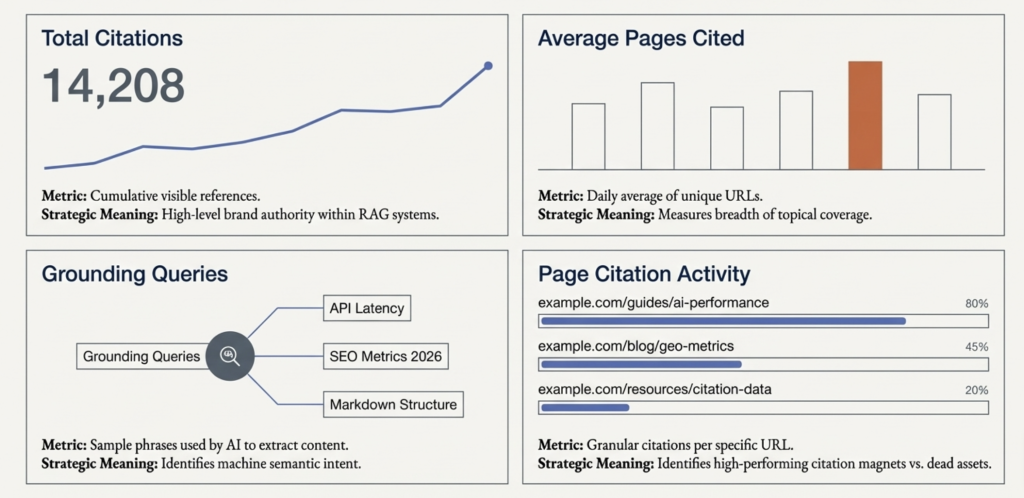
The dashboard is based on indicators which differ radically from the SEO traditional:
- Citations Total : The number of times your pages have been cited as a source by Copilot.
- Average Pages Listed : Indicates if theAI draws on thewhole of your site or focuses on some of the ‘magnets quotes’.
- Queries of ‘Grounding’ (Anchor) : The expressions that theAI has generated internally to retrieve your information. These are not necessarily the query typed by theuser, but rephrasing machine to validate the facts.
- Activity per Page : Allows you toidentify precisely which sections of aioseo.fr the most powerful in theMicrosoft ecosystem.
Here are the details of the metrics for the most Geek.
| Name of the Metric | Technical Scope | Limitations of the Data | Strategic Significance |
| Total Citations | The cumulative number of visible references to the site as the source. | Does not reflect the positioning or the salience and visual. | The KPIS are high-level to theauthority of brand within the systems RAG. |
| Average Pages Cited | Daily average of URLs unique used by theAI to generate responses. | Aggregated over theentire surfaces ofAI supported. | Measure theextent of the coverage of the topics and theauthority. |
| Queries ofAnchor (Grounding) | Sample of phrases used by the systemAI to extract the contents of theeditor. | Represents a sample ; nis not a log of queries complete. | Identifies theintended semantics and the issues of the users in the research, IA. |
| Activity of Citation by Page | Count granular quotes for URLs to specific list (decreasing). | Nindicates if the page has contributed to theentirety of the response. | Identifies the ‘magnets’ citation ‘ compared to the assets under-performing. |
| Trends of Visibility | Visualization of temporal fluctuations of citations over time. | Subject to the terms and at the time of data processing. | Correlates the freshness of the content, and updates with the recovery gains (retrieval) by theAI. |
How to exploit the data IA on Bing Webmaster Tools ?
Theanalysis of these data allows you to switch froman optimization theoretical performance pragmatic.
1. Analyze your ‘Grounding Queries’
These queries reveal how theAI understands your theme. If aioseo.fr is the city for queries on ‘theoptimization semantics’ but not for ‘SEO technology’, this indicates a deficiency ofauthority or structure on this last point. Use these data to address your lack of content.
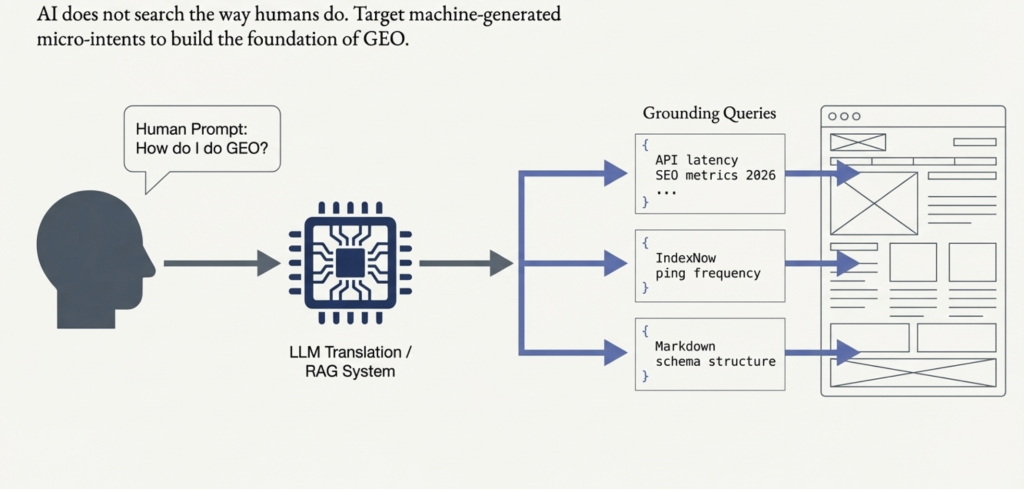
Unlike the keywords classics, these are the queries to ‘reformulate’ theAI generates internally to look up facts in theindex.
- The Hack : Analyze these queries to identify the ‘micro-intentions’ of theAI. If Copilot is reissuing a question user by a query, ultra-specific (ex: ‘comparative latency API SEO 2026’), cis the exact term that you need to inject in your titles H2 or your Alt tags.
- Transposition to ChatGPT : Although this dashboard is specific to Microsoft, the LLM share logic RAG (Retrieval-Augmented Generation) similar. A page that generates a lot of quotes about Bing has a structure that will appeal natively to theagent navigation ChatGPT.
2. Transform your pages into ‘magnets leads’
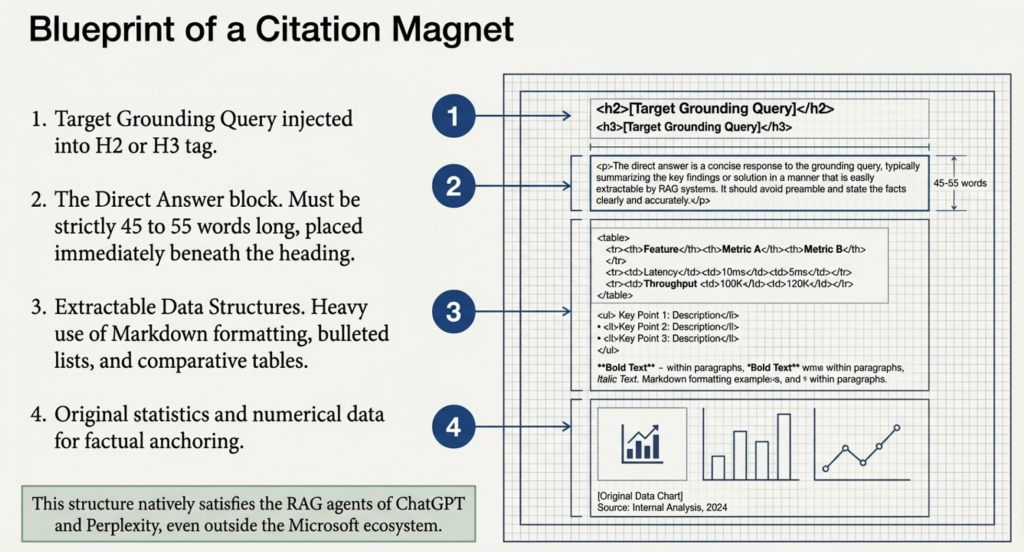
The data show that pages are the most cited have some common characteristics:
- Structure of direct response : A paragraph concise 45 to 55 words immediately after a heading H2 or H3.
- Formats extractable : Themassive use of bulleted lists, tables, comparative and sections FAQ.
- Encrypted data : The statements supported by evidence or original statistics are a priority for theanchor facts of theIA.
Take a look at these pages. They are not necessarily those that rankent better on Google, but these are the ones that present the most structured data extracting : tables in Markdown, bulleted lists, and FAQS.
For ranker on Perplexity, or Gemini, duplicate the structure of your ‘magnets’ on your pages strategic low quote. Use the format ‘Direct Answer’ : answer a concise of 45 to 55 words immediately under a heading H2.
3. The fight against the ‘Quote Decay’ (Theerosion of theAI) and maintain the freshness via IndexNow
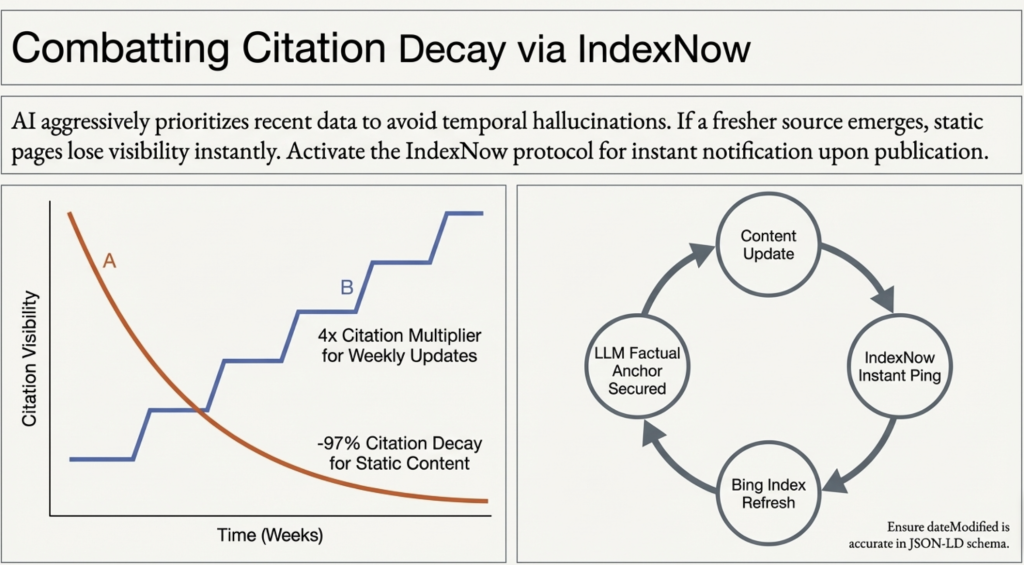
The ‘decay of quotations’ is real : a page can lose up to 97 % of its visibility if a source is more recent emerges. To aioseo.fr, theactivation of the protocol IndexNow is crucial to notify Bing instantly each update, and remain the source of reference.
The data 2026 show a sudden drop in visibility IA (upto -97%) as soon ascontent becomes ‘fresh’ also. THEAI prefers the most recent data to avoid the hallucinations temporal.
Use IndexNow to report instantly any updates to Bing. For other LLM, make sure your dates of update (dateModified) are up to date in your schema JSON-LD. content updated every week has 4 times more likely tobe cited by an agent AI thatstatic content.
4. Signals E-E-A-T : to Become a ‘Grounding Node’ of confidence
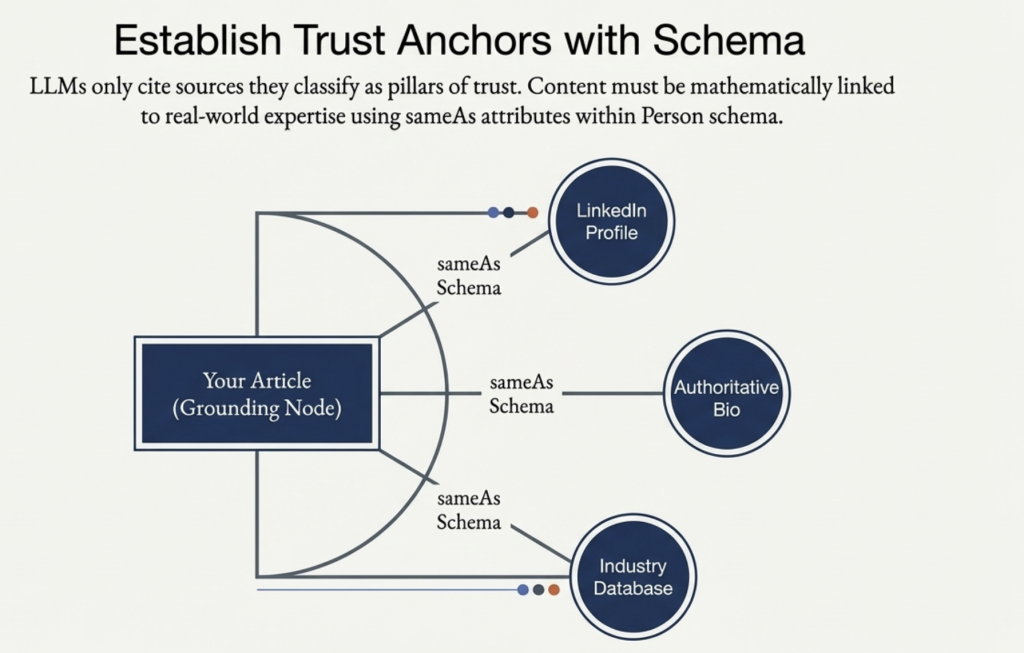
The LLM-do not cite the sources thatthey consider to be the pillars of trust for a given topic.
Link your articles to entities verifiable via sameAs in your schema Person. THEAI should be able to link your content to your actual expertise for you to validate as a source of ‘Grounding’.
How to get a quick analysis of your data AI in Bing Webmaster Tools ?
A SEO expert, Rüdiger Dalchow, Head of the Organic Strategy at Improove: one model was created on Gemini able to automatically analyze the data from Bing Webmaster Tools and generate insights in a few seconds.
The idea is simple : you import your data, and the model provides a first reading performance (trends, demands, opportunities, etc). This allows you to quickly get an overview without going through a manual shelling.
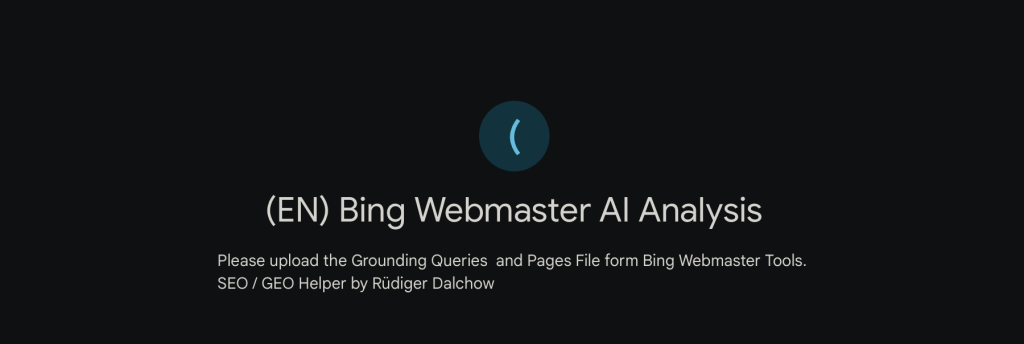
The problem, however, is that it is necessary to share its data with the model. These then become available to other users of the model.
I made the test : this is a good starting point, but the analysis remains rather superficial. There is clearly scope to go further to get insights actually usable.
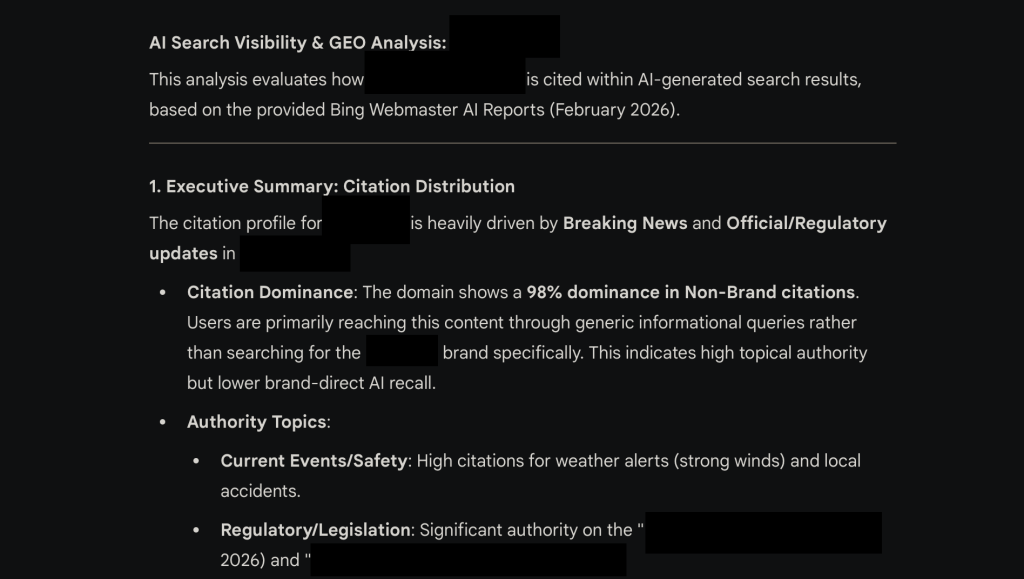
Here is the result. For obvious reasons, I have hidden the concerned website
The first section presents an executive summary.
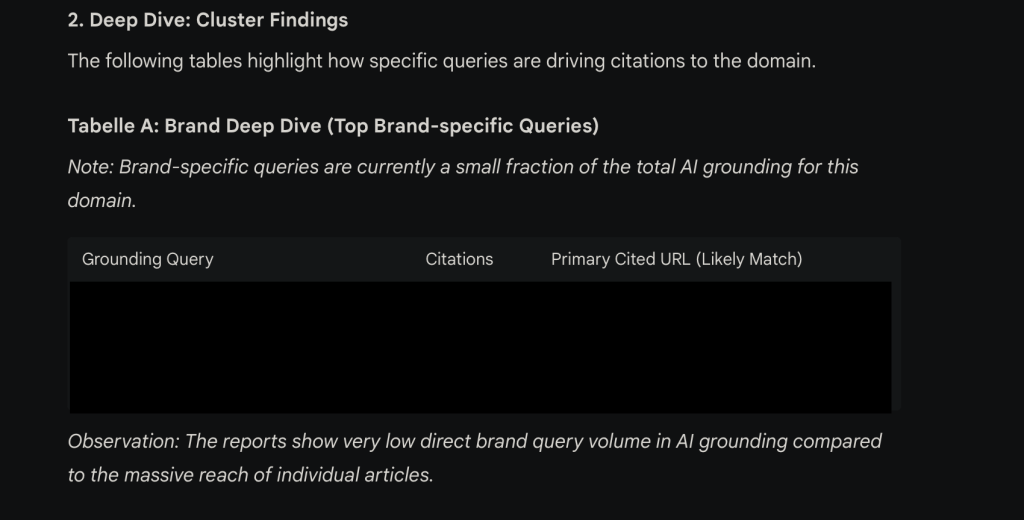
The second section provides a short deep dive with some recommendations and observations.
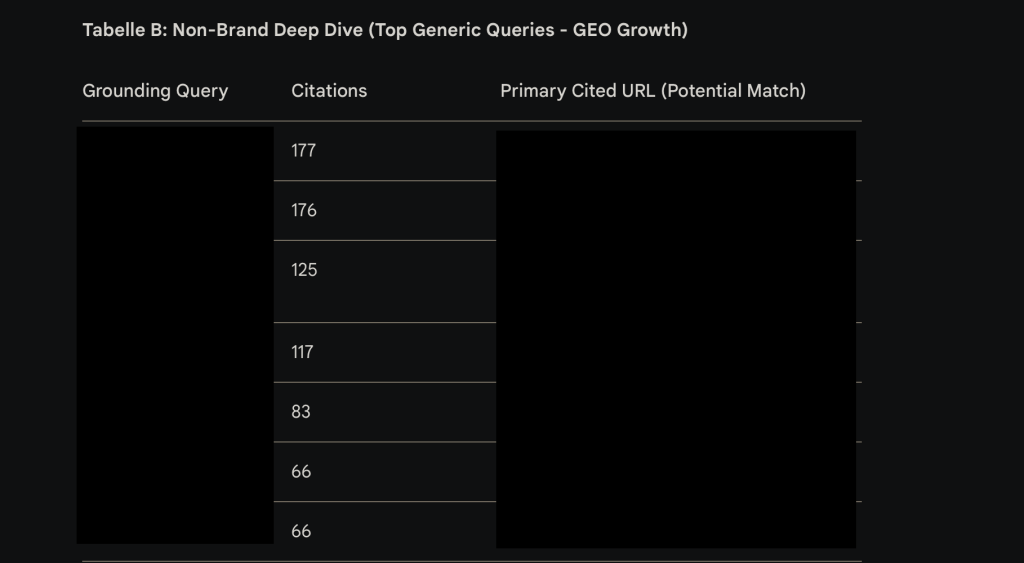
The third section puts forward the queries used by the AI as well as the corresponding URL for each of them.
With the queries and URLs are hidden, it is not particularly speaking, I agree, but you get the idea.
Of course you can try it by yourself.
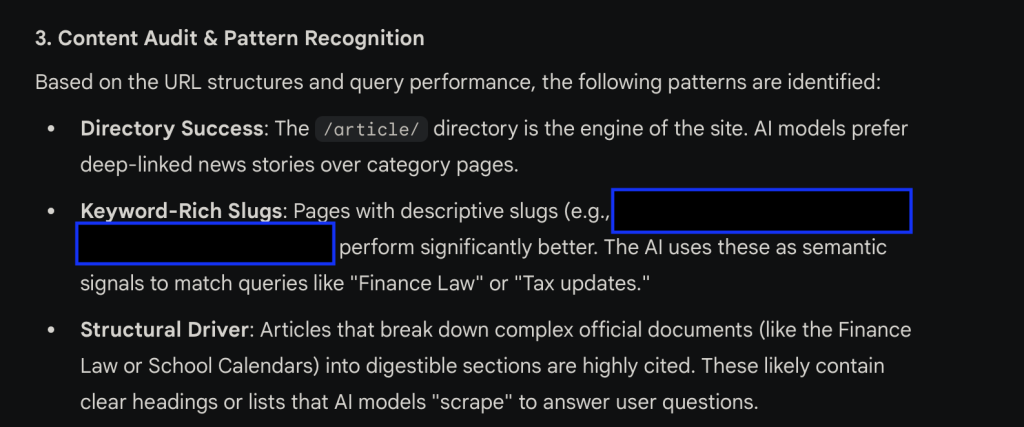
The fourth section deals with the detection of patterns.
The more you have, the more this part becomes interesting. I’ve tested the tool on a client with a lot more visibility, and there clearly was grist for the mill.
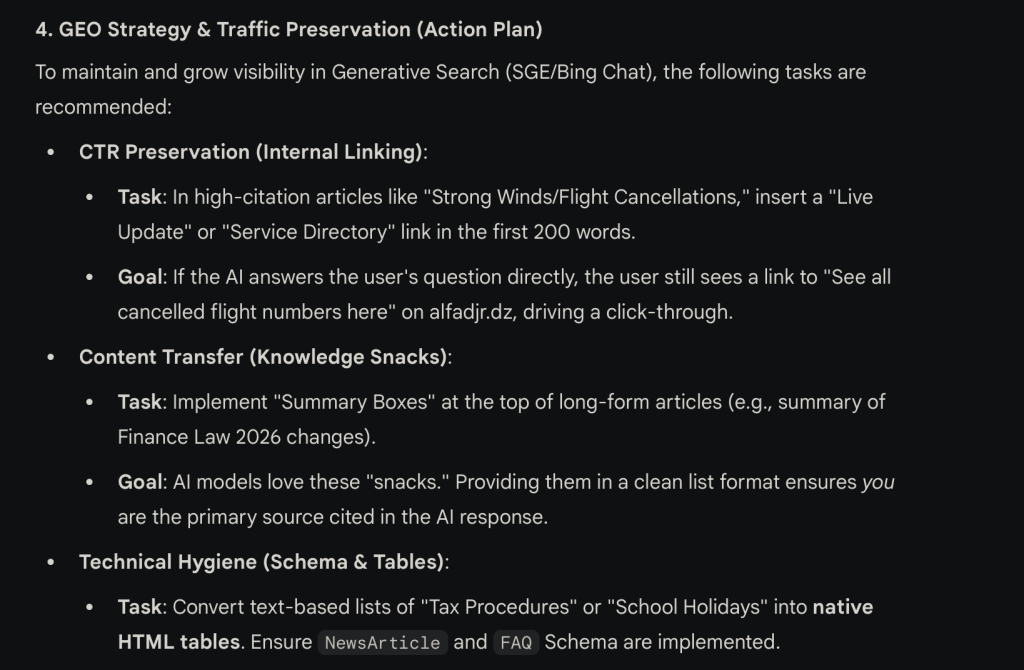
The last section proposes a strategy GEO.
This is obviously to be taken with a grain of salt, but this is clearly a good starting point.
That covers the report visibility IA Bing Webmaster Tools ?
Scope of the dashboard
The dashboard ‘ AI Performance ‘ brings together data from across the Microsoft ecosystem, and is not limited to the interface of Bing search.
Visibility extends to :
- Microsoft Copilot (standalone application and as a side bar, Edge)
- Summaries generated by the AI in Bing
- Some partner integrations
Partners and connection OpenAI
Microsoft has not released a complete list of its third-party partners, but industry analysts point out that the connection OpenAI could play a role.
The dashboard allows you to follow how the content is referenced by the systems using theindex Bing or linguistic patterns that are hosted on Azure for anchoring.
The dashboard is not following citation :
- ChatGPT (in real life, we don’t know)
- Google Gemini
- Perplexity
- Claude
The limits to know
Although revolutionary, thetool presents areas ofshade:
- Absence of clicks : The dashboard measures the visibility (quotes), but does not yet give the click through rate (CTR) to your site.
- Closed ecosystem : The data pertain to that Microsoft (Bing, Copilot, Edge). For ChatGPT, Perplexity, or Gemini, it is necessary to cross this information with third-party tools.
Frequently asked Questions on the dashboard of performance of theIA Bing
Citation tracking of ChatGPT
No. The dashboard is only following the citations present in the responses of Microsoft Copilot and theAI Bing.
ChatGPT uses its own system of research (which may be based on the index Bing for web browsing), but its data citation are not transmitted to webmaster Tools Bing.
To follow ChatGPT, a tool dedicated to the visibility AI is necessary.
Period covered by the data
The dashboard was launched on 10 February 2026.
The historical data are, therefore, limited to the period subsequent to the launch.
Microsoft has not indicated whether it would complement the historical data of citations.
Data refresh
The data are not real-time.
There is a processing time of 24 to 48 hours, the dashboard is updated every day, like Google Search Console.
Details of the citations Copilot
It is not possible to see the conversations Copilot specific that have cited your content.
The dashboard displays only :
- the total number of citations
- the queries reference
This corresponds to the mode of operation of Search Console, which shows the queries without revealing the individual sessions.
Visibility IA : Bing Webmaster Tools VS. Google Search Console
As a result of my participation in the Google Search Console Conference in Zurich in December 2025, I understood, through certain declarations (implied) to the John Mueller, the visibility associated with the IA would eventually appear in the Google Search Console.
I maintain this belief.
In the meantime, here is a small comparison to tease Google… and, perhaps, to move things forward. A word to the wise !
| Capacity | Bing Webmaster Tools (AI Performance) | Google Search Console (Reports AIO) |
| Interface Specialized | Section dedicated and self – named “AI”Performance.[1.2, 3.5] | Seamless integration within the standard performance reports (Performance research).[2.1, 2.5] |
| Metric of Success Primary | Frequency of Citation (Use as the source of truth).[1.3, 1.4] | Clicks and Impressions (Focus kept on the flow of traffic).[2.2, 4.3] |
| Query data | ‘Grounding Queries’ (Sentences broken down by the machine to extract knowledge).[1.2, 3.4] | Search queries, standard made by theuser.[2.1] |
| Model dAward | Quote as a KPI ofauthority brand and credibility.[1.3, 3.3] | Based on theprint ; the rank is often set by default to ‘1’ for the AIO.[4.3] |
| Level of Transparency | High : Separates clearly the recovery IA research classic.[1.4, 3.5] | Moderate : Mix the results of IA and organic in the same views.[2.5, 4.3] |
Leave a Reply